Documents
Living Trusts
A living trust can help your family avoid probate for the property placed into it and can give clear instructions for what happens if you die or become unable to manage things. It is not right for every family, but it can be very useful in the right situation.
What a living trust is
A living trust is a legal document you create while you are alive. Usually, you transfer certain property into the trust and serve as your own trustee at first, so you still manage your money and property during your lifetime. You also name a successor trustee to step in if you die or cannot manage things yourself.
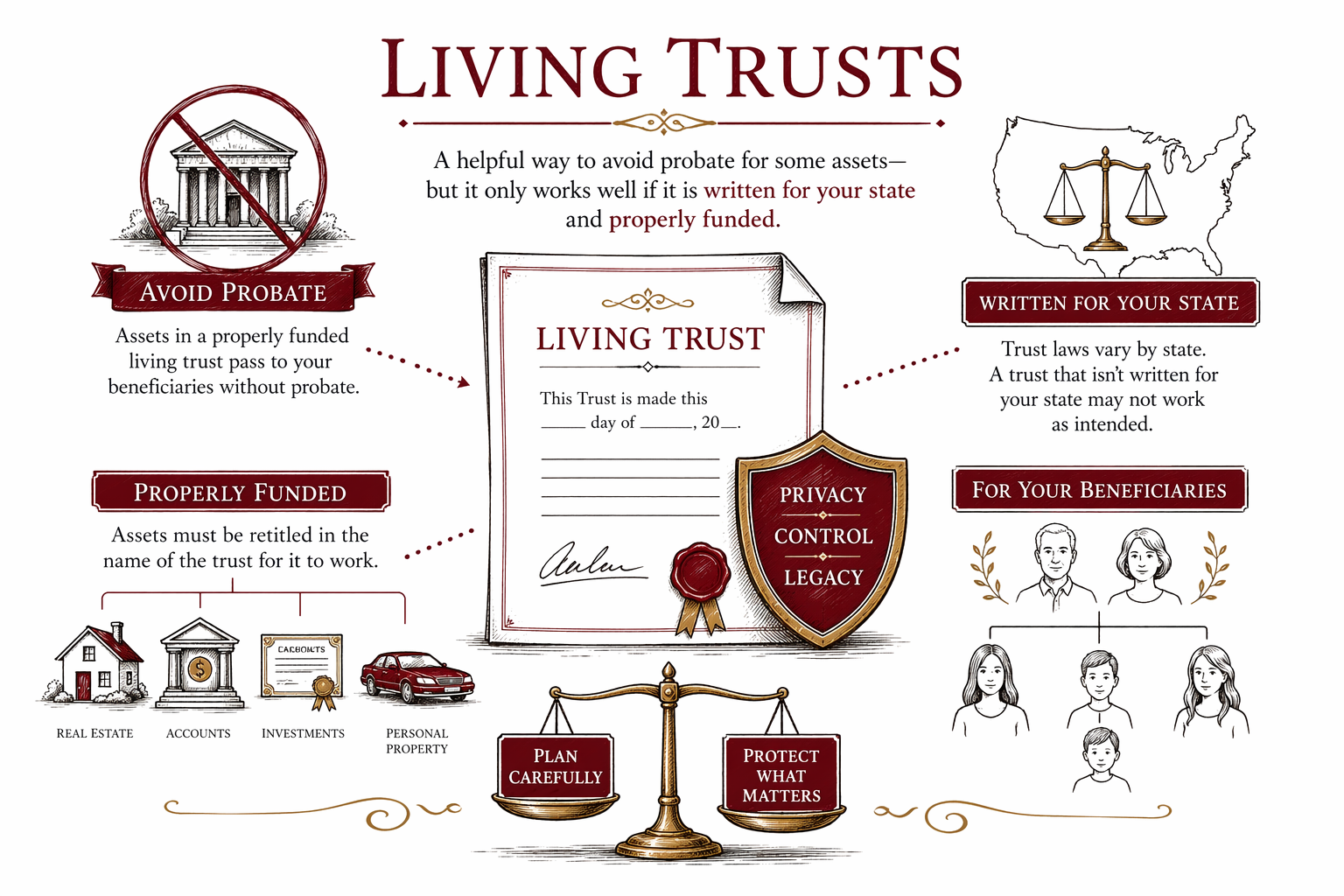
The main reason many families use a living trust is to help avoid probate for the assets that are actually titled in the trust. Probate is the court process that may be needed after a death. In many states, avoiding probate can save time, lower stress, and keep more matters private.
A living trust can also say how and when beneficiaries receive property. For example, it may allow money to be managed for a young child, a family member with special needs, or an adult child who is not ready to receive everything at once.
This is general educational information only, not legal, tax, or financial advice. Living trust rules, probate rules, and signing requirements vary by state, so it is smart to speak with a licensed estate planning attorney in your state.
What a living trust does — and does not do
A living trust can control assets that are properly transferred into the trust. That may include a home, some bank or investment accounts, and other property, depending on state law and the type of asset. If those assets are in the trust, the successor trustee can often manage or distribute them without a full probate case.
But a living trust does not replace every other estate planning document. Most people with a living trust also need a pour-over will, a financial power of attorney, and health care documents such as an advance directive. The pour-over will can help catch assets left outside the trust, but those assets may still need probate.
A living trust also does not automatically protect assets from taxes, creditors, nursing home costs, or family conflict. Some people hear that a trust "avoids everything," but that is not true. What it does and does not protect depends on the kind of trust, the assets involved, your goals, and your state's law.
One very common mistake is thinking you are done once the trust is signed. A trust only works for probate avoidance if it is funded, meaning the right assets are actually retitled or assigned to the trust.
Who may want a living trust
A living trust may be worth discussing if you own a home, have children, want to make things easier for your family after a death, or want someone you chose to step in smoothly if you become incapacitated. It can also be helpful if you own property in more than one state, because that can complicate probate.
Many parents like the extra control a trust can offer. Instead of leaving everything outright at age 18, for example, the trust can say when funds may be used for health, education, or support, and when a child or young adult receives full control.
A living trust is not always necessary. Some people have simple estates, few assets, or beneficiary designations that already cover most of what they own. In other situations, a will-based plan may be enough. The right choice depends on your family, your property, and your state.
If you are not sure, start with the plain question: do you want your family to have an easier path outside probate for certain assets, and are you willing to do the funding work? A licensed estate planning attorney can explain your options.
How a living trust gets set up
Most living trusts are prepared as part of a larger estate plan. The attorney learns your goals, explains your state's rules, prepares the trust and related documents, and tells you how to sign and fund everything correctly. Estate planning is often quoted as a flat fee, not hourly, but the price depends on the documents, complexity, and the state.
A basic process usually looks like this:
- Meet with a licensed estate planning attorney in your state and explain your goals.
- Choose who will serve as trustee now and successor trustee later.
- Decide who should inherit, and whether anyone should receive money over time instead of all at once.
- Review related documents, such as a pour-over will, power of attorney, and advance directive.
- Sign the trust correctly under your state's rules.
- Fund the trust by changing titles or beneficiary arrangements where appropriate.
- Review the plan after major life changes, a move to another state, marriage, divorce, births, deaths, or major asset changes.
WillArbor is not a law firm and not your lawyer. We do not draft trusts or give legal advice. We are a free matching service that helps families connect with licensed estate planning attorneys, and it is always free for the family. We collect only contact and planning intent information, such as your name, phone, optional email, state, what you want to plan, and preferred language.
Common mistakes families make
The biggest mistake is an unfunded trust. Families sign the document, put it in a drawer, and assume probate is avoided. If the home deed is never updated, or accounts are never moved or coordinated properly, the trust may not control those assets the way you expected.
Another mistake is using DIY forms that do not fit your state. Trust law, witness rules, notarization, real estate transfer rules, and probate procedures vary by state and can change over time. A form that works somewhere else may cause problems where you live.
It is also common to forget the rest of the plan. A living trust does not name guardians for minor children by itself the way a will often does. Families also overlook out-of-date beneficiary designations on retirement accounts or life insurance, which can override parts of the trust plan.
Other plain-language pitfalls include:
- dying without a will, which can lead to intestacy rules deciding who inherits
- no named guardian for minor children
- old trustees or beneficiaries still listed after divorce, remarriage, or deaths
- property bought after the trust was signed but never added to the trust
- assuming every asset should go into the trust without legal guidance
What living trusts usually cost
In many parts of the United States, a simple living trust package for one person may cost about $1,500 to $3,500 as a flat fee. For a married couple or a more complete trust-based estate plan, a common range is about $2,500 to $6,000 or more. These are general educational ranges, not quotes.
Costs often go up if you have multiple properties, a blended family, a child with special needs, business interests, complex distribution instructions, or extra deed work and funding support. Costs may be lower for a straightforward plan with clear goals and fewer assets. Prices also vary a lot by state and local market.
Ask what is included in the flat fee. Some attorneys include the trust, pour-over will, powers of attorney, advance directives, and basic funding instructions. Others charge separately for deeds, deeper funding help, or later amendments.
Before any work starts, ask for the flat fee in writing and what it covers. You can learn more about general planning costs at costs, explore planning options at services, or get matched for free with a licensed estate planning attorney near you. You stay in control, compare attorneys, choose who to hire, and confirm the fee in writing before moving forward.
A living trust can be a helpful way to avoid probate for some assets, but it only works well if it is written for your state and properly funded.
Common questions
Do I still need a will if I have a living trust?
Usually, yes. Many people with a living trust also have a pour-over will, which can name guardians for minor children and help direct assets left outside the trust. State rules vary, so ask a licensed estate planning attorney in your state.
Does a living trust avoid probate?
It can help avoid probate for assets that are properly funded into the trust. Assets left outside the trust may still go through probate, depending on the asset and your state's law.
Can I change my living trust later?
Many living trusts are revocable, which means they can often be changed while you are alive and have capacity. Whether and how you can change it depends on the trust terms and state law.
Is a living trust only for wealthy people?
No. Some families with modest estates use living trusts to avoid probate, manage property smoothly during incapacity, or control when children receive money. Others may do well with a will-based plan instead.
What information does WillArbor need to help me get matched?
Only basic contact and planning intent: your name, phone, optional email, state, what you want to plan, and preferred language. WillArbor is a free matching service, not a law firm, and does not need asset values, account numbers, SSNs, or document contents.
How do I know an attorney is licensed?
You can ask for the attorney's full name and confirm their bar license with your state's attorney licensing authority or state bar directory. It is a good step before hiring anyone for estate planning.
Related help
A will says who gets what and who is in charge after you die — here is what it does, what it costs, and how to set one up the right way.
Open → Powers of AttorneyA power of attorney lets someone you trust act for you on money or health decisions if you can't — here is how the two main kinds work.
Open → Advance Directives & Living WillsAn advance directive states your medical wishes and who speaks for you if you can't — here is what to include.
Open →