Documents
Probate After a Death
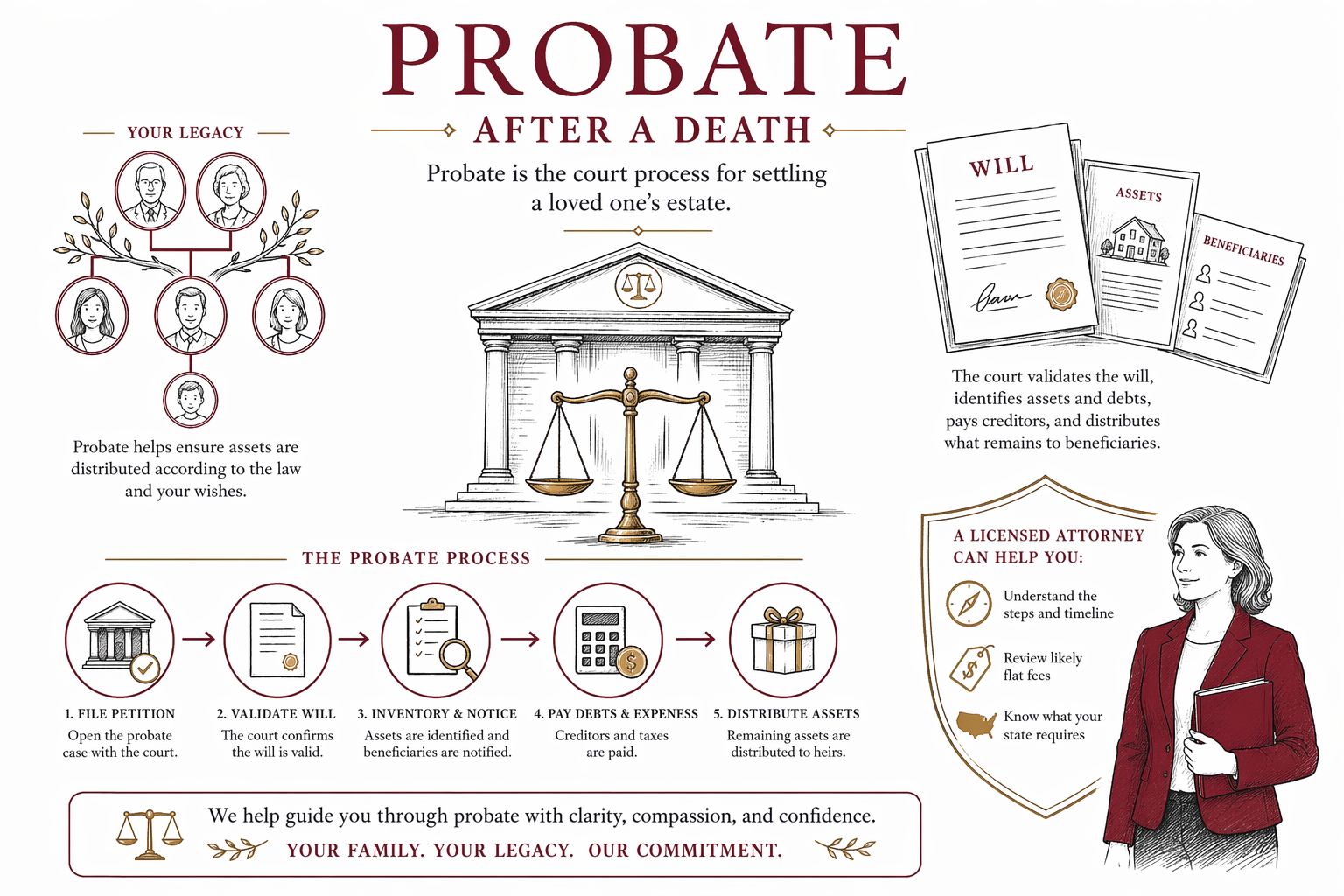
Probate is the court process for settling a person's estate after death. It can feel overwhelming, but understanding the steps, likely costs, and where an attorney helps can make it more manageable.
What probate is — and what it is not
Probate is the legal process used to gather a person's property, pay valid debts and taxes, and transfer what is left to the right people after death. If there is a will, the court usually reviews it and appoints the person named to handle the estate. If there is no will, state law decides who inherits and who can serve.
Probate does not mean every asset automatically goes through court. Some property may pass outside probate, such as accounts with a named beneficiary, life insurance with a beneficiary, or jointly owned property, depending on state law and how the asset was titled.
Probate also does not erase family conflict, debt, or tax issues. It is a court process with deadlines, notices, forms, and rules that vary by state. That is why many families talk with a licensed estate planning or probate attorney in their state.
WillArbor is a free matching service, not a law firm and not your lawyer. We give general educational information only and can help you get matched with a licensed estate planning attorney near you.
When probate is needed
Probate is often needed when a person dies owning assets in their name alone and those assets do not have another legal way to pass to someone else. Common examples include a house titled only in the person's name, a bank account with no beneficiary, or other property with no joint owner.
Sometimes probate is small and fairly simple. Sometimes it is larger, takes longer, or becomes contested. Whether probate is required depends on the kind of property involved, the value of the estate, whether there is a valid will, and the rules in that state.
Many states also have simplified procedures for smaller estates. These are not available in every situation, and the dollar limits and requirements vary by state.
A licensed attorney can help you understand whether full probate, a simplified process, or no probate may apply.
What a probate attorney usually does
A probate attorney helps the personal representative, executor, or administrator move the estate through the required court steps. They often prepare and file court papers, help gather asset information, arrange required notices, explain deadlines, and help with the final transfer of property.
If there is a will, the attorney may help present it to the court and confirm that the named executor can serve. If there is no will, the attorney may help a family member ask the court to appoint an administrator under state intestacy rules.
A probate attorney does not make the family's choices for them or guarantee a fast result. They also do not change state inheritance law. Their role is usually to guide the estate through the legal process correctly and help avoid mistakes that can cause delay or conflict.
If you are comparing options, start with services to understand related estate planning documents, then talk with a licensed attorney in your state about the probate process that fits your situation.
Basic probate steps after a death
The exact steps depend on the state, the court, and the estate. In plain terms, probate often looks like this:
- Find the will, death certificate, and basic information about the person's property and debts.
- File the first court papers to open the estate and ask the court to appoint the person who will handle it.
- Notify interested people and, where required, give notice to creditors.
- Identify and value estate property.
- Pay valid debts, expenses, and required taxes from estate assets.
- Keep records and, if required, provide an accounting to the court or beneficiaries.
- Transfer the remaining property to the right heirs or beneficiaries and close the estate.
Even when these steps sound simple, paperwork and timing can be stressful during a time of grief. A probate attorney can explain what your state requires and what documents the court expects.
Common mistakes families make
One common problem is assuming a will avoids probate. A will gives instructions, but property titled only in the person's name may still need to go through probate so the court can oversee the transfer.
Another mistake is waiting too long to get advice when there is confusion about assets, debts, missing documents, or family disagreement. Delay can lead to missed deadlines, extra court trouble, or problems accessing property.
Families also run into trouble when beneficiary designations are out of date, when a trust was created but never funded, or when a person died without a will at all. Dying without a will is called intestacy, and state law then decides who inherits.
DIY forms can also fail if they were not valid for that state or were signed incorrectly. Probate and estate-planning rules vary by state and change over time, so it is wise to have a licensed attorney review the situation.
How much probate help may cost
Probate costs vary a lot by state and by the type of estate. Many attorneys quote probate work as a flat fee for a simpler estate, while more complex or disputed matters may be priced differently. The numbers below are general educational ranges, not quotes.
For a straightforward small-estate process or a simple uncontested probate, a flat fee might be around $1,500 to $4,000 in some states. For a more typical uncontested probate with more paperwork, multiple assets, or a home to transfer, families may see ranges around $3,000 to $7,500 or more. If there is a will contest, creditor dispute, missing heirs, business ownership, real estate in more than one state, or tax complexity, the total can be much higher.
Court filing fees, publication costs, certified copies, appraisals, bond premiums, and other case expenses may be separate from the attorney's fee. Always ask what is included, whether the attorney is offering a flat fee for the expected work, and what could increase the total.
You can learn more about honest planning costs on our costs page. Before any work starts, the family should confirm the flat fee and scope in writing.
How to find the right help, free
If you are handling a loved one's estate, you do not have to figure everything out alone. A licensed estate planning or probate attorney can tell you what process may apply in your state, what documents to gather first, and whether the estate may qualify for a simpler procedure.
WillArbor is free for families. We are not a law firm, do not draft documents, and do not create an attorney-client relationship. We simply help you get matched with a licensed estate planning attorney near you.
We only collect contact and planning intent: your name, phone, optional email, state, what you want help with, and preferred language. We do not ask for account numbers, Social Security numbers, asset values, income, or private estate details.
As you compare attorneys, stay in control:
- Ask whether they handle probate in your state regularly.
- Confirm they are licensed and in good standing with the state bar.
- Ask whether the matter can be handled for a flat fee and what is included.
- Get the fee and scope in writing before work begins.
- Choose the attorney you feel comfortable with.
Probate is the court process for settling a loved one's estate, and a licensed attorney can help you understand the steps, likely flat fees, and what your state requires.
Common questions
Do all assets go through probate after someone dies?
No. Some assets may pass outside probate, such as property with a valid beneficiary designation or certain jointly owned assets. What does and does not go through probate depends on state law and how each asset was titled.
If there is a will, do we still need probate?
Sometimes yes. A will says who should receive property, but assets owned in the person's name alone may still need the court process to be transferred. The answer depends on the estate and your state's rules.
How long does probate take?
It varies widely by state, court, and complexity. A simple uncontested estate may move faster, while disputes, creditor issues, missing documents, or property in more than one state can make probate take much longer.
Can I handle probate without an attorney?
Sometimes, especially for a small or simple estate, but many families prefer legal help because the court process has forms, notices, and deadlines. A licensed attorney in your state can tell you whether the estate may qualify for a simpler process.
How much does a probate attorney cost?
Many probate matters are quoted as a flat fee for simpler estates, but costs vary by state, documents, and complexity. General ranges may start around $1,500 to $4,000 for simpler matters and go higher for a typical probate or any dispute; these are not quotes.
What if my parent died without a will?
That is called intestacy. State law then decides who inherits and who can ask the court to manage the estate, so it is a good idea to speak with a licensed probate attorney in that state.
Related help
A will says who gets what and who is in charge after you die — here is what it does, what it costs, and how to set one up the right way.
Open → Living TrustsA living trust can avoid probate and add control over how and when your family receives what you leave — here is the plain version.
Open → Powers of AttorneyA power of attorney lets someone you trust act for you on money or health decisions if you can't — here is how the two main kinds work.
Open →