Guides
Will vs. Trust: Which Do You Need?
A will and a trust can both protect your family after you pass away—but they do different jobs. This guide explains the practical difference, when each one makes sense, and when many families use both.
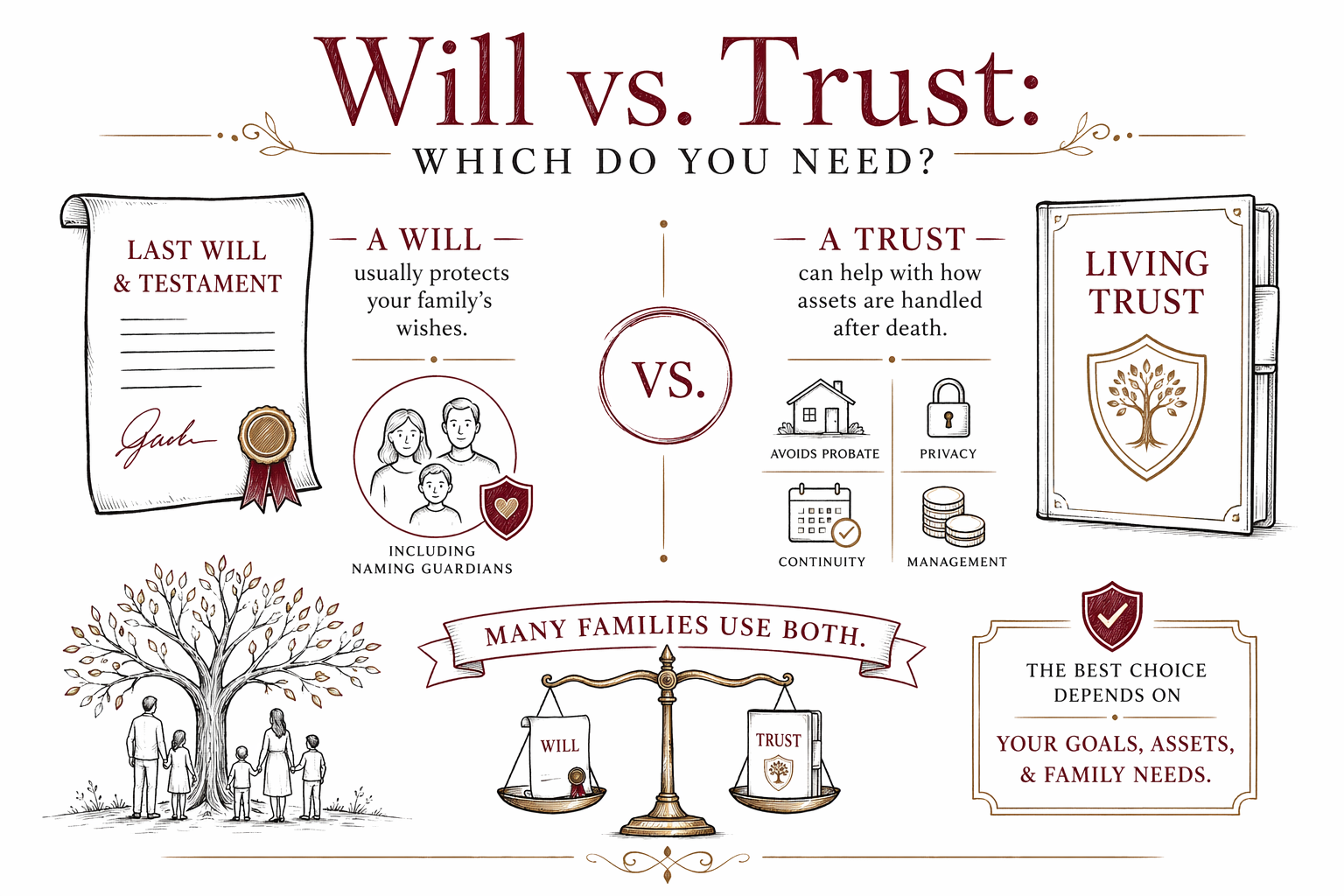
Quick answer: what to pick first?
Start with a will. A will is usually the simplest way to name who should receive your assets and (most importantly) who should care for your minor children.
A living trust is often useful when you want more control over what happens to assets during probate and after death, or when you’re trying to make transfers smoother. But a trust is not automatically better for everyone—rules and results vary by state and by how your assets are titled.
If you’re unsure, the safest next step is to talk with a licensed estate planning attorney in your state. They can review your situation at a high level and explain what documents actually fit your state’s process and deadlines.
The plain difference: will vs. living trust
A will generally does three main things: it states who gets your property, it can name a guardian for children, and it tells the court how to handle your estate after you pass away.
A living trust (sometimes called a “revocable trust”) is a document you create while you’re alive. It holds assets that you transfer into the trust. When you pass away, the trust instructions guide what happens to those assets, typically without needing the same kind of court process as many assets in a will.
Important: a living trust only works for the assets you actually put into it. This is a common reason people end up with an “unfunded” trust that doesn’t do what they expected.
When a will is usually the right choice
A will is often a good fit if you want clear instructions for your family and you need to name a guardian for children. For many families, especially those with straightforward situations, a will can provide the core protection.
A will can also be the right starting point if you want a simple, direct plan and you’re not sure yet whether a trust would add meaningful value.
Common pitfall: dying without a will. If you die intestate (without a will), state law decides who receives your property and whether your preferred guardian can be used—this may not match your family’s wishes.
When a living trust can be helpful
A living trust may be helpful if you want to reduce or avoid probate for assets titled in the trust, or if you want a plan that keeps things organized for a successor.
It can also be useful when you’re concerned about privacy, have complicated family situations, or want a structure that can be easier for your chosen person to manage after your death.
Common pitfall: “DIY trust” forms that don’t match your state, plus failing to update and transfer assets into the trust. Estate-planning law and probate vary by state, so what works in one place may not work the same way elsewhere.
Why many families use both
Many families use a will and a living trust together. A trust can handle some assets, while a will can still cover items not in the trust and name guardians for children.
This “both” approach is often about practical coverage: making sure your plan is complete, consistent, and aligned with how your assets are actually owned.
The right combination depends on your state rules and the details of your assets—not just the documents. A licensed estate planning attorney can explain what would likely happen in your state’s probate process and how to design a plan that fits.
Practical next steps (and what to ask)
Before you meet with an attorney, gather basic information about what you want your plan to do (for example: guardians for children, who should inherit, and who you trust to handle decisions).
When you speak with a licensed estate planning attorney, consider asking:
1. “In my state, when do wills and living trusts go through probate (and what does that mean in real life)?”
2. “Do I need a guardian named in a will, and how is that handled in my state?”
3. “Would a trust be useful for my assets—or would it need to be funded by transferring assets into it?”
4. “What documents do you recommend beyond a will or trust (like powers of attorney or advance directives)?”
Pitfalls to watch for:
- Out-of-date beneficiary designations (often on accounts outside of your will)
- DIY forms that don’t match your state’s requirements
- Unfunded trusts (trust created, but assets not placed into the trust)
- No named guardian for children
If cost is a concern, that’s normal. Most estate planning work is quoted as a flat fee (not hourly), and prices vary by state and document complexity—so get a written flat-fee confirmation before any work begins. Get matched with a licensed estate planning attorney near you through WillArbor, and compare options in your state. It’s free for your family.
A will usually protects your family’s wishes (including naming guardians), while a living trust can help with how assets are handled after death—many families use both, and the best choice depends on your state’s rules, so get matched for free with a licensed estate planning attorney.
Common questions
Do I need a living trust if I already have a will?
Not always. Many people start with a will, especially if they need a guardian for minor children. A living trust may help in some states and situations, but it only covers assets you transfer into it, and probate rules vary by state—so it’s best to confirm with a licensed attorney in your state.
Will a trust let me avoid probate for everything?
Often, assets titled in a properly funded living trust can avoid certain probate steps, but not necessarily every asset. Some items may still pass through other processes (for example, assets with beneficiary designations). Rules vary by state, so ask your attorney how your specific assets would be handled.
What’s the biggest mistake families make with wills or trusts?
Two common issues are dying without a will (intestacy) and setting up documents without keeping them current—like failing to update beneficiary designations or leaving a trust “unfunded.” Also, DIY forms may not meet your state’s requirements, which can lead to delays or added court involvement.
How much does it cost to set up a will or a living trust?
Most estate planning is quoted as a flat fee, but the real number depends on your state and what documents you need (for example, will only vs. will + trust, plus powers of attorney and advance directives). If you want, you can start by [getting matched](/get-matched/) for free with a licensed attorney who can explain a written flat-fee option—ranges are not quotes.
Related help
Plain-language ways families reduce or avoid probate — trusts, beneficiary designations, and joint ownership.
Open → What Happens If You Die Without a WillIntestacy explained: how your state decides who inherits when there is no will — and why that may not match your wishes.
Open → What Estate Planning Really CostsFlat fees vs hourly billing, typical ranges by document, and how to avoid overpaying.
Open →