Guides
What Happens If You Die Without a Will
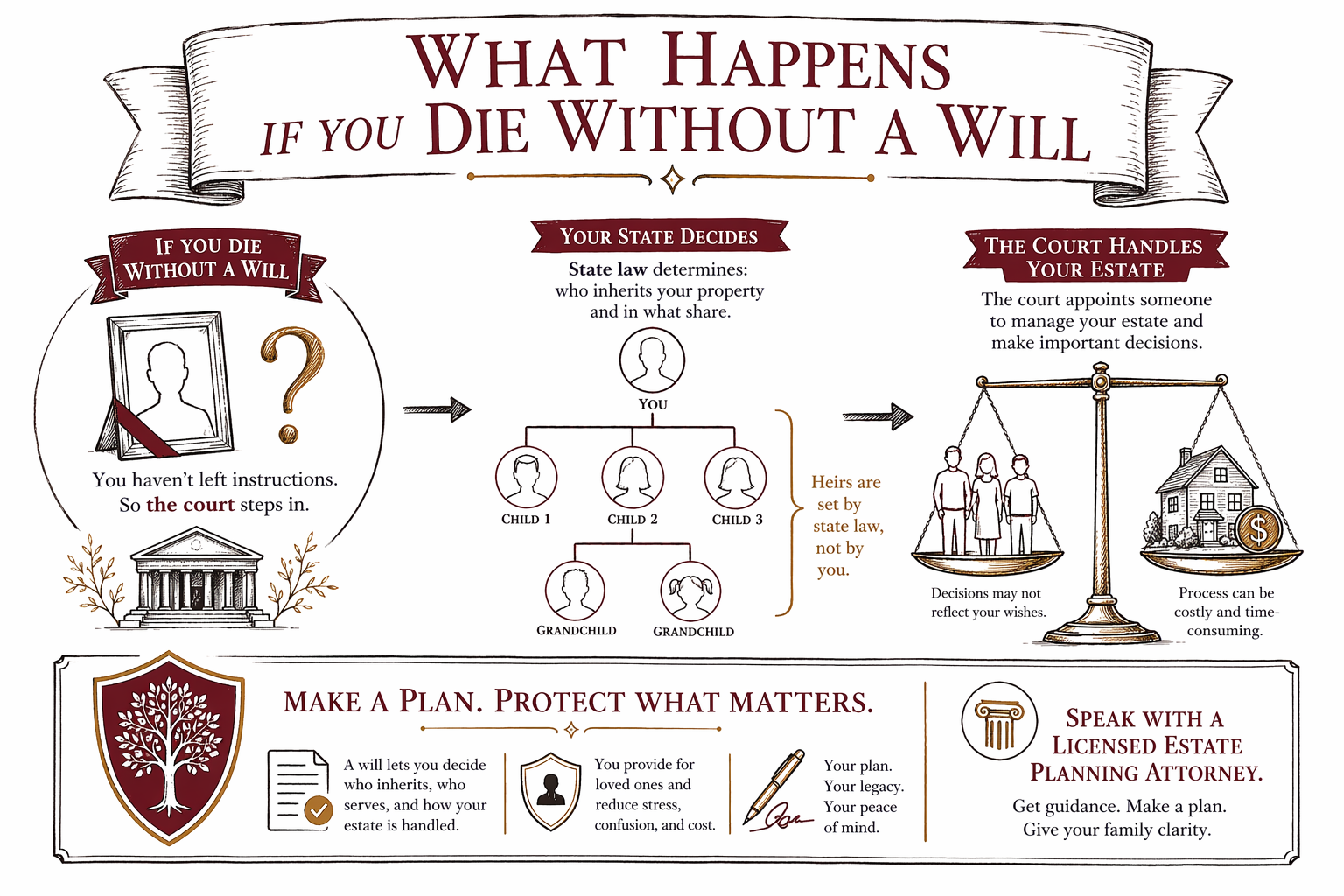
If you die without a will, your state’s intestacy law decides who gets your property. That may be very different from what you would have chosen, and the rules vary by state.
The direct answer
When there is no valid will, the court follows state law to decide who inherits, who handles the estate, and sometimes who cares for minor children. This is called dying "intestate."
In many families, the result is simple enough. In others, it can be surprising, especially if you have a spouse from a later marriage, children from different relationships, stepchildren, or relatives who live outside the United States. The law may not divide things the way you expected.
Estate planning rules vary by state and change over time, so the exact outcome depends on where you lived and what property you owned. A licensed estate planning attorney in your state can explain the law that applies to your family.
- Intestacy = no valid will at death
- State law, not your wishes, controls who inherits
What usually happens next
First, a family member usually asks the probate court to open an estate. The court then names a person to manage the process, often called a personal representative or administrator.
That person gathers the property, pays valid debts and expenses, and distributes what remains according to state law. If there is no will, the court does not get instructions from you about who should receive specific items, who should serve as guardian, or who should serve as the manager of the estate.
If you have minor children and no valid guardianship plan, the court may have to decide who will care for them. That is one reason many parents choose to make a will even if they do not own much property.
- The court may appoint someone to settle the estate
- A judge may need to decide guardianship for minor children
Common outcomes under intestacy
In many states, a surviving spouse may receive part or all of the estate. Children may also inherit, sometimes in equal shares. Parents, siblings, or other relatives may inherit if there is no spouse or child.
But the details matter. The result can change based on whether property is separate or marital, whether children are from the same relationship, and whether relatives can be located. Property with a named beneficiary, like some life insurance or retirement accounts, may pass outside the probate process if the designation is up to date.
That last point is a common pitfall: people think a will controls everything, but beneficiary forms often control certain accounts. Another common problem is an old form that still names a former spouse or someone who has died. DIY forms can also fail if they are not valid in your state.
- Out-of-date beneficiary forms can override your expectations
- DIY forms may not be valid or complete in your state
- Stepchildren often do not inherit automatically under intestacy
Why this can create stress for families
Dying without a will can mean delay, extra court steps, more cost, and family conflict. Relatives may disagree about who should manage the estate or what should happen to personal items.
It can also leave your wishes unheard. If you wanted to leave something to a friend, a stepchild, a charity, or a caregiver, intestacy usually will not do that. And if you wanted to name a guardian for your children, the court will not have that instruction.
For families who are new to the United States, this can be especially confusing because the law here may be different from the country you came from. A local attorney can explain how the state rules work in plain language.
- More delay and court involvement are common
- Your personal wishes may not be followed
What to do if you want to protect your family
- Make a will if you want to choose who inherits, who manages the estate, and who cares for minor children.
- Review beneficiary designations on accounts that pass outside a will.
- Consider whether a trust, power of attorney, or advance directive also makes sense for your situation.
- Keep documents current after marriage, divorce, a birth, a death, or a move to another state.
- Have a licensed estate planning attorney in your state review your plan and confirm the flat fee in writing before any work starts.
WillArbor is a free matching service, not a law firm and not your lawyer. We do not draft documents. We simply help you connect with a licensed estate planning attorney near you, and the family stays in control of who to hire.
- Match with a licensed attorney in your state
- Confirm the attorney’s bar license and flat fee in writing
How WillArbor can help
If you are worried about what happens without a will, you do not have to figure it out alone. We help families find a licensed estate planning attorney near them for a free consultation-style match based on contact and planning intent only: name, phone, optional email, state, what they want to plan, and preferred language.
You compare attorneys, ask questions, and choose who to hire. Most estate planning is quoted as a flat fee, not hourly, but the real number depends on the documents, complexity, and state. Any range you hear is only a general guide, not a quote.
If you want to learn more first, you can browse our guides or review our services. When you are ready, you can get matched with a licensed estate planning attorney.
- Free for the family
- No attorney-client relationship is created by the match
Without a will, your state decides who inherits and who handles your estate, so it is wise to make a plan and speak with a licensed estate planning attorney.
Common questions
If I die without a will, does the state take everything?
Usually no. The state uses intestacy law to decide which family members inherit, and if no heirs can be found, the property may eventually pass to the state. A local attorney can explain how that works in your state.
Does a spouse automatically get everything if there is no will?
Not always. In some states a spouse gets everything, but in others the estate is shared with children, parents, or other relatives. The exact result depends on state law and your family situation.
Do beneficiary forms matter more than a will?
For some assets, yes. Accounts with valid beneficiary designations can pass outside the will, so outdated forms are a common mistake. It is wise to review them with a licensed attorney or other qualified professional.
Will a court decide who takes care of my children?
If you have minor children and no valid guardian nomination, the court may need to decide. A will is the main place many parents name a guardian, subject to state law and court review.
Related help
The difference between a will and a living trust, when each makes sense, and why many families use both.
Open → How to Avoid ProbatePlain-language ways families reduce or avoid probate — trusts, beneficiary designations, and joint ownership.
Open → What Estate Planning Really CostsFlat fees vs hourly billing, typical ranges by document, and how to avoid overpaying.
Open →