Documents
Powers of Attorney
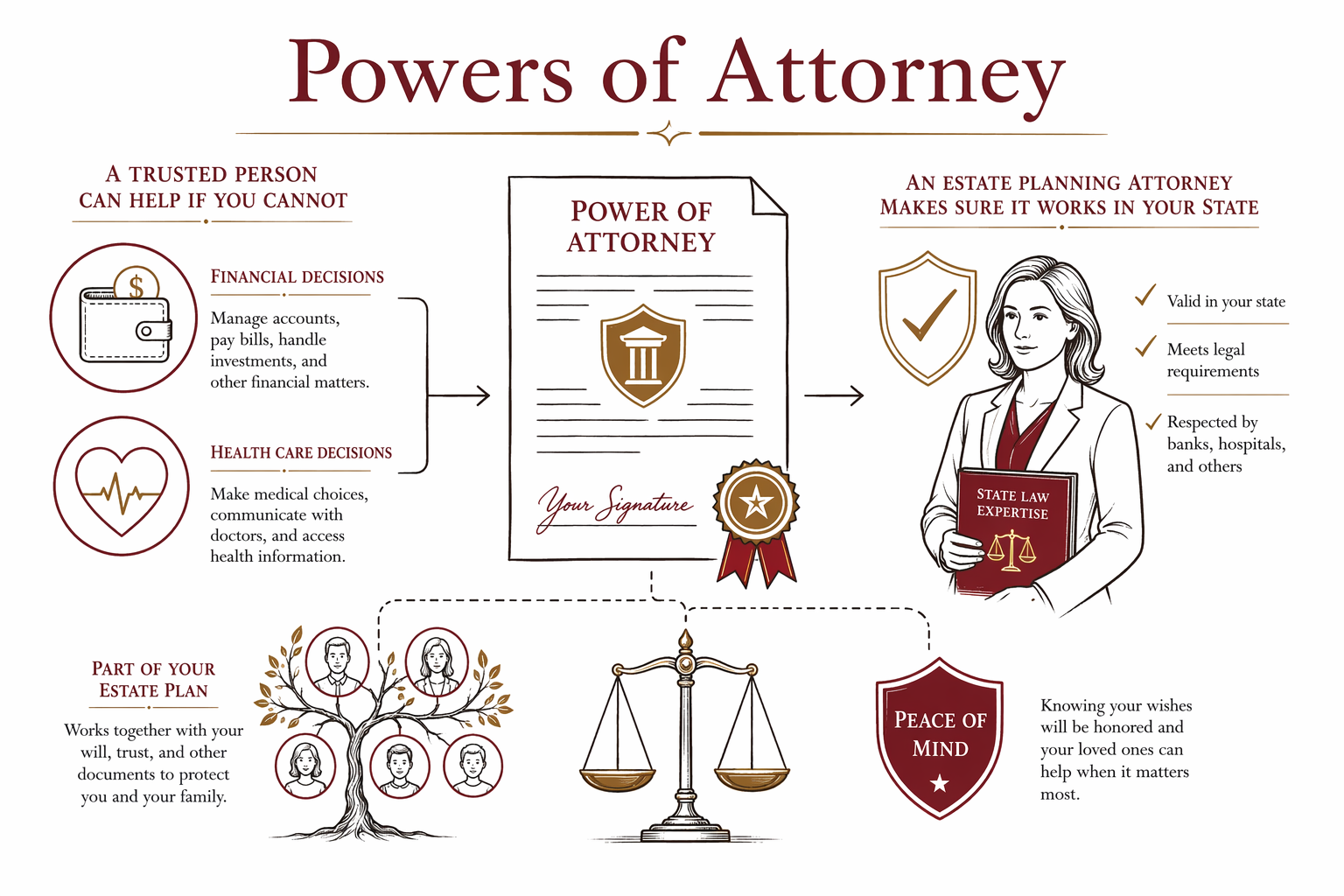
A power of attorney lets you choose who can act for you if you cannot handle things yourself. It can protect your money, your health decisions, and your family from confusion in an emergency.
What a power of attorney is
A power of attorney, often called a POA, is a legal document that gives another person authority to act for you. The person who gives the authority is sometimes called the principal. The person chosen to help is often called the agent or attorney-in-fact.
There are two main kinds most families ask about: a financial power of attorney and a health care power of attorney. A financial POA can let someone handle money and property matters for you. A health care POA can let someone make medical decisions for you if you cannot speak for yourself.
A POA can be very broad or very limited. It may start right away, or only under certain conditions, depending on state law and how the document is written. Because rules vary by state, a licensed estate planning attorney in your state should explain what is allowed where you live.
What it does — and what it does not do
A financial power of attorney may help with tasks like paying bills, dealing with a bank, signing tax forms, handling a home sale, or managing other day-to-day financial matters if you are sick, injured, traveling, or unable to act. A health care power of attorney may let your chosen person talk with doctors, review treatment options, and make medical choices if you cannot decide for yourself.
A POA does not let someone rewrite your will. It does not decide who inherits your property after death. In most cases, a power of attorney ends at your death, and then your will, trust, beneficiary designations, or state probate rules take over.
A POA also does not replace an advance directive or living will in every state. Those documents often work together: one names who speaks for you, and the other explains your wishes about certain medical care. If you are building a full plan, it helps to look at services together instead of one document at a time.
Who usually needs powers of attorney
Almost every adult should at least consider having both a financial POA and a health care POA. This is not only for older adults. A young parent, a single adult, a college student, a business owner, or a person caring for aging parents can all need one unexpectedly.
Without a valid POA, your family may have trouble helping if you become incapacitated. They may not be able to access accounts, pay important bills, speak with doctors, or make timely decisions. In some cases, they may need to go to court to ask for authority, which can be slower, more stressful, and more expensive.
POAs are especially important if you have minor children, own a home, travel often, have health concerns, or want to make things easier for a spouse or trusted relative. If English is not your first language, it is also helpful to work with a lawyer who explains the choices clearly and, if possible, in your preferred language.
How powers of attorney are set up
A lawyer usually starts by asking who you trust, what powers you want to give, when the authority should begin, and whether any limits should be written in. Different states have different signing rules. Some require witnesses, notarization, special language, or separate forms for health care decisions.
Once the documents are signed correctly, keep the originals in a safe but accessible place. Give copies to the people who may need them, such as your named agent, your doctor, or sometimes your financial institutions. A POA that no one can find may not help when your family needs it.
A simple process often looks like this:
1. Decide who you trust to handle money matters and health decisions.
2. Meet with a licensed estate planning attorney in your state.
3. Review what powers to give, and whether they should be broad or limited.
4. Sign the documents using your state's required formalities.
5. Share copies with the right people and update them when life changes.
WillArbor is not a law firm, does not draft documents, and is not your lawyer. We are a free matching service that helps families connect with a licensed estate planning attorney near them through get matched.
Common mistakes families make
One common mistake is naming the wrong person. The best choice is not always the oldest child or closest relative. It should be someone responsible, available, calm under pressure, and able to follow your wishes.
Another problem is using a DIY form that does not meet your state's rules or does not work well with local banks, hospitals, or title companies. Estate planning and probate rules vary by state, so a form that worked elsewhere may fail where you live.
Families also run into trouble when documents are too old, too vague, or never shared. A divorce, remarriage, move to a new state, serious diagnosis, or conflict in the family can all be reasons to review your documents.
Watch for these issues:
- No power of attorney at all
- Picking an agent without talking to them first
- DIY forms that may not be valid in your state
- Giving powers that are too broad or too narrow for your needs
- Not signing with the right witnesses or notarization
- Keeping the document hidden so no one can use it in time
- Forgetting to review the document after major life changes
What powers of attorney usually cost
Many estate planning attorneys charge a flat fee for powers of attorney, not an hourly rate. For one person, a simple financial POA or health care POA alone may often cost about $100 to $400 per document in some areas. A pair of POAs for one person may often fall around $200 to $800. In a broader estate plan bundle, the cost may be packaged together rather than priced separately.
For a full estate plan that includes a will, financial power of attorney, health care power of attorney, and advance directive, many families may see flat-fee ranges around $600 to $2,500 or more, depending on the state and complexity. In higher-cost states or more detailed plans, the price can be higher. These are general educational ranges, not quotes.
What moves the price up or down usually includes:
- Your state and local legal market
- Whether you need one document or a full plan
- Whether the lawyer is preparing documents for one person or a couple
- The complexity of your wishes and family situation
- Whether you need urgent turnaround or special coordination
Before you hire anyone, ask for the flat fee in writing, what documents are included, whether signing help is included, and what updates would cost later. You can read more general pricing guidance on costs.
How to find the right attorney
Look for a licensed estate planning attorney in your state who regularly prepares powers of attorney, not someone who only handles unrelated legal work. Ask whether they explain the difference between financial and health care POAs in plain language, whether they offer a flat fee, and whether they can communicate in your preferred language.
It is also smart to confirm the lawyer's active bar license in your state before hiring. Ask for the scope of work and fee in writing before any work begins. The family stays in control: you compare attorneys, choose who to hire, and decide whether to move forward.
WillArbor is free for families. We only collect contact and planning intent — such as your name, phone, optional email, state, what you want to plan, and preferred language — so we can help you connect with a licensed estate planning attorney. We do not ask for account numbers, asset values, Social Security numbers, income, or the private contents of your estate plan.
If you are ready to talk with someone, you can get matched for free.
A power of attorney lets a trusted person help with money or health decisions if you cannot, and a licensed estate planning attorney can make sure it works in your state.
Common questions
Do I need both a financial power of attorney and a health care power of attorney?
Many adults choose both because they do different jobs. One usually covers money and property matters, and the other covers medical decisions if you cannot speak for yourself.
Does a power of attorney let someone inherit my property?
No. A power of attorney usually gives authority to act for you while you are alive, not the right to inherit after you die. Inheritance is usually controlled by a will, trust, beneficiary designation, or state law.
When does a power of attorney end?
That depends on the document and your state's law, but in most cases it ends at your death. Some also end earlier if you revoke them or if a court intervenes.
Can I make a power of attorney without a lawyer?
Some people use forms, but DIY documents can fail if they do not meet your state's rules or if they are too vague for banks or hospitals to accept. A licensed estate planning attorney can help make sure the document is valid and usable in your state.
What if I move to another state?
Your old documents may still help, but estate planning rules vary by state. After a move, it is wise to have a licensed attorney in the new state review your POAs.
How does WillArbor help?
WillArbor is a free matching service, not a law firm and not your lawyer. We provide general educational information and help you connect with a licensed estate planning attorney in your state.
Related help
A will says who gets what and who is in charge after you die — here is what it does, what it costs, and how to set one up the right way.
Open → Living TrustsA living trust can avoid probate and add control over how and when your family receives what you leave — here is the plain version.
Open → Advance Directives & Living WillsAn advance directive states your medical wishes and who speaks for you if you can't — here is what to include.
Open →