Free guides
Will vs. Trust Decision Worksheet
Use this free Will vs. Trust Decision Worksheet to sort out what your family needs—whether a will, a trust, or a combination. It’s education only, and rules vary by state.
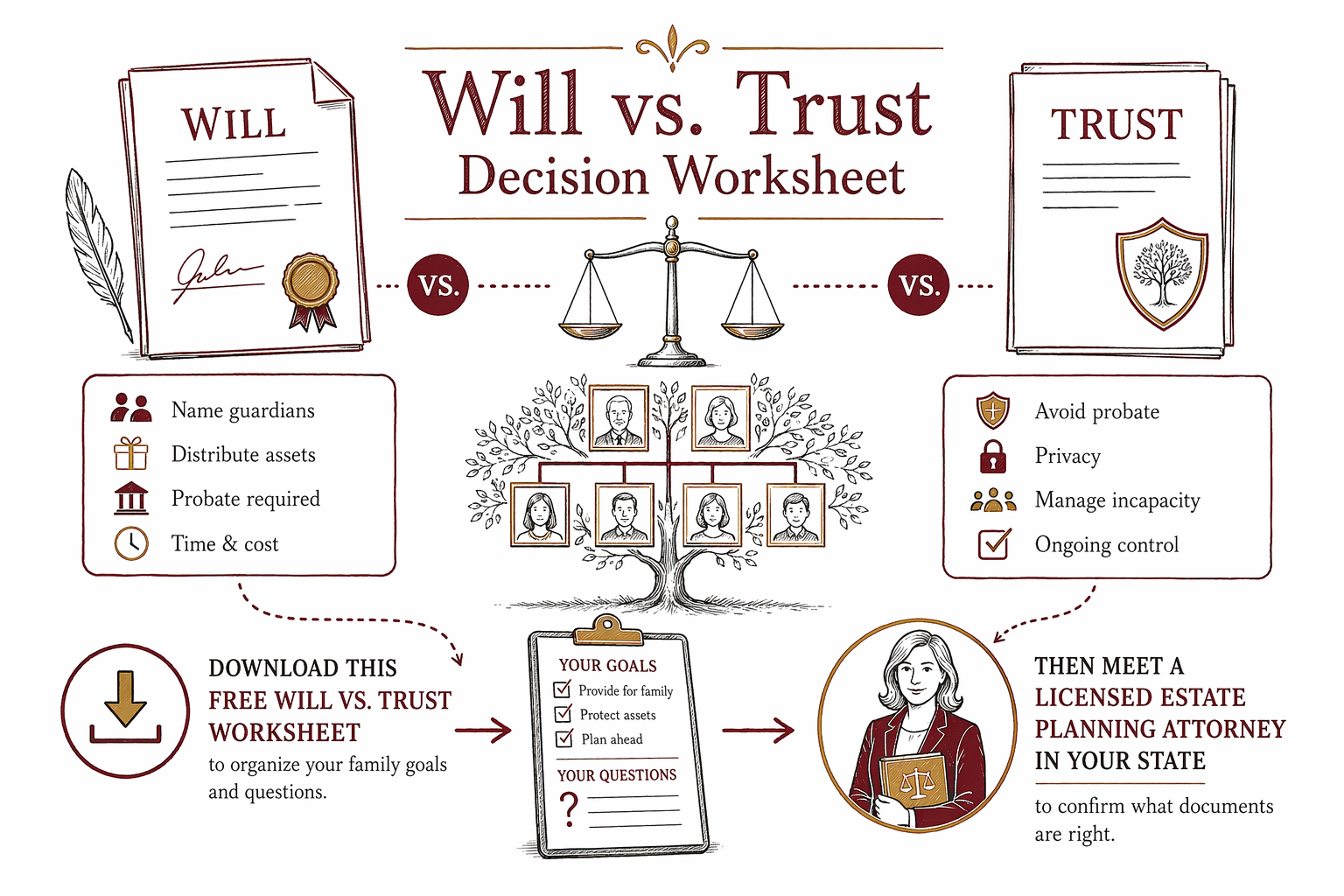
What’s in the worksheet (and what it helps you decide)
This free downloadable PDF is a guided checklist/worksheet to help you think through the differences between a will and a trust, and when each one may fit better.
You’ll get prompts to organize your family goals (for example: naming guardians for children, choosing who should inherit, and what you want to happen if you or a parent dies). It also helps you spot common “next questions” to ask an attorney.
This is not legal advice and it doesn’t replace a licensed attorney’s review. Estate planning rules and probate processes vary by state and can change over time.
- A simple way to compare “will only” vs. “trust (often plus a will)” in plain language
- Questions to bring to your first meeting so you feel less rushed
Who this worksheet is for
This tool is designed for adults who want to protect their family and feel more confident before meeting an attorney—especially if you’re new to the US, prefer plain language, or are meeting estate planning for the first time.
It can be useful whether you’re planning for your own future or helping with a parent’s estate after a death. If you’re worried about paperwork, court steps, or “what happens if I do nothing,” this worksheet can help you prepare.
If you already have documents, the worksheet may help you identify whether something seems out of date—like named guardians or beneficiary choices.
- Families planning for children or guardianship
- People trying to understand probate and avoid surprises
How to use it before you talk to an attorney
Start by downloading and printing the PDF, or use it on a tablet if that’s easier for you. Don’t try to get everything perfect—your goal is to think clearly and write down what matters most to your family.
Then do a quick “fill-in” pass and bring your answers to your appointment. Your attorney can explain what applies in your state and what documents (if any) make sense for your situation.
Remember: WillArbor is a FREE matching service, not a law firm. We help connect you with a licensed estate planning attorney near you—but the attorney is the one who reviews your state’s rules and your family’s needs.
- Write your goals first (family, guardianship, who inherits), not details you may not need yet
- Bring your completed worksheet—so you can ask better questions sooner
What you should NOT do with this worksheet
This worksheet is for organizing your thinking. It is not meant to replace legal review or to tell you what you personally “should” do.
Do not use it to draft documents yourself or to rely on generic forms. DIY forms often fail to match your state’s requirements, and estate plans can be invalid if they don’t follow local rules.
Also, keep your comfort and privacy in mind: when you sign up with WillArbor, we collect only contact and planning intent (and your preferred language and state)—not asset values, account numbers, SSNs, or other sensitive estate details.
- Avoid DIY documents without state-specific guidance
- Don’t assume a trust is always better or always necessary—state facts matter
Cost expectations (so you’re not surprised)
Estate planning fees are commonly quoted as a flat fee (not hourly), but the real cost depends on the documents you need and the complexity of your situation—and it varies by state and by attorney.
As a rough expectation, many people pay flat-fee ranges for basic planning such as a will and related documents, while more involved planning (like adding one or more trusts and additional directions) can cost more. Final pricing is confirmed in writing by the attorney after they understand what’s needed.
If you want to compare options, you can explore services and then get matched so you can ask about their flat fee for the documents that fit your state and goals.
- Typical flat-fee ranges can vary widely; they’re not quotes
- Complexity, number of documents, and state rules are common cost drivers
Before you download: common pitfalls this tool helps you avoid
Many families run into problems when they never finalize a plan. Dying without a will can lead to “intestacy” rules in your state, which may not match what you would have chosen for your family.
Another common issue is out-of-date beneficiary designations (for example, on retirement or insurance). Even a well-made will can’t always fix those if designations don’t match your plan.
This worksheet also encourages you to think about basics like naming a guardian for children when relevant—and keeping documents current—so you’re not relying on hope or uncertainty.
- Avoid “no will” surprises by naming what you want to happen
- Think about guardian and beneficiary choices early
Download this free Will vs. Trust Worksheet to organize your family goals and questions—then meet a licensed estate planning attorney in your state to confirm what documents are right.
Common questions
Is this worksheet a legal document or legal advice?
No. It’s a free educational worksheet to help you think and prepare questions for an attorney. Estate planning rules vary by state, so a licensed estate planning attorney must review what fits your situation.
Do I need a trust, or is a will enough?
There isn’t one answer for everyone. Some families use a will alone, others use a trust (often along with a will), and the “best fit” depends on state rules and your goals. Use the worksheet to identify your priorities, then ask a licensed attorney to explain options in your state.
Will this tool help me if I’m dealing with a parent’s estate after a death?
It can help you organize what you need to ask about probate and next steps, especially if you’re not sure what documents exist or what the process may be in your state. Your attorney can guide you based on the facts and the timeline.
What information do I need to fill this out?
You can generally focus on your family goals (like guardianship, who inherits, and what outcomes you want). You don’t need to provide sensitive details such as account numbers or SSNs to use the worksheet or to get matched with an attorney through WillArbor.
Related help
A free, printable checklist of the documents and decisions to cover before you meet an attorney.
Open → The Executor's Duties GuideA free plain-language guide to what an executor actually has to do.
Open → The Estate Document OrganizerA free template to record where your key documents and accounts are kept — so your family can find them.
Open →