Your situation
Estate Planning for Blended Families
Blended families often need more than a simple will. A clear plan can help protect a current spouse, provide for children from a previous relationship, and reduce confusion, hurt, and court fights later.
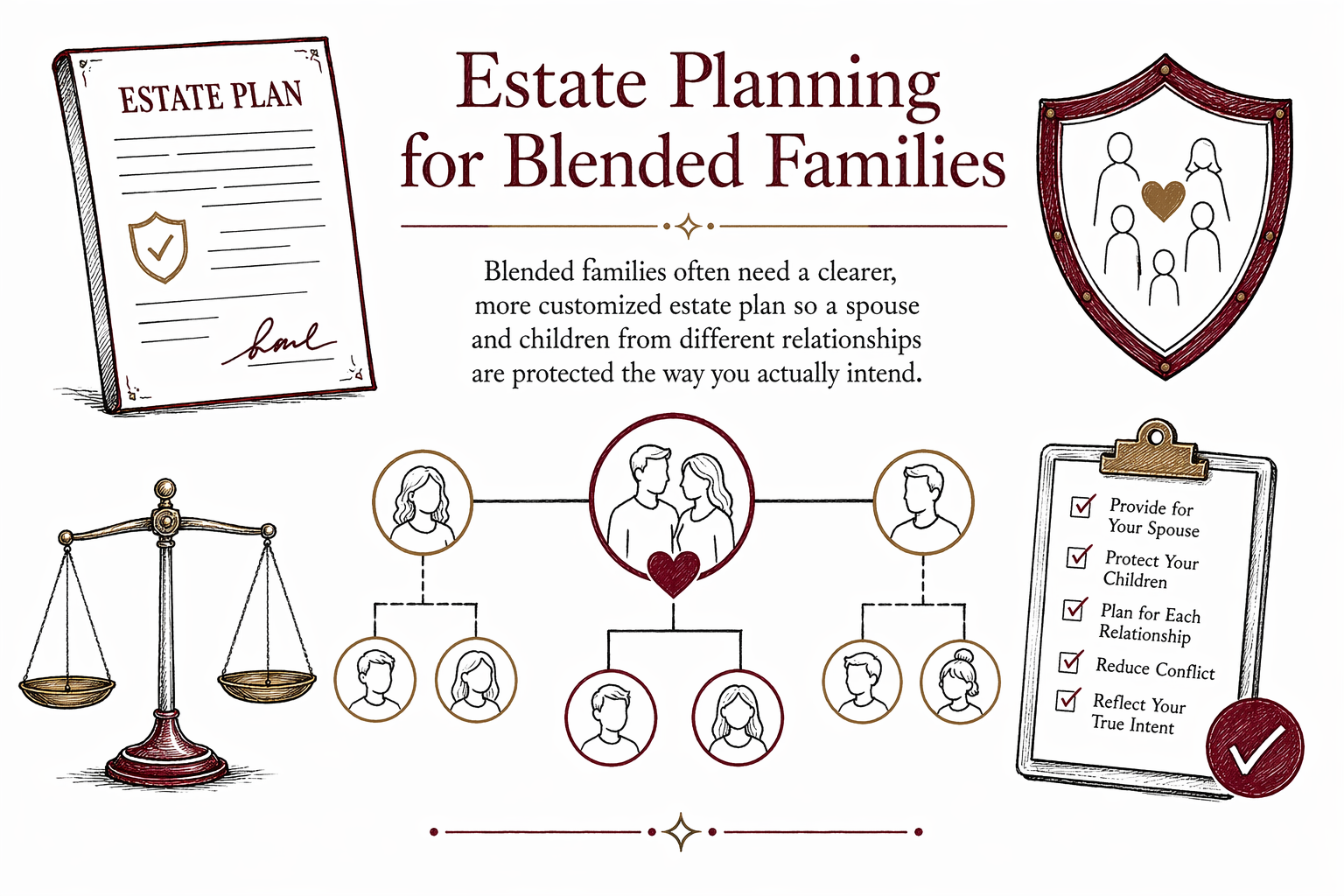
Why blended families need a careful estate plan
When a family includes a second marriage, stepchildren, children from a prior relationship, or shared children together, estate planning can get complicated fast. Many people want to do two things at once: care for a current spouse now and make sure their own children inherit later. Without a clear plan, those goals can easily collide.
A basic will may not be enough, especially if you own a home together, have separate property, want to leave different shares to different people, or worry that one side of the family could be left out. If you die without a valid plan, state intestacy rules decide who inherits, and those rules may not match what your family thinks is fair.
This page gives general educational information only, not legal, tax, or financial advice. Estate-planning and probate rules vary by state and change over time, so it is important to speak with a licensed estate planning attorney in your state.
What many blended families choose to set up
A complete plan often includes a will, powers of attorney, and advance directives, and in many blended-family situations, a living trust is worth discussing too. The right mix depends on your family, your property, and your state.
A will can name who inherits property that passes through your estate, name guardians for minor children, and name the person who handles your estate after death. But a will alone may still require probate, and it may not be the best tool if your main concern is balancing support for a spouse with protection for children from an earlier relationship.
A revocable living trust can sometimes help create clearer rules. For example, some families want a spouse to use certain assets during life, with the remainder going to specific children later. Trust planning can also help avoid one common problem: assets passing in a way that was never really intended because accounts, homes, or beneficiary forms were set up years ago and never updated.
You may also need to review how title is held on a home, and who is named on retirement accounts, life insurance, and payable-on-death accounts. Beneficiary designations can override a will, which surprises many families.
- Will for inheritance instructions and guardianship
- Living trust if you want more control over timing or who receives what
- Financial power of attorney for money and property decisions if you cannot act
- Health care directive and health care power of attorney for medical decisions
- A full review of beneficiary designations and asset ownership
Common problems in blended families
The most common mistakes are usually not dramatic. They are ordinary oversights that cause real pain later. One parent assumes "everything will just go to my spouse, and then to my kids," but nothing legally requires that outcome unless the documents and account designations actually say so.
Another common problem is leaving an old beneficiary on a retirement account or life insurance policy. A divorce, remarriage, or years of family changes can leave old forms in place. A will may say one thing while the account pays someone else directly.
DIY forms are another risk. A form that seems simple online may not meet your state's signing rules, may not fit a blended-family situation, or may say something unclear. If a trust is created but never funded, that is another major pitfall: an unfunded trust often cannot do the job people expected.
Families also run into trouble when they never discuss who would care for minor children, who should make decisions if a parent becomes incapacitated, or how to treat stepchildren if the parent wants them included. These are exactly the questions a licensed estate planning attorney can help you think through.
- No will, so intestacy law controls
- Old beneficiary forms that no longer match the family
- A trust that was signed but never funded
- No named guardian for minor children
- Unclear wording that invites conflict after a death
How attorneys often think through fairness
In blended families, "equal" and "fair" are not always the same thing. One spouse may have brought more assets into the marriage. One parent may want to preserve an inheritance for children from a prior relationship. Another family may want all children treated the same, including stepchildren, if state law allows and the documents are written clearly.
An attorney will often ask practical questions: Which assets are separate and which are shared? Are there minor children? Is there a house, and who should live there if one spouse dies first? Should the surviving spouse have broad access to assets, or should some property be reserved for children later? Are there concerns about conflict between a surviving spouse and adult children?
For some families, the answer is a simple, direct plan. For others, trust terms are used to give support to a spouse while preserving the remaining assets for children from an earlier relationship. There is no one-size-fits-all answer, and state law matters a great deal.
If you are not sure where to start, reviewing your goals with a lawyer is often the most useful first step. You can also explore more general help at services or browse other family situations at situations.
What estate planning may cost
Many estate planning attorneys charge a flat fee, not hourly, for common planning work. The real cost depends on the documents you need, the complexity of the family situation, and your state. These ranges are general information only, not quotes.
For a simple will-based plan, many families may see flat-fee ranges around $300 to $1,200 per person, or sometimes more depending on the state and what is included. A more complete package for a couple with wills, powers of attorney, and health care directives may often fall around $800 to $2,500 or more.
If a blended family needs trust planning, separate property planning, or more detailed instructions for a spouse and children from different relationships, the flat fee is often higher. Trust-based plans commonly range from about $1,500 to $5,000+, and complex plans can exceed that in some states.
What raises the price? More documents, more customized trust terms, planning for a home or several accounts, tax-sensitive issues, business ownership, and the need to coordinate many beneficiary designations. Before any work starts, the family should confirm the flat fee in writing and understand exactly what is included.
How WillArbor helps you find the right attorney
WillArbor is a free matching service for families. We are not a law firm, not a lawyer, and we do not draft documents or create an attorney-client relationship. We provide general educational information and help connect you with a licensed estate planning attorney near you.
We only collect basic contact and planning-intent information: your name, phone number, optional email, state, what you want to plan, and your preferred language. We do not ask for asset values, account numbers, Social Security numbers, income, or private estate details.
When you speak with an attorney, stay in control. Compare options, ask whether the lawyer handles blended-family planning regularly, confirm the lawyer is licensed in your state, and ask for the flat fee in writing before hiring anyone. The right attorney should be able to explain your choices in plain language.
If you want help taking the next step, you can get matched for free with a licensed estate planning attorney in your state.
Blended families often need a clearer, more customized estate plan so a spouse and children from different relationships are protected the way you actually intend.
Common questions
If I am married, does my spouse automatically get everything?
Not necessarily. What a spouse inherits depends on state law, how assets are titled, beneficiary designations, and what your documents say. In blended families, assumptions here often lead to painful surprises.
Can I provide for my spouse but still make sure my children inherit later?
Sometimes, yes, but it needs careful planning. In many cases, a trust is discussed for this reason, because it may allow support for a spouse while directing what remains to children later, depending on state law and the terms used.
Do stepchildren inherit automatically?
Usually not in the same automatic way a legal child may inherit under state law, though rules vary by state. If you want stepchildren included, that usually needs to be stated clearly in proper documents.
Is a will enough for a blended family?
Sometimes, but often not. A will can be important, but many blended families also need beneficiary reviews, incapacity documents, and sometimes a living trust to make the plan work the way they intend.
What should I bring to a first meeting with an estate planning attorney?
A simple family list, names of your spouse and children, any prior estate documents, and a basic list of what kinds of property or accounts you have is usually enough to start. You do not need to hand over sensitive account numbers just to get oriented.
How do I know the attorney is really licensed?
Ask for the lawyer's full name and confirm the bar license with your state's attorney licensing authority. It is a good step before hiring anyone.
Related help
Guardians, a will, and a simple plan so your children are cared for if something happens to you.
Open → Estate Planning for HomeownersHow to keep your home out of probate and pass it to the people you choose.
Open → Estate Planning for Small-Business OwnersSuccession, ownership, and keeping a business running if the owner dies or is incapacitated.
Open →