Your situation
Estate Planning for Small-Business Owners
If you own a small business, estate planning helps protect your business and your loved ones if you die or cannot make decisions. This page explains the common documents to consider and how WillArbor can help you find a licensed attorney near you—free.
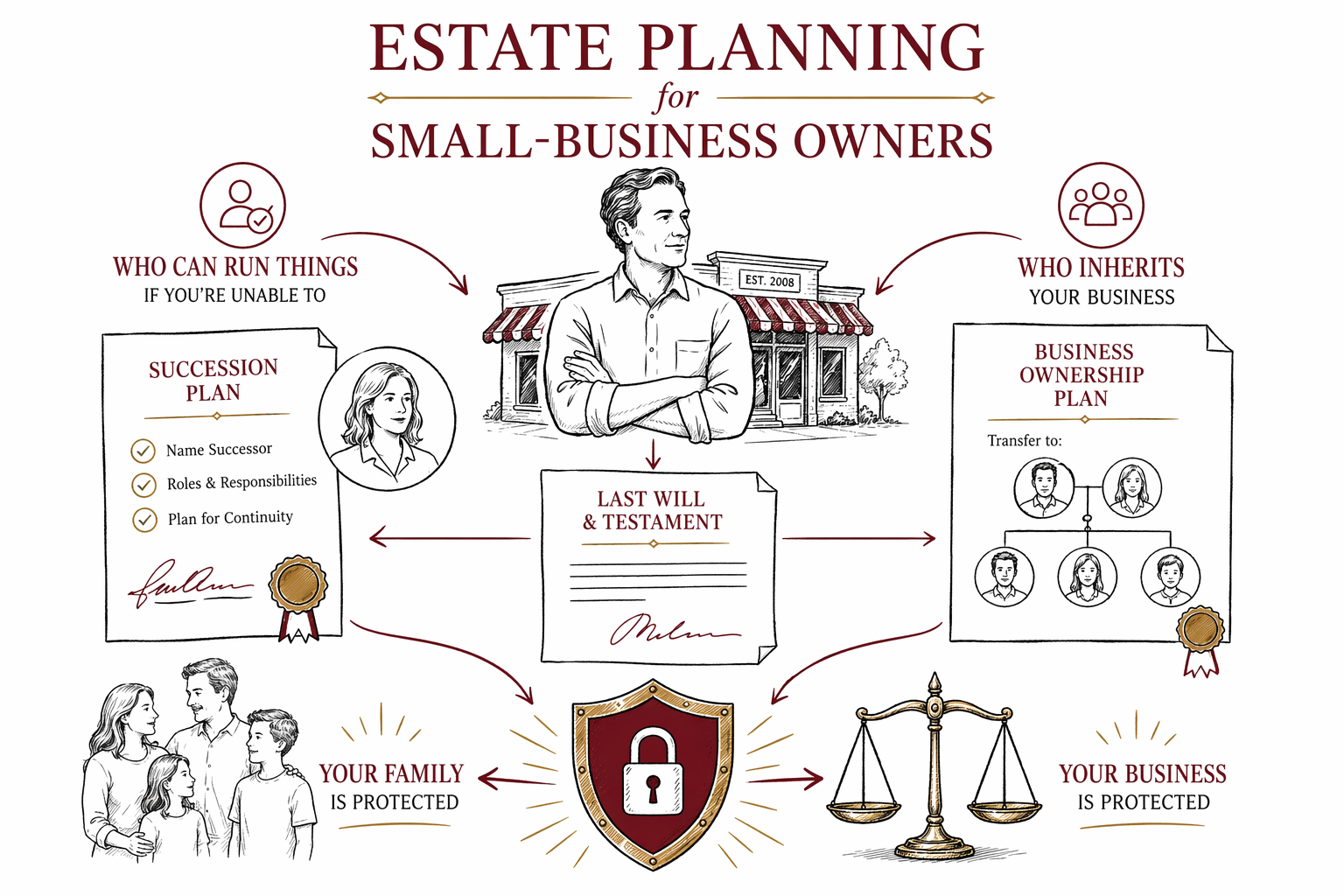
Why estate planning matters for small-business owners
Many small businesses run smoothly when the owner is available. But if you die or become unable to act, gaps in legal authority can slow decisions, confuse family members, and delay paying bills or managing contracts.
Estate planning is one way to plan ahead for “ownership and control” (who receives your business interests and when) and “day-to-day authority” (who can manage business decisions if you’re incapacitated). Rules can be very state-specific, so it’s best to speak with a licensed estate planning attorney in your state.
WillArbor is a FREE matching service, not a law firm. We help you connect with a licensed estate planning attorney near you based on your goals and preferred language.
Key planning goals (keep it simple)
Most business-owner estate plans focus on a few practical goals:
1) Continuity: Who can step in to manage the business if you can’t?
2) Ownership: What happens to your business interest (shares, membership, sole proprietorship assets) after death?
3) Decisions: How will major choices be made, and when?
4) Family protection: How do you reduce stress and confusion for your spouse, kids, or partners?
Because estate and probate laws vary by state—and so do business entity rules—the right plan can look different for every owner.
Documents to consider (and what they usually do)
Estate planning for small-business owners often includes a mix of personal documents (for you and your family) and business-related decisions (for who controls your interest). Your attorney will tailor this to your situation and state.
Here are common building blocks:
1. Will: A will can name who receives your property at death, including how your ownership interest should be distributed (where applicable).
2. Trust (often a living trust): A trust may help with smoother management and transfer of assets, depending on your state and how your assets are titled or held. In some families, trusts also help with incapacity planning.
3. Durable power of attorney (POA): This is commonly used to let a trusted person handle legal/financial decisions if you are incapacitated. For business owners, the details of authority matter.
4. Healthcare advance directive (living will) + healthcare POA: These cover medical decision preferences and who can communicate with clinicians. They’re separate from business control, but still important for the “incapacity” part of planning.
5. Business succession planning tools: Some business structures and agreements use separate documents (for example, buy-sell concepts between owners). Your estate plan and your business documents should work together—not conflict.
Important: A “will alone” may not cover everything if the goal is to keep the business running immediately during incapacity. A licensed attorney can help you map what you need in your state.
- Pitfall to avoid: relying on online DIY forms that may not work in your state (or may not address your business concerns).
- Pitfall to avoid: having a plan, but failing to update it when ownership or your family situation changes.
Common situations for small-business owners
Different business owners need different answers. Some common “situation pages” within estate planning include:
- New to the US or unfamiliar with US legal terms: You may want a plan translated in plain language, and a clear explanation of who to contact when something happens.
- Parents with young children: If your business is part of your family’s safety net, you may need coordination between guardianship decisions and how business interests pass to the next generation.
- Blended families: Family dynamics can get complicated. Clear instructions help reduce the risk of disputes and misunderstandings.
- Partners or co-owners: If more than one person owns the business, your plan should consider who has authority and how ownership transitions if one owner dies or becomes incapacitated.
If you share your goals with an attorney—especially how you want authority and ownership to work—you’ll usually get a clearer roadmap.
What it can cost (flat-fee ranges) and what affects price
Estate planning for business owners often costs more than a basic personal plan because it may involve additional documents and more coordination between your personal situation and your business interests.
Most estate planning work is quoted as a FLAT FEE (not hourly), but the real number depends on things like:
- Which documents you choose (will only vs. will + trust + POAs, etc.)
- Complexity (family situation, multiple owners/partners, special asset considerations)
- State rules and required formalities
- Whether updates are needed for existing estate documents
As a general budgeting guide, some common flat-fee ranges for a more complete estate plan often fall into these broad categories (not a quote):
- Basic plan (for example, a will and common POAs): often lower than more complex plans
- Comprehensive plan (for example, will + trust + POAs + advance directives, plus coordination): often higher
Because ranges vary widely by state and scope, WillArbor can help you find attorneys who will confirm their specific FLAT FEE in writing after you discuss your needs. Ranges are not promises of final cost.
How to find a licensed estate planning attorney (and what to ask)
Start by finding a licensed estate planning attorney in your state. Confirm they are in good standing and licensed to practice there. If you prefer, choose an attorney who can communicate in your preferred language.
When you talk with an attorney, consider asking:
- “How should my incapacitation be handled so the business can keep moving?”
- “How will my business interest pass to my chosen people at death?”
- “Will you review my existing documents and update what needs updating?”
- “What documents do you recommend for my goals, and what are the flat-fee options?”
- “What is included in the flat-fee work, and what happens if changes are needed?”
If you don’t already have documents, that’s okay—your attorney can guide you. If you already have documents, updating them can be just as important as creating new ones.
You can use get matched with WillArbor for FREE. We collect only contact details, your state, and your planning intent (for example, continuity, ownership transfer, incapacity planning). We do not collect asset values, account numbers, SSNs, or document contents.
Estate planning for a small-business owner helps you name who can run things if you’re unable to, and who inherits your business—so the business (and your family) are protected with a clear plan.
Common questions
Do I need a trust, or is a will enough for my business?
A will can be important, but it may not fully address “incapacity” or immediate authority to manage business decisions. Whether a trust is helpful depends on your state, how your business interests are held, and your goals. A licensed estate planning attorney can explain the practical differences for your situation.
If my business is a sole proprietorship, how does that change estate planning?
Ownership and transfer may be simpler than for corporations or LLCs, but you still need plans for incapacity, business continuation, and how your family will handle ongoing operations. The right approach varies by state and by what “business assets” you own.
Can the same person handle both my medical decisions and my business decisions?
Sometimes yes, but those powers usually come from different documents. Healthcare authority typically comes from a healthcare advance directive/healthcare POA, while business or financial authority comes from legal/financial POAs or business-specific provisions. Your attorney can help you align them.
What if my business partner and I disagree about succession?
Partner disagreements are common, and estate planning often has to coordinate with existing business agreements (like buy-sell concepts or operating agreements). A licensed attorney can help you review what documents control and how to reduce uncertainty.
I already have estate documents—do I still need to talk to an attorney?
Many owners benefit from a review, especially after major life changes (new partner, divorce, children, changes in ownership, moving states, or updating beneficiary decisions). Document updates can prevent avoidable problems later. Your attorney can tell you what’s outdated and what should be revised.
WillArbor is a law firm that prepares my documents?
No. WillArbor is a FREE matching service. We help you connect with a licensed estate planning attorney, but we do not draft documents or provide legal advice. You stay in control of hiring and you should confirm the attorney’s flat fee in writing before any work starts.
Related help
Guardians, a will, and a simple plan so your children are cared for if something happens to you.
Open → Estate Planning for HomeownersHow to keep your home out of probate and pass it to the people you choose.
Open → Estate Planning for Blended FamiliesPlans that protect a current spouse and children from a previous relationship — fairly and clearly.
Open →