Guides
What is an advance healthcare directive?
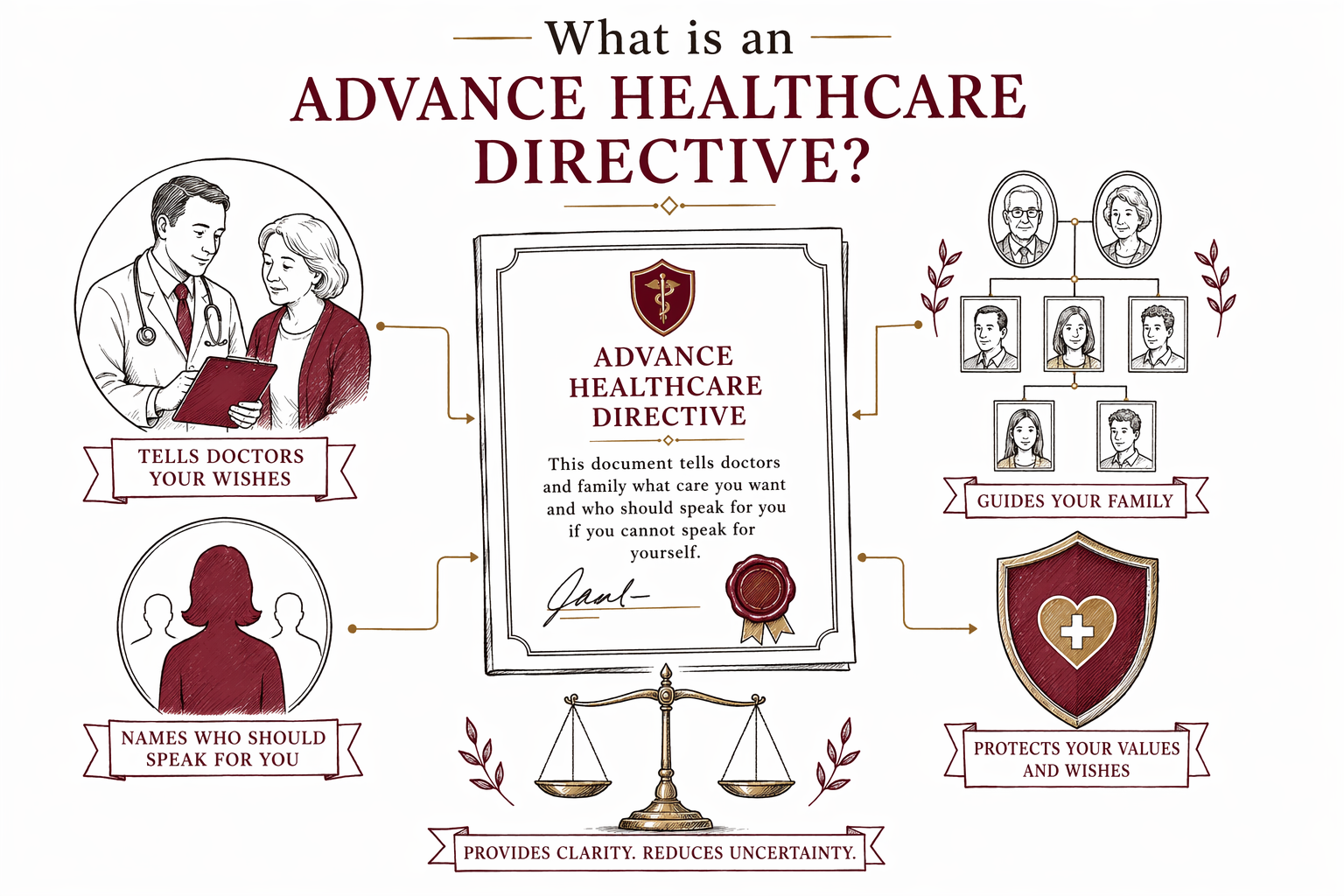
An advance healthcare directive is a legal document that says what medical care you want if you cannot speak for yourself, and often names someone to speak for you. The exact form and rules vary by state.
What it means in plain language
An advance healthcare directive is a written plan for medical decisions if you are too sick or injured to communicate. It helps your family and doctors understand your wishes during a hard moment.
In many states, this document includes two parts: instructions about the care you do or do not want, and the name of a trusted person who can make healthcare decisions for you. That person is often called a healthcare agent, healthcare proxy, or medical power of attorney, depending on the state.
People sometimes call this a “living will,” but the terms are not always identical in every state. Some states use one combined form, and others separate the documents. Because rules vary by state, it is smart to use the form that works where you live and ask a licensed estate planning attorney in your state if you are unsure.
What decisions it can cover
An advance healthcare directive can describe your choices about medical treatment if you cannot decide for yourself. For example, it may address life support, breathing machines, CPR, tube feeding, pain relief, comfort care, organ donation, or who should talk with doctors on your behalf.
It can also reduce family conflict. When your wishes are written down and you have clearly named the person you trust, loved ones are less likely to argue or guess about what you would want.
This document is not mainly about money or property. It is about medical care. For financial decisions, people often use a separate power of attorney. For what happens to property after death, people usually use a will or trust. You can learn more in our guides or review planning options on our services page.
Who should have one
Almost every adult should consider an advance healthcare directive, not only older adults. A medical emergency can happen at any age. If you are 18 or older, your parents, spouse, or adult children may not automatically have clear legal authority to speak for you in every situation.
This document can be especially important if you are a parent, have a serious illness, are divorced, live with a partner, have strong wishes about end-of-life care, or want to make sure the right person makes decisions for you. It can also help families who are more comfortable in a language other than English, because clear written instructions can prevent confusion.
If you move to another state, review your documents. A form signed in one state may still be recognized elsewhere, but not always in the same way. State law matters.
Common mistakes families make
A common mistake is thinking, “My family already knows what I want.” Sometimes they do not, or they disagree under stress. A written directive gives clearer guidance.
Another mistake is naming the wrong person. Your healthcare agent should be calm under pressure, willing to speak up with doctors, and ready to follow your wishes even if others disagree. It should be someone you trust, not just the closest relative.
Other common pitfalls include using a DIY form that does not meet your state's signing rules, not updating the document after marriage, divorce, illness, or a move, and not giving copies to the people who may need it. Families also sometimes create a full estate plan but forget to include healthcare documents.
More broadly, estate-planning problems often happen together: dying without a will, out-of-date beneficiary designations, DIY forms that fail in your state, an unfunded trust, or no named guardian for children. A licensed estate planning attorney can help you see the full picture.
How to make one and what it may cost
In many states, making an advance healthcare directive is not complicated, but the form and signing requirements matter. Some states require witnesses, some require a notary, and some have special rules for who may serve as a witness.
- Think about your wishes for serious illness, life support, pain care, and who should speak for you.
- Choose a trusted healthcare agent and at least one backup.
- Use the correct form for your state.
- Sign it the way your state requires.
- Give copies to your agent, backup agent, doctors, and close family.
- Review it after major life changes.
If you hire an attorney, this document is often included in a larger estate plan quoted as a flat fee, not hourly. Very general ranges: a standalone healthcare directive may be around $100 to $500 through an attorney in some states, while a basic estate plan that includes a will, financial power of attorney, and healthcare documents may be roughly $600 to $2,500 or more. More complex plans, trusts, blended families, business interests, or special planning needs can increase the flat fee. These are not quotes, and the real number depends on the documents, complexity, and your state.
How WillArbor can help
WillArbor is a free matching service for families looking for estate planning help. We are not a law firm, not a lawyer, and do not draft documents or create an attorney-client relationship.
If you want help, we can connect you with a licensed estate planning attorney in your state. You stay in control: compare your options, choose who to hire, and confirm the flat fee in writing before any work starts. It is always free for the family to use WillArbor.
We only collect basic contact information and planning intent: your name, phone, optional email, state, what you want to plan, and preferred language. We do not ask for asset values, account numbers, Social Security numbers, income, or the contents of your documents. If you are ready, you can get matched for free.
An advance healthcare directive tells doctors and family what care you want and who should speak for you if you cannot speak for yourself.
Common questions
Is an advance healthcare directive the same as a living will?
Sometimes people use those terms to mean the same thing, but not always. In some states a living will is one part of an advance healthcare directive, while in others one form covers both instructions and your healthcare agent.
Who should I choose as my healthcare agent?
Choose someone you trust to stay calm, talk with doctors, and follow your wishes. It should be a person who can handle stress and may be available quickly in an emergency.
Do young adults need this document too?
Yes, many do. Once someone is an adult, family members may not automatically have clear authority to make medical decisions for them, so having this document can help at any age.
Does this document cover money or paying bills?
Usually no. An advance healthcare directive is about medical decisions; financial matters are usually covered by a separate financial power of attorney.
Can I just use a free form online?
Maybe, but it needs to meet your state's current rules. A common pitfall is using a DIY form that is outdated or signed incorrectly, which can create problems when the document is needed most.
How often should I update it?
Review it after major life changes like marriage, divorce, a serious diagnosis, a move to another state, or a change in the person you trust. Even without big changes, it is wise to check it every few years.
How do I find the right attorney?
Look for a licensed estate planning attorney in your state and confirm the attorney's bar license. WillArbor can help you get matched for free, but we are a matching service, not a law firm or your lawyer.
Related help
The difference between a will and a living trust, when each makes sense, and why many families use both.
Open → How to Avoid ProbatePlain-language ways families reduce or avoid probate — trusts, beneficiary designations, and joint ownership.
Open → What Happens If You Die Without a WillIntestacy explained: how your state decides who inherits when there is no will — and why that may not match your wishes.
Open →