Guides
What is a tod deed?
A TOD deed is a deed that may let a house pass directly to a named person when the owner dies, without probate. It is a useful tool in some states, but the rules vary by state and it is not right for every family.
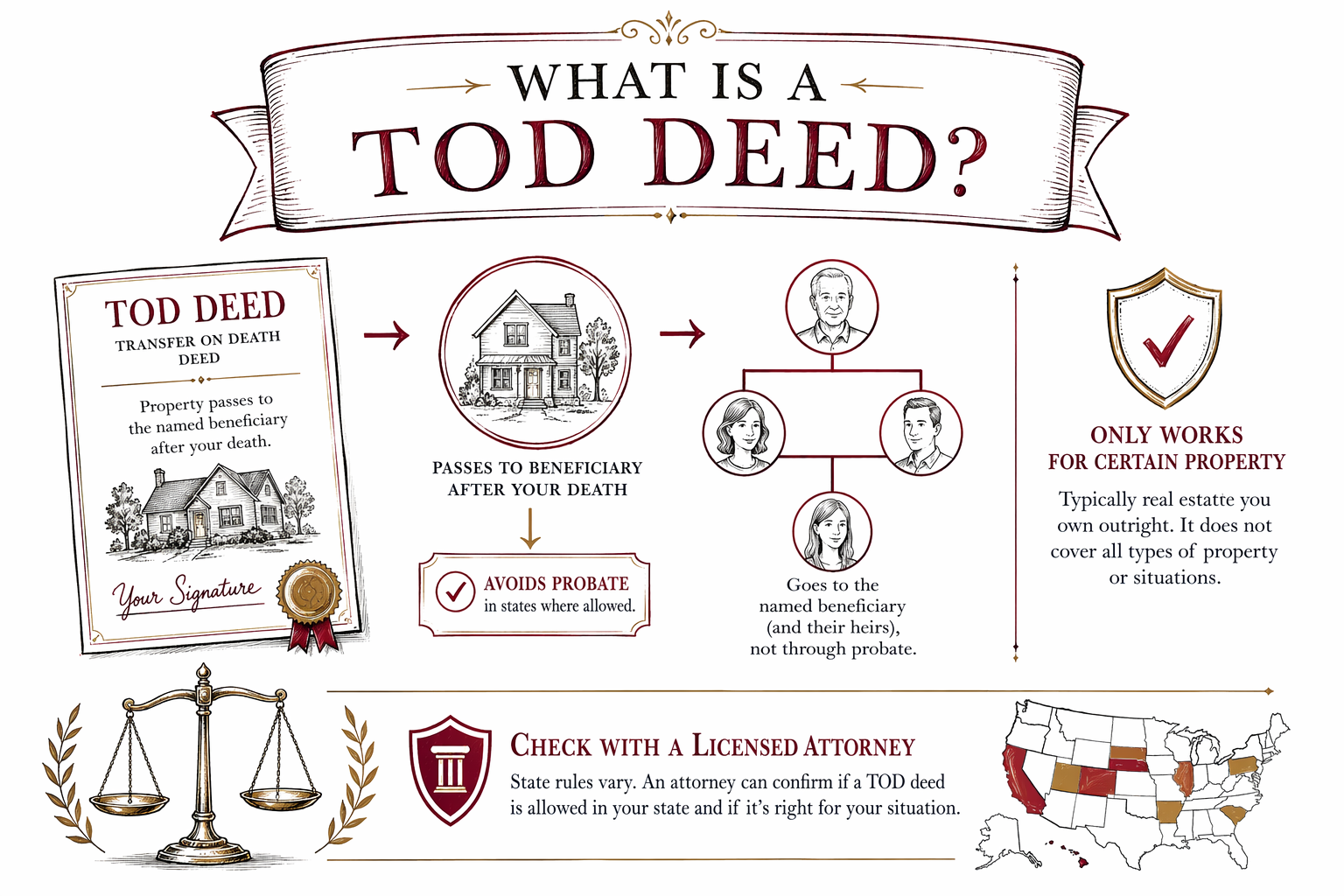
What a TOD deed does
A TOD deed means “transfer on death” deed. In simple terms, it lets the owner name a person who should receive the home after death, while the owner stays in control during life.
Usually, the owner can still live in the home, sell it, or change the deed if the law in that state allows it. The transfer happens later, after death, if the deed was done correctly and the state recognizes this kind of deed.
This can help families avoid probate for that one property. But it does not replace a full estate plan, and it does not automatically cover bank accounts, cars, guardians for children, or other property.
When a TOD deed may be useful
A TOD deed can be a simple way to pass a house to one or more chosen people without making them wait for probate court. For some families, that can save time, reduce paperwork, and make the transfer easier.
It may be especially helpful when the main goal is to pass a home to an adult child, spouse, or other trusted person, and the owner does not need a trust. It can also be a practical option for people who want a narrow, house-only plan.
But it is not the same as a will or trust. If you want to name guardians for minor children, control how several assets are handled, or plan for someone with special needs, a TOD deed by itself is usually not enough.
Common pitfalls to know about
A TOD deed can create problems if it is used without a bigger plan. One common mistake is assuming it controls everything you own. It usually affects only the property named in the deed.
Another common pitfall is an out-of-date plan. If the named beneficiary dies first, moves away, gets divorced, or the family changes, the deed may no longer match your wishes. Some states also have special signing, recording, witness, or notarization rules that must be followed exactly.
Other common estate-planning problems still matter:
- dying without a will, which can leave state intestacy rules in charge
- outdated beneficiary designations on accounts and insurance
- DIY forms that do not work in your state
- an unfunded trust, where the trust exists but the home was never put into it
- no named guardian for children
How a TOD deed compares with a will or trust
A will says who should inherit and can name a guardian for minor children, but a will often goes through probate. A trust can help manage more than one asset and may avoid probate for assets that are properly moved into the trust.
A TOD deed is narrower. It is usually only for real estate and only works in states that allow it. It can be a good fit for some families, but it does not solve every planning need.
If you are unsure whether a TOD deed, a will, a trust, or a mix of tools is best, a licensed estate planning attorney in your state can explain the choices in plain words. WillArbor is a free matching service, not a law firm, not a lawyer, and not your lawyer.
What to do next
If you are thinking about a TOD deed, start with the basics:
- Check whether your state allows TOD deeds for your type of property.
- Make sure the deed matches the exact state rules for signing and recording.
- Review who you want to receive the home and whether that person should share the property with anyone else.
- Look at the rest of your estate plan so the home transfer does not conflict with your will, trust, or beneficiary forms.
- Get a licensed estate planning attorney to review the plan before you rely on it.
Most estate planning is handled for a flat fee, not hourly, but the real cost depends on the documents you need, the complexity of your family situation, and your state. A simple review may cost less than a full plan; a more complete plan may cost more. Those ranges are not quotes.
You can read more guides, learn about our free matching service, or get matched with a licensed estate planning attorney near you. You stay in control and choose whether to hire.
A TOD deed can pass a home to someone after death without probate in some states, but it only works for certain property and should be checked by a licensed attorney because state rules vary.
Common questions
Does a TOD deed avoid probate?
It may help the named home transfer outside probate in states that allow TOD deeds, if the deed was done correctly. But it only applies to that property, and the rest of the estate may still need probate.
Can I use a TOD deed instead of a will?
Usually no. A TOD deed only deals with the property covered by the deed, while a will can cover broader instructions and can name guardians for children. Many families need both or need a trust instead.
Is a TOD deed available in every state?
No. Rules vary by state, and not every state uses the same kind of transfer-on-death deed. A local estate planning attorney can tell you what is allowed where you live.
What information does WillArbor collect?
We collect only contact and planning intent information, like name, phone, optional email, state, what you want to plan, and preferred language. We do not collect asset values, account numbers, SSNs, or document contents.
Related help
The difference between a will and a living trust, when each makes sense, and why many families use both.
Open → How to Avoid ProbatePlain-language ways families reduce or avoid probate — trusts, beneficiary designations, and joint ownership.
Open → What Happens If You Die Without a WillIntestacy explained: how your state decides who inherits when there is no will — and why that may not match your wishes.
Open →