Guides
What is a codicil?
A codicil is a short legal document used to change an existing will instead of writing a whole new one. It can work for small updates, but whether it is valid depends on state law and how much has changed.
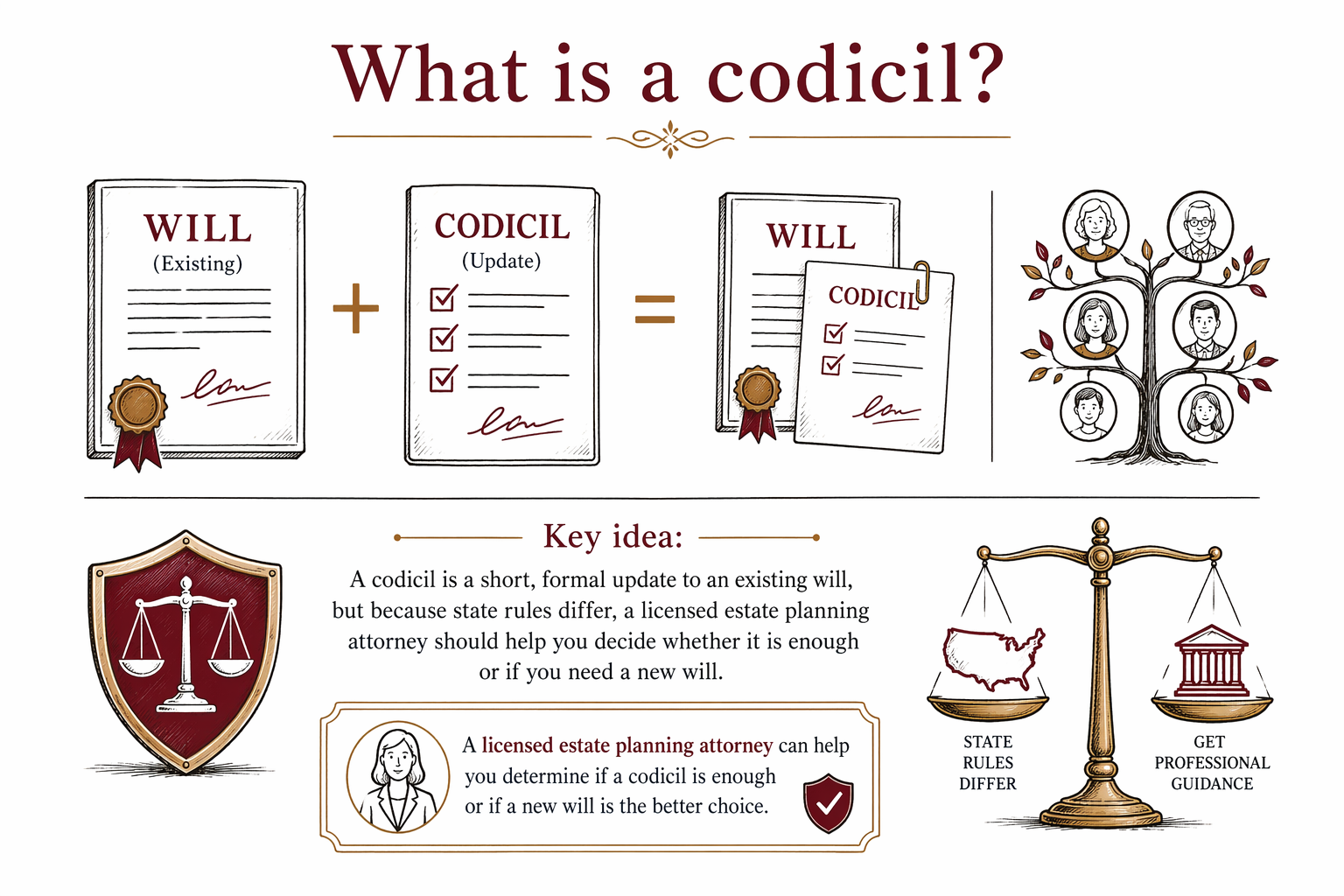
What a codicil does
A codicil is an amendment to a will. People use it to make a limited change, such as updating a guardian choice, changing an executor, or fixing a name after marriage or divorce.
It does not replace the original will. The codicil and the will are read together, so both documents matter.
If the change is simple and the will is still otherwise up to date, a codicil may be enough. If several things need to change, many families choose to sign a new will instead.
Estate-planning rules vary by state, so a codicil that is valid in one state may not work the same way in another.
When a codicil may be a good fit
A codicil is often used when the change is small and clear. For example, a parent may want to change one gift, name a new backup executor, or update a beneficiary description in the will.
It can be less expensive and faster than rewriting the whole will, but only if the original document is still a good fit.
A licensed estate planning attorney can help you decide whether a codicil or a new will is safer for your situation. WillArbor is a free matching service, not a law firm, and does not draft documents or give legal advice.
- Best for a small update to an otherwise current will
- May be simpler than signing a brand-new will
- Should be reviewed carefully so it does not conflict with the original will
When a new will is usually better
If the family situation has changed a lot, a codicil can become confusing. That can happen after marriage, divorce, a birth, a death, a move to another state, or several changes to beneficiaries or guardians.
A new will is often cleaner when the changes are more than minor. It helps reduce the risk that someone reads the old will and the codicil differently.
One common pitfall is relying on a DIY form that does not match your state’s signing rules. Another is forgetting to update beneficiary designations on accounts, which can override what the will says in some cases.
- Multiple changes to the will
- Major life events or a move to a different state
- Conflicting or outdated instructions in older papers
Common mistakes families run into
A codicil must usually be signed and witnessed with the same care as the will, and the exact rules vary by state. If the signing is done wrong, the change may not count.
Another problem is keeping the codicil in a separate place from the will, so family members cannot find both documents later. It is also easy to forget that an unfunded trust, no named guardian, or outdated beneficiary forms can still cause problems even when a will is updated.
If you are settling a parent’s estate, a codicil may also matter during probate because the court may need to see the full set of documents.
- Dying without a valid will can lead to intestacy
- Out-of-date beneficiary forms can override the will
- DIY changes that do not follow state rules may fail
How to get help without pressure
If you are not sure whether a codicil makes sense, speak with a licensed estate planning attorney in your state and ask for the flat fee in writing before any work starts. Most estate planning is priced as a flat fee, not hourly, but the exact amount depends on the documents, complexity, and state.
For many families, a simple codicil may cost less than a full plan, while a new will or a trust-based plan may cost more. Those are only general ranges, not quotes.
WillArbor can help you get matched for free with a licensed estate planning attorney near you. You share only contact and planning intent — like your name, phone, optional email, state, what you want to plan, and your preferred language — and you stay in control of who you hire. Start at get matched or learn more in our guides.
What to have ready before you talk to an attorney
You do not need to gather financial records to ask the first question. Keep it simple and focus on what changed.
- Bring the current will, if you have it.
- Write down what you want to change and why.
- Note your state and any recent move.
- List any major life events, like marriage, divorce, a birth, or a death.
- Be ready to say whether you want a small update or a full review.
That is usually enough for a first conversation about whether a codicil or a new will is the better path.
A codicil is a short, formal update to an existing will, but because state rules differ, a licensed estate planning attorney should help you decide whether it is enough or if you need a new will.
Common questions
Is a codicil the same as a new will?
No. A codicil changes an existing will, while a new will replaces the old one. If the changes are bigger, many families use a new will to keep things clear.
Do I need a lawyer for a codicil?
You do not always need one, but it is wise to have a licensed estate planning attorney review it. State rules differ, and a small mistake can make the change ineffective.
Can I just handwrite the change on my will?
Usually that is risky. Handwritten changes may not be valid, especially if they are not signed and witnessed the way your state requires.
How does WillArbor help?
WillArbor is a free matching service, not a law firm. We help you connect with a licensed estate planning attorney near you; you compare options, choose who to hire, and confirm the flat fee in writing before work starts.
Related help
The difference between a will and a living trust, when each makes sense, and why many families use both.
Open → How to Avoid ProbatePlain-language ways families reduce or avoid probate — trusts, beneficiary designations, and joint ownership.
Open → What Happens If You Die Without a WillIntestacy explained: how your state decides who inherits when there is no will — and why that may not match your wishes.
Open →