Guides
Estate Planning for New Arrivals to the US
If you are new to the United States, estate planning is the process of deciding who should care for your children, who should receive your property, and who can act for you if you cannot. The basic ideas are simple, but the rules vary by state, so a licensed attorney should review your plan.
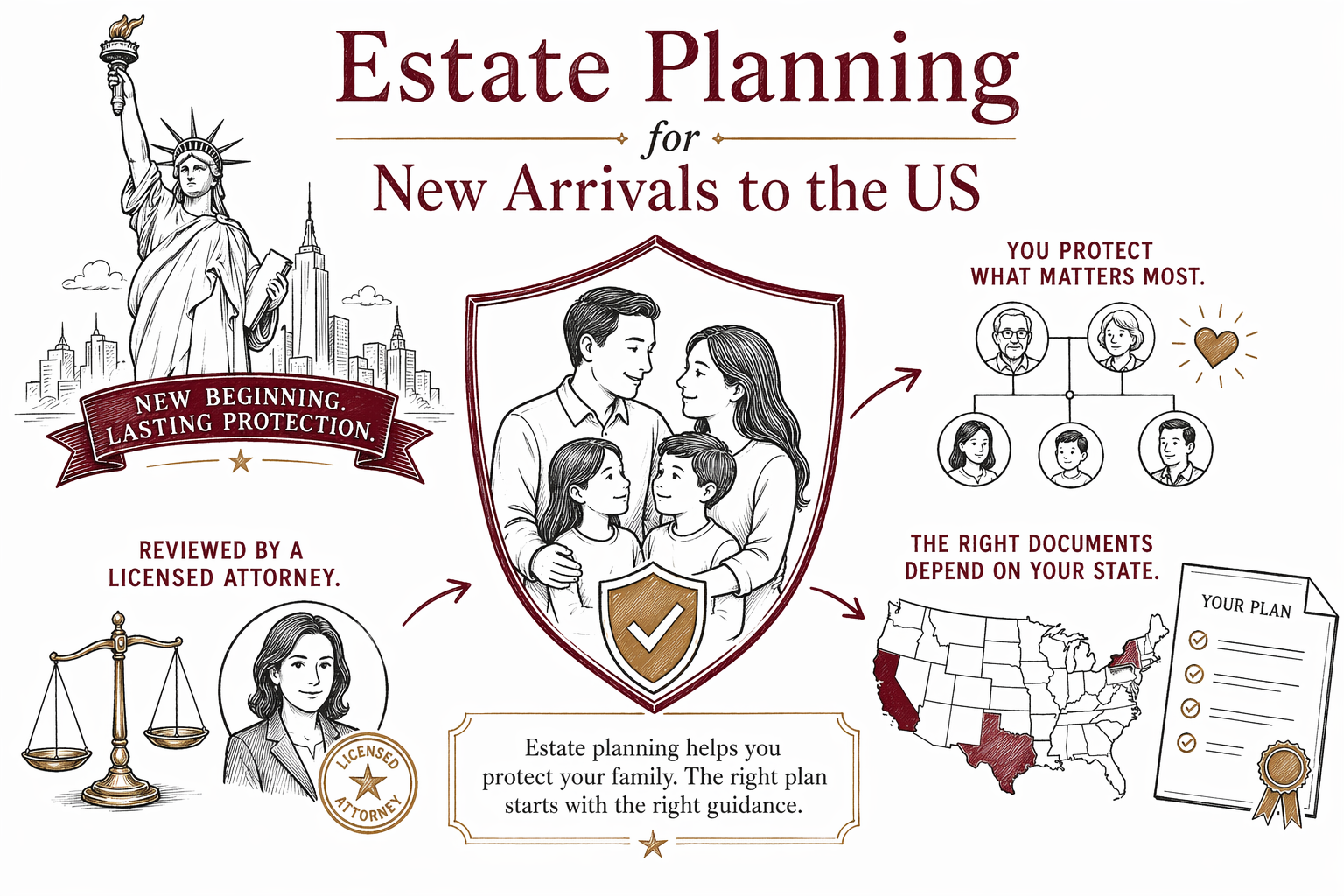
What estate planning means when you are new to the US
Estate planning is not only for wealthy families. It is for anyone who wants to make things clearer for loved ones and avoid confusion later.
If you move to the US, you may have property here, property in another country, children, a spouse, or parents who depend on you. A good plan can say who inherits, who can make medical or money decisions if you are sick, and who can take care of minor children.
WillArbor is a free matching service, not a law firm, not a lawyer, and it does not draft documents. We help you connect with a licensed estate planning attorney near you so you can get state-specific advice.
- Name guardians for children, if needed
- Choose who gets your property
- Plan for illness or incapacity
- Reduce the chance of probate problems after death
The main documents families usually hear about
A will says who gets your property after you die and, if you have minor children, who you want to care for them. A living trust can help some families keep certain assets out of probate, but it only works if it is set up and funded correctly.
A power of attorney lets someone help with financial matters if you cannot. An advance directive, sometimes called a living will, explains your medical wishes and can name someone to speak for you about health care.
These documents are common, but the right combination depends on your state, your family, and what you own. A family in one state may use a different plan than a family in another state.
- Will: who inherits, and often guardian nominations for children
- Trust: can help manage assets and may avoid probate for funded assets
- Power of attorney: financial decisions if you are unable to act
- Advance directive: medical wishes and health-care decision maker
Common issues for new arrivals
One common pitfall is assuming a plan from another country will work the same way here. It might not. US estate rules vary by state, and a document that is valid in one place may not do what you expect in another.
Another common problem is outdated beneficiary forms on life insurance, retirement accounts, or bank accounts. Those forms can control where money goes, sometimes even if a will says something different.
Families also run into trouble with DIY forms that do not meet state requirements, a trust that was never funded, or no named guardian for children. If you are helping a parent settle an estate, missing paperwork can slow everything down.
- Out-of-date beneficiary designations
- DIY forms that do not meet state rules
- An unfunded trust
- No named guardian for minor children
If you own property here and abroad
Many new arrivals have money, a home, or family ties in more than one country. That can make planning more complicated, because different countries may have different inheritance rules, probate systems, and document rules.
A US attorney can help you understand what should be handled in the United States and what may need separate planning elsewhere. They can also tell you whether a will, a trust, or another approach fits your situation.
This is one reason to get state-specific legal help instead of relying only on general online forms. The right answer depends on where you live, where the property is, and what you want to happen.
- A US plan may not control everything you own abroad
- Foreign property can require separate review
- Cross-border families should get advice before signing forms
How WillArbor helps, and what to expect
You share only contact information and your planning intent, such as whether you need a will, trust, power of attorney, advance directive, or help with probate. We do not ask for asset values, account numbers, document contents, SSNs, income, or other sensitive estate details.
We then match you with a licensed estate planning attorney near you. You stay in control: you compare attorneys, choose who to hire, and confirm the flat fee in writing before any work begins. Most estate planning is quoted as a flat fee, not hourly, but the real number depends on the documents, complexity, and state. Any price range you hear is not a quote.
Participating attorneys pay a flat fee to take part in the service. It is free for the family.
- Free matching service for families
- Choose the attorney you want to hire
- Confirm the flat fee in writing before work starts
- Check the attorney’s bar license in your state
What to do next
If you are new to the US, a simple first step is to think about three things: who should care for your children, who should handle money or medical decisions if you cannot, and who should receive your property.
Then gather only basic planning information: your name, phone, optional email, state, what you want to plan, and your preferred language. That is enough to start a conversation with a licensed attorney.
If you want a clear next step, you can use our guide hub, learn about estate planning services, or get matched with a licensed estate planning attorney near you.
- Think about guardians, decision-makers, and beneficiaries
- Avoid relying on old forms or out-of-state documents
- Get state-specific advice before you sign anything
If you are new to the US, estate planning helps you protect your family, but the right documents depend on your state and should be reviewed by a licensed attorney.
Common questions
Do I need estate planning if I just moved to the United States?
Often, yes. If you have children, a spouse, property, or accounts, even a simple plan can help your family avoid confusion and delays. Because rules vary by state, a licensed attorney should review what fits your situation.
Will a will from my home country work here?
Not always. Some documents may not meet US state requirements or may not do what you expect with US assets, beneficiary forms, or guardianship. It is safest to have a licensed attorney in your state review it.
What is the biggest mistake new arrivals make?
A common mistake is assuming old beneficiary forms, DIY templates, or an unfunded trust will solve everything. Another is not naming a guardian for minor children. These issues can create delays and family conflict.
How much does estate planning usually cost?
Most estate planning is quoted as a flat fee, not hourly. The real fee depends on the documents, the complexity, and the state, so any range is only a general estimate, not a quote. A licensed attorney can explain the fee in writing before you decide.
Related help
The difference between a will and a living trust, when each makes sense, and why many families use both.
Open → How to Avoid ProbatePlain-language ways families reduce or avoid probate — trusts, beneficiary designations, and joint ownership.
Open → What Happens If You Die Without a WillIntestacy explained: how your state decides who inherits when there is no will — and why that may not match your wishes.
Open →