How we've helped
A homeowner sets up a trust to spare the family probate
Below is an anonymized, illustrative story about how one homeowner learned what options fit their family and worked with a licensed estate planning attorney. It’s educational—not legal advice—and rules vary by state.
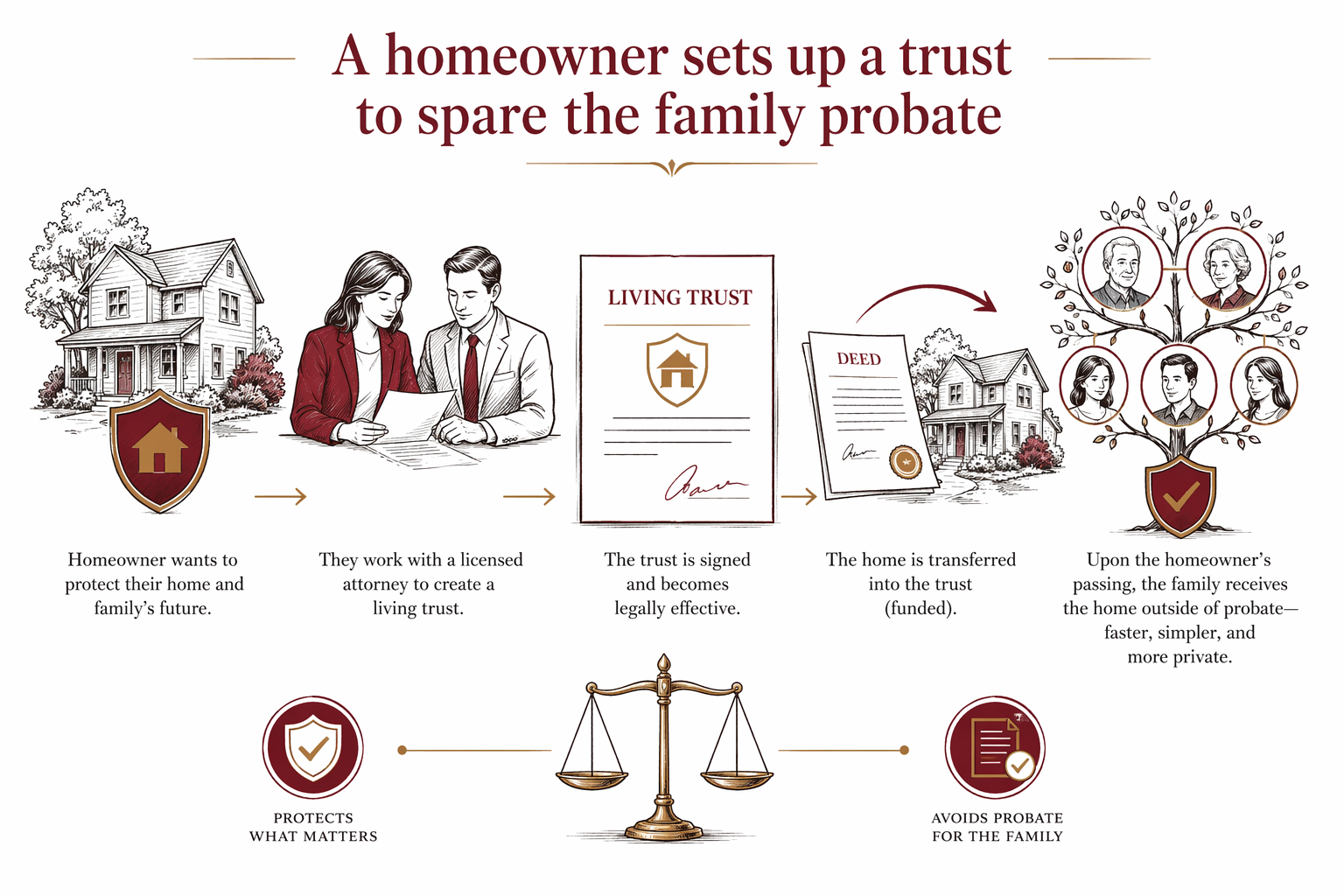
An illustrative story: a trust to help avoid probate
This is an ANONYMIZED, ILLUSTRATIVE story. It is not about a real named client, and it does not predict results for any specific person. Estate planning rules and probate procedures vary by state.
In this story, a homeowner wanted to make things easier for their family after they passed away. They were especially worried about delays, paperwork, and having the family deal with court when inheriting the house.
They had heard that a “trust” can sometimes help keep certain assets out of probate. But they also knew that not every situation is the same—and that even a trust has details that must be done correctly for it to work the way people expect.
How they figured out what they needed
Before they contacted an attorney, the homeowner listed a few needs in plain language: protect their spouse/partner, make sure the home went to the right people, and reduce the family’s burden after a death.
They also learned the difference between a will and a living trust in simple terms:
- A will generally tells the court how to handle your property and who should receive it at death.
- A living trust can hold property during life and, depending on how it’s set up, can help move ownership after death without going through probate for that property.
Their main takeaway was careful: a trust is not automatically “magic.” If the trust is created but nothing is properly moved into it, the house may still go through probate.
Getting matched with a licensed attorney (free for the family)
The homeowner used WillArbor to get connected with a licensed estate planning attorney near them. WillArbor is a FREE matching service—not a law firm, and not your lawyer. We collect contact and planning intent only (for example: your state and what you want to plan), and we do not ask for sensitive details like account numbers or asset values.
After the match, the homeowner chose whether to proceed. They asked questions in their own pace and made sure they understood what documents were being considered and why.
Confirming a flat fee before any work begins
The homeowner was relieved when the attorney discussed costs clearly. Many estate planning matters are quoted as a FLAT FEE (not hourly), but the actual price depends on the documents, the complexity, and the state.
They confirmed the flat fee in writing before any work started. They also learned to expect that the final package could be more than one document—for example, a living trust plus related paperwork such as powers of attorney and advance directives. The homeowner knew they should not rely on a range alone; a range is not a quote.
General flat-fee ranges for a typical living trust plan can vary widely by state and complexity. As an educational guideline, you might see amounts such as:
- Roughly $1,500–$3,500 for a more straightforward living trust setup in some states
- Roughly $3,000–$6,000+ where more complexity is involved (for example, multiple scenarios, additional documents, or more involved coordination)
These are broad educational ranges, not promises or quotes. The attorney’s written confirmation is what matters.
What “moving the house into the trust” really means
Once the homeowner decided to proceed, the attorney explained the practical steps needed for the plan to work as intended. A living trust is usually not just a form—it’s also a process.
For the house, the key concept was “funding” the trust: putting the property into the trust so that the trust can handle it according to the plan. The attorney explained that steps may include re-titling the deed or other changes, depending on state rules.
In simple terms, the family focused on outcomes they could understand:
- The house should be titled in a way that matches the trust plan.
- The trust should name the right people (and backups, if needed).
- Other essential documents should be in place so the family isn’t left scrambling.
They also avoided a common pitfall: assuming that creating a trust automatically takes care of everything. They treated the “funding” step as equally important as the trust documents themselves.
How the family protected their wishes
After the work was completed, the homeowner took time to review what was prepared and to understand how it would work. They confirmed that the named beneficiaries and directions matched their intentions.
They also made a plan to keep things current. Estate planning often needs updates when life changes—such as marriage, divorce, a child’s needs changing, moving to a new state, or changes in who should inherit.
A final comfort for the family: they weren’t guessing. They had a clear plan, made with a licensed estate planning attorney, and they knew the next steps to keep it working over time.
If you’re worried about probate, you don’t have to figure everything out alone. Consider getting matched for a conversation with a licensed estate planning attorney and confirming the FLAT FEE in writing.
In this illustrative story, a homeowner worked with a licensed attorney to set up and fund a living trust so the family could be less likely to face probate for the home.
Common questions
Does a living trust guarantee my family won’t have probate?
Not always. Whether probate happens depends on state law and what property is titled in the trust versus outside it, plus other factors. A licensed estate planning attorney in your state can explain what is realistic for your situation.
What does it mean to “fund” a trust?
Funding means transferring or retitling assets so they are actually owned by the trust, consistent with the plan. If an asset isn’t properly moved, it may still go through probate.
How much does a living trust plan cost?
Flat-fee pricing is common, but it varies by state and complexity. As an educational guideline, you may see broad ranges (for example, around $1,500–$3,500 for simpler plans, and $3,000–$6,000+ for more complex situations), but these are not quotes—your attorney should confirm the actual flat fee in writing.
Is WillArbor a law firm that drafts documents?
No. WillArbor is a FREE matching service. We connect families with licensed estate planning attorneys, but we do not draft documents and we do not provide legal advice or create an attorney-client relationship.
Related help
How a couple with two small children used WillArbor to find an attorney for a will, a power of attorney, and guardian nominations.
Open → Adult children get help settling a parent's estateHow siblings found a probate attorney to settle their late mother's estate without conflict.
Open → A new arrival plans a will in their own languageHow someone new to the US found a bilingual attorney to write a will covering US and overseas wishes.
Open →