How we've helped
A new arrival plans a will in their own language
Illustrative story: how one new arrival used a free matching service to find a bilingual estate planning attorney, confirm a flat fee, and put a valid will in place with more peace of mind.
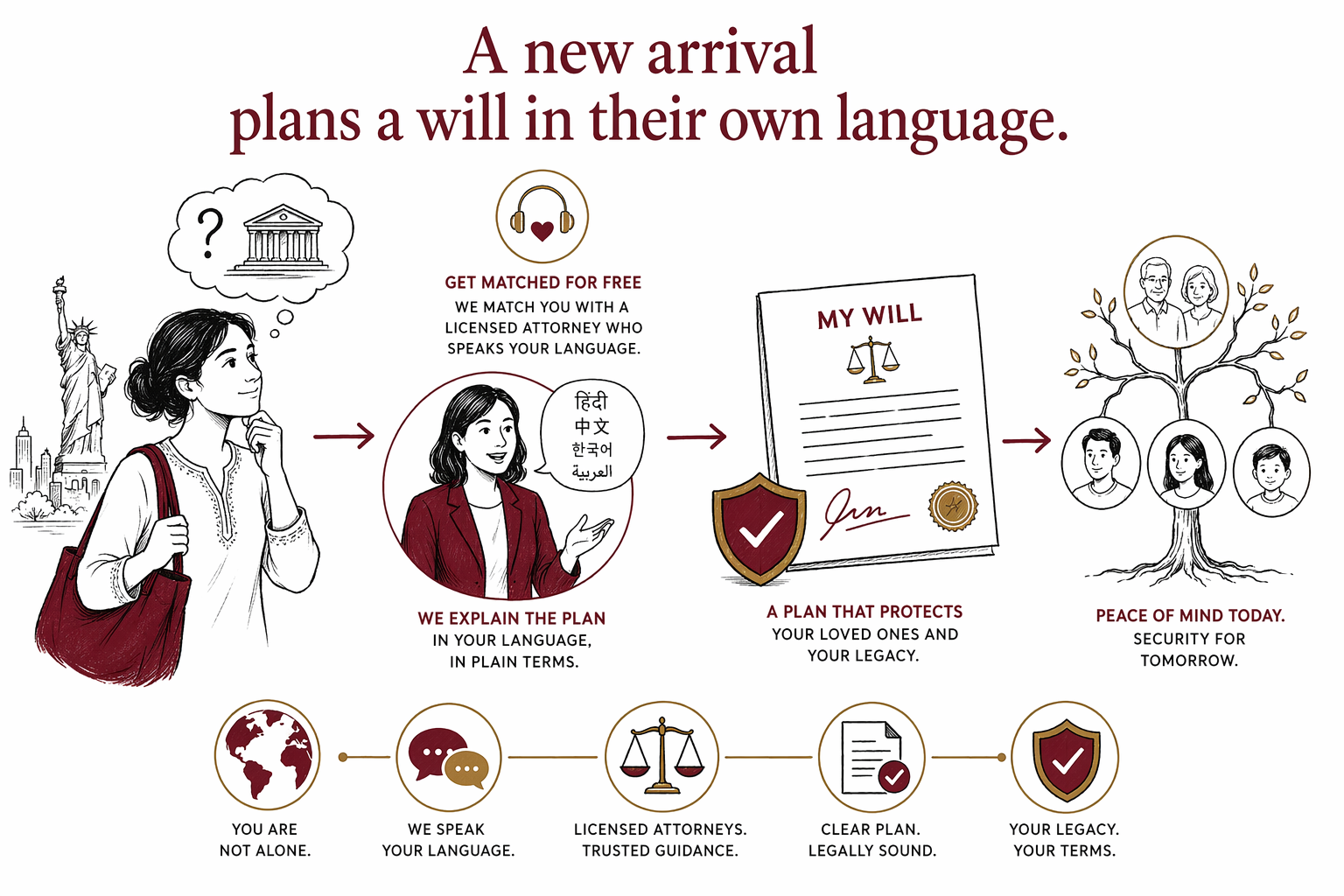
This is an illustrative story, not a real named client
The details below are anonymized and combined from common situations families face. It is meant to show how the process can work, not to describe one specific person.
WillArbor is a free matching service, not a law firm and not your lawyer. We do not draft documents or give legal advice. Estate planning rules vary by state, and families should get advice from a licensed estate planning attorney in their state.
The worry was simple: “I want my wishes understood clearly”
In this story, a parent had recently moved to the United States and felt more comfortable speaking in their first language than in English. They had children, some savings, and close family both in the US and overseas. Their biggest fear was not luxury planning or taxes. It was something more basic: if something happened, would anyone understand what they wanted?
They had heard terms like will, trust, probate, power of attorney, and living will, but the words felt heavy and unfamiliar. They also worried that an online form might miss state rules or fail because it was not signed correctly.
Like many families, they were not ready to hand over private financial details to a website. They mainly wanted help finding the right lawyer, in the right language, in the right state.
How they got matched without sharing sensitive estate details
They used WillArbor to ask for a match. The information requested was basic: name, phone number, optional email, state, what they wanted to plan, and preferred language. That was enough to help connect them with participating attorneys.
WillArbor did not ask for account numbers, asset values, Social Security numbers, income, or the contents of a draft will. That mattered to the family. They wanted to take one careful step at a time.
After that, they were connected with a licensed estate planning attorney who could speak their language and practice in their state. As with any lawyer a family may hire, they were encouraged to confirm the attorney's bar license before moving forward.
How they figured out what they actually needed
At first, they thought they only needed a will. During the consultation, the attorney explained the basics in plain language. A will can say who should inherit, who should handle the estate, and who should care for minor children. But a will does not avoid probate by itself, and probate rules vary by state.
The attorney also asked careful questions about family structure, property location, and whether any wishes involved people or assets outside the United States. That did not mean the family had to solve every international issue at once. It meant they could understand where a simple will might be enough and where more planning might be needed.
In this illustrative example, the family learned they likely needed a will first, plus a review of beneficiary designations and possibly powers of attorney and advance directives later. They also learned about common problems: dying without a will, no named guardian, old beneficiary forms that do not match the plan, and DIY documents that do not meet state rules.
They asked about cost early and got the flat fee in writing
One of their first questions was cost. That was the right question to ask. Most estate planning work is quoted as a flat fee, not hourly, but the real number depends on the state, the documents, and how complex the situation is.
For a simple will package, families often see ranges such as about $300 to $1,000+ in some states. A will package for a couple, or one that includes powers of attorney and advance directives, may be higher. If the plan involves blended families, minor children, overseas issues, business interests, or a trust, the cost can rise further. These are general educational ranges, not quotes.
In the story, the attorney explained the scope of work and the flat fee before any work started. The family compared their options, chose who to hire, and asked for the fee and documents included to be confirmed in writing. That gave them clarity and control.
What happened next, step by step
The process felt less scary once it was broken into steps:
- They asked for a free match through WillArbor.
- They spoke with a licensed estate planning attorney in their preferred language.
- They confirmed the lawyer's state bar license and asked what documents were recommended.
- They reviewed the flat fee, what was included, and any extra charges that might apply.
- They gathered basic family information and signed their documents the way their state requires.
- They stored the signed will safely and told the right people where it was.
The attorney also reminded them that a will is not a “set it and forget it” document. Plans should be reviewed after major life changes such as marriage, divorce, a new child, a move to another state, or a death in the family.
The result was not perfection. It was clarity.
This family did not solve every future legal issue in one meeting. That is normal. What changed was that they had a valid plan started in their own language, with a lawyer licensed in their state, and a clearer understanding of what to do next.
They had named the people they trusted. They had reduced the risk of confusion. They had avoided one of the most common estate-planning mistakes: waiting too long because the process seemed too complicated.
If your situation feels similar, you can read more stories or learn about common services. When you are ready, you can get matched, free, with a licensed estate planning attorney and ask your questions in the language you prefer.
This story shows that even if US estate planning feels unfamiliar, you can take a careful first step by getting matched for free with a licensed attorney who speaks your language and explains the flat fee clearly.
Common questions
Can a new immigrant in the US make a valid will here?
Often yes, but the rules depend on the state and the person's circumstances. A licensed estate planning attorney in your state can explain what is required for a valid will and how overseas family or property may affect the plan.
What if I need a lawyer who speaks my language?
You can ask to be matched based on preferred language. WillArbor is a free matching service, not a law firm, and helps families connect with participating attorneys who may be able to assist in the language they are most comfortable using.
How much does a will usually cost?
Many estate planning matters are priced as a flat fee. A simple will package may be around $300 to $1,000+ in some states, but the real cost depends on the documents, the complexity, and the state; these ranges are not quotes.
Do I need to share my bank balances or asset details to get matched?
No. WillArbor collects contact information and planning intent only, such as your name, phone, optional email, state, what you want to plan, and preferred language.
Is a will enough if I have family or property overseas?
Sometimes, but not always. Cross-border family or property issues can add complexity, so it is especially important to speak with a licensed estate planning attorney in your state for advice specific to your situation.
How do I know the attorney is licensed?
Ask for the attorney's name and confirm their bar license with the state bar or licensing authority in the state where they practice. Families should always verify this before hiring.
Related help
How a couple with two small children used WillArbor to find an attorney for a will, a power of attorney, and guardian nominations.
Open → A homeowner sets up a trust to spare the family probateHow a single homeowner moved a house into a living trust to keep it out of probate.
Open → Adult children get help settling a parent's estateHow siblings found a probate attorney to settle their late mother's estate without conflict.
Open →