Documents
Full Estate Plans
A full estate plan brings the main documents together so your family knows who can act, who inherits, and what you want if you become sick or die. It is often the clearest way to protect children, avoid confusion, and keep important decisions in trusted hands.
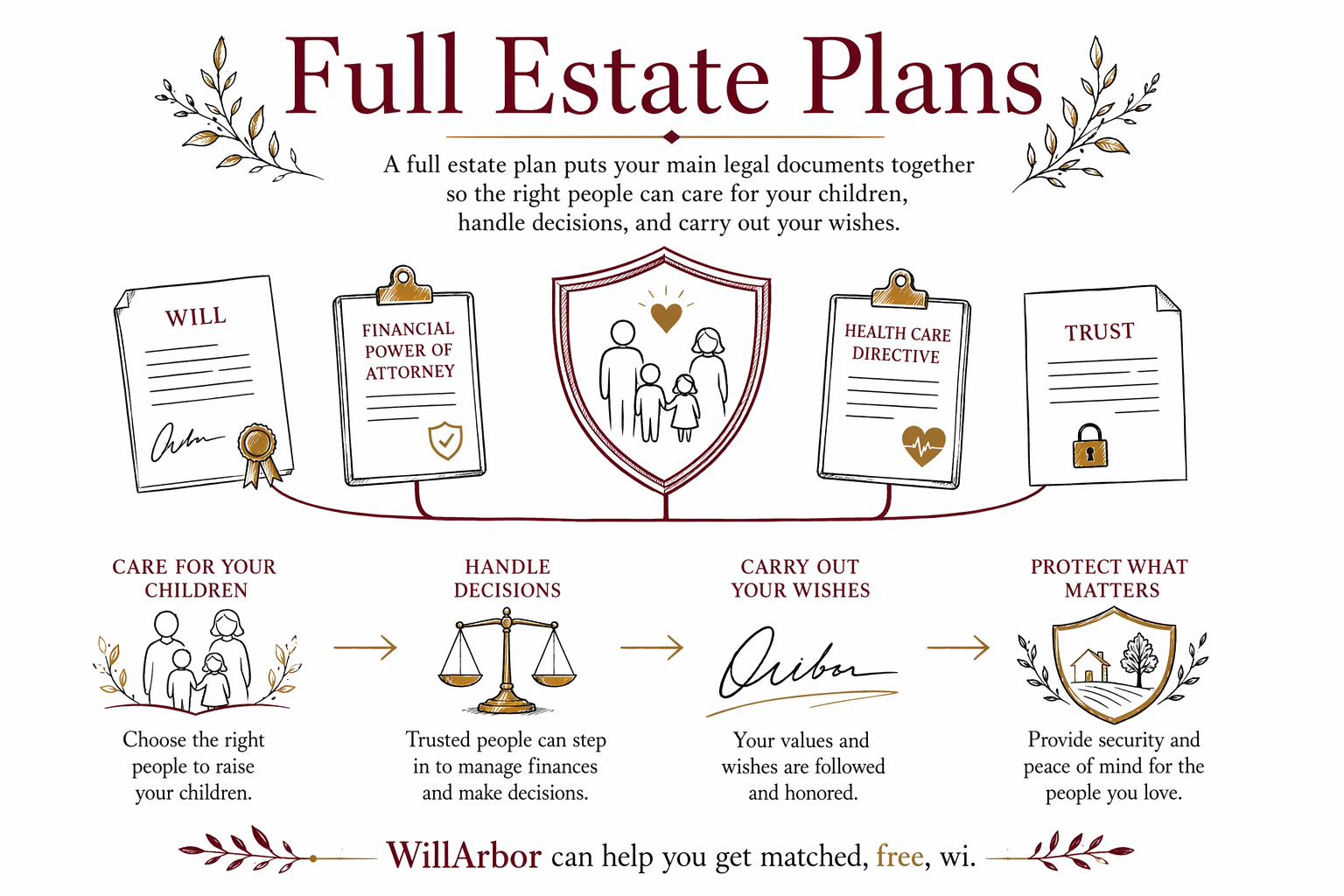
What a full estate plan is
A full estate plan is not one single paper. It is a set of legal documents that work together. For many families, that includes a will, and often a revocable living trust, a financial power of attorney, a health care power of attorney, and an advance directive or living will.
Each document has a different job. A will says who should receive your property and, if you have minor children, who you want to raise them. A trust can help manage property during your life and after death, and in some cases can help your family avoid probate for assets placed into the trust. A power of attorney lets someone handle money or legal matters for you if you cannot. A health care document lets someone make medical decisions and states your wishes for care.
What it does not do: it does not solve every tax issue, protect every asset from every risk, or avoid probate automatically in every case. Whether a plan works as intended depends on your state, your family situation, how your assets are titled, and whether the documents were properly signed and updated. Estate planning and probate rules vary by state and change over time, so this page is general educational information only.
If you are unsure which documents you need, start with the basics and ask a licensed estate planning attorney in your state to explain what fits your life. WillArbor is a free matching service, not a law firm or lawyer, and does not draft documents or give legal advice.
Who usually needs a full estate plan
A full estate plan can help almost any adult, but it becomes especially important if other people depend on you or if life is getting more complex. Many people first think about estate planning after having children, buying a home, getting married, starting a business, caring for aging parents, or building savings over time.
You may need a full plan if you want to name a guardian for a child, leave property in a clear way, choose who can act for you in a medical emergency, or make things easier for your family after a death. It can also help if you are part of a blended family, own property in more than one state, have a relative with special needs, or want more privacy and structure than a will alone can provide.
A full estate plan is also useful for immigrants and families who speak more than one language. Clear legal documents can reduce confusion when relatives live in different places or are more comfortable in another language. A local attorney can explain the plan in plain words and make sure the documents meet your state's rules.
- Parents of minor children often need a will and guardian nominations
- Many adults need powers of attorney before any health crisis happens
- A trust may help some families avoid probate for assets transferred into it
- People with blended families usually benefit from careful planning
What is usually included — and what each part does not do
A full estate plan often starts with a will. A will can name beneficiaries, name an executor, and nominate guardians for minor children. But a will usually does not avoid probate by itself. If you die with only a will, your estate may still go through the probate process in your state.
A revocable living trust is often added when a family wants more control over how assets are managed or passed on. A trust can help avoid probate for assets that are actually transferred into the trust during life. But an unfunded trust — one that was signed but never properly connected to your house, bank account, or other assets where appropriate — may not do much. That is one of the most common mistakes.
A financial power of attorney lets someone you trust handle financial matters for you while you are alive if you cannot act yourself. A health care power of attorney and advance directive help with medical decisions and end-of-life wishes. These documents stop being useful in different ways at death, so they are not substitutes for a will or trust.
Beneficiary designations on life insurance, retirement accounts, and some bank accounts also matter. These forms can override what a will says. That is why a true estate plan looks at the whole picture, not just one document at a time.
How a full estate plan gets set up
Most families work with a licensed estate planning attorney and pay a flat fee for a package of documents. The attorney asks about your family, the people you trust, what you own in general, and what goals matter most to you. They should explain your options in plain language and tell you which documents are included before any work starts.
A simple process often looks like this:
- You decide what you want to protect: children, a home, savings, medical choices, or all of the above.
- You get matched with a licensed estate planning attorney in your state through WillArbor's free service.
- You ask what documents are recommended, whether the fee is flat, and what is included.
- The attorney prepares drafts, explains them, and tells you how signing must happen under your state's rules.
- If a trust is part of the plan, you ask what needs to be funded or retitled so it actually works.
- You store the signed documents safely and review them after major life changes.
Before hiring anyone, confirm the attorney is licensed in your state and ask for the flat fee in writing. You stay in control: you compare attorneys, choose who to hire, and decide whether to move forward. WillArbor is always free for the family. Participating attorneys pay a flat fee to take part, but WillArbor is not your lawyer and does not create an attorney-client relationship.
To help match you, WillArbor collects only basic contact and planning intent information: your name, phone, optional email, state, what you want to plan, and preferred language. We do not ask for asset values, account numbers, document contents, Social Security numbers, income, or private estate details.
Common mistakes families make
A full estate plan only helps if it is complete, valid, and kept current. One common mistake is having no will at all. If you die without a will, state intestacy laws decide who inherits, and that may not match what you would have wanted.
Another problem is relying on DIY forms that do not meet your state's signing rules or do not fit your family. Estate planning laws vary by state, so a document that looks fine online may fail when your family needs it most. Out-of-date beneficiary designations are another frequent issue, especially after marriage, divorce, remarriage, or the birth of a child.
Families also forget to fund a trust, fail to name backup decision-makers, or never update documents after a move to another state. Even small errors can cause delay, court involvement, or conflict.
A licensed estate planning attorney can help you avoid these problems and explain what needs to be reviewed over time.
- No will, so state intestacy rules decide who inherits
- No named guardian for minor children
- DIY forms that are not valid in your state
- A trust that was signed but never funded
- Old beneficiary forms that conflict with the plan
- No backup agents named in POA or health care documents
What a full estate plan may cost
In many parts of the United States, a full estate plan is priced as a flat fee, not hourly. For a simpler plan centered on a will, powers of attorney, and health care documents, families often see total flat-fee ranges around $800 to $2,500. For a more complete plan that includes a revocable living trust, the range is often about $2,000 to $6,000 or more. These are general educational ranges, not quotes.
The real price depends on the documents included, the complexity of your family and property, and the state. Costs may go up if you need trust planning, planning for blended families, tax-sensitive issues, special needs planning, business interests, real estate in multiple states, or detailed instructions for children. Costs may be lower when the plan is straightforward and the attorney offers a standard flat-fee package.
Ask exactly what the fee includes. Does it include both spouses, deed work, trust funding guidance, notarization, extra meetings, or later updates? A lower fee may cover fewer documents or less support after signing. You can read more general information at estate planning costs and compare options through our services page.
No one should pressure you. Ask for the flat fee in writing before work begins, ask who you will be working with, and confirm the attorney's state bar license.
A full estate plan puts your main legal documents together so the right people can care for your children, handle decisions, and carry out your wishes, and WillArbor can help you get matched, free, with a licensed estate planning attorney.
Common questions
Do I need a full estate plan or just a will?
Many people need more than a will because a will does not help if you become incapacitated, and it usually does not avoid probate by itself. A licensed estate planning attorney in your state can explain whether a simpler plan or a fuller plan makes sense for you.
Does a full estate plan avoid probate?
Not always. A will alone usually does not avoid probate, and even a trust helps only for assets that were properly transferred into it. Probate rules vary by state.
How often should I update my estate plan?
Review it after major life events such as marriage, divorce, a new child, a death in the family, a move to another state, or big changes in property. Even without major changes, many families review every few years.
Can WillArbor make the documents for me?
No. WillArbor is a free matching service, not a law firm or lawyer, and does not draft documents or give legal advice. We help you connect with a licensed estate planning attorney in your state.
What information do I need to share to get matched?
Only basic contact and planning intent information: your name, phone, optional email, state, what you want to plan, and preferred language. You do not need to share account numbers, asset values, SSNs, income, or private document details to get started.
Is it free to use WillArbor?
Yes. It is free for families to get matched. If you decide to hire an attorney, ask for the flat fee in writing before any work starts.
Related help
A will says who gets what and who is in charge after you die — here is what it does, what it costs, and how to set one up the right way.
Open → Living TrustsA living trust can avoid probate and add control over how and when your family receives what you leave — here is the plain version.
Open → Powers of AttorneyA power of attorney lets someone you trust act for you on money or health decisions if you can't — here is how the two main kinds work.
Open →