Guides
What is an irrevocable trust?
An irrevocable trust is a legal arrangement you create, then you generally can’t change or cancel on your own once it’s set up. This guide explains what that means for your family planning goals and how to talk with a licensed estate planning attorney.
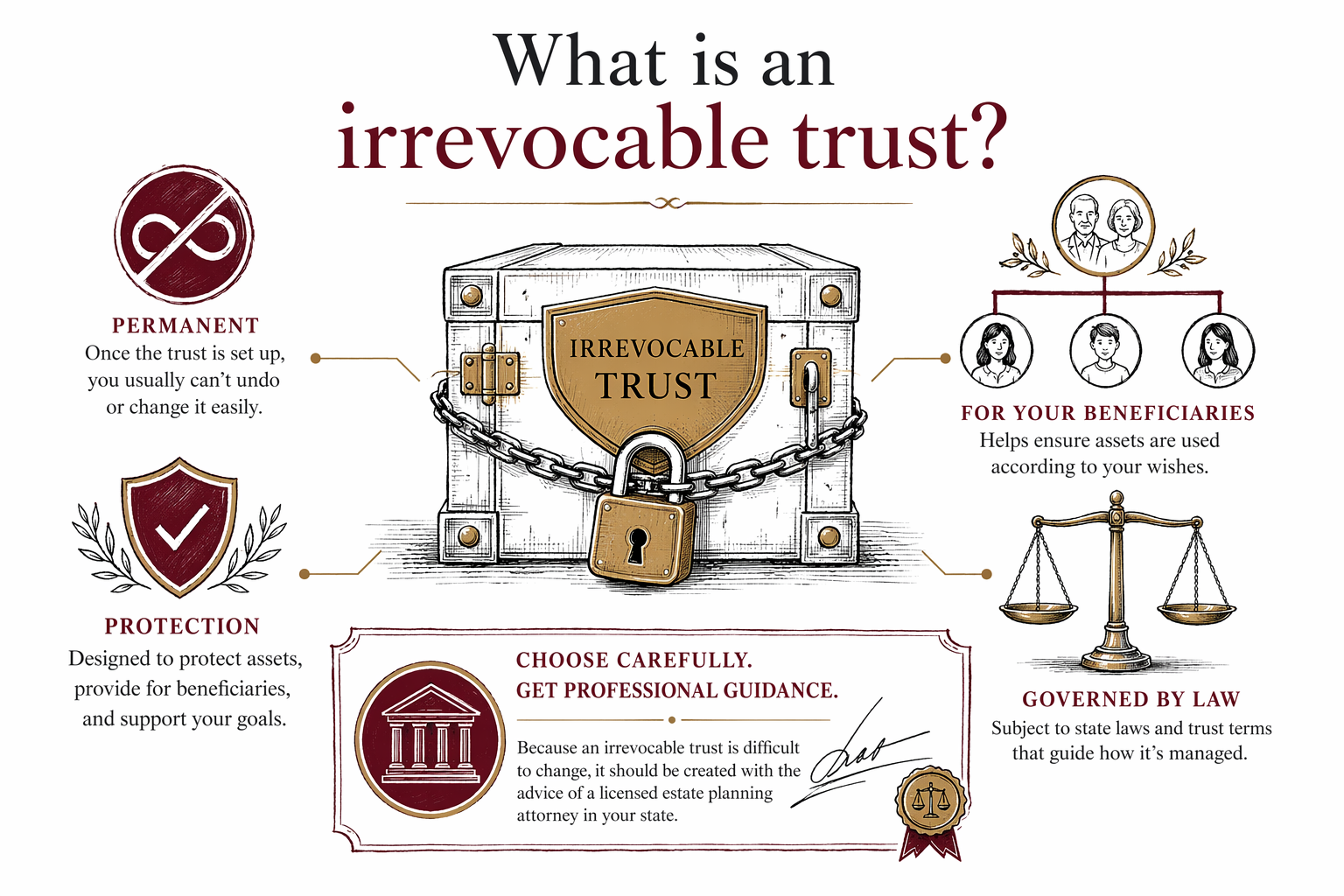
An irrevocable trust, in plain terms
An irrevocable trust is a trust you create using a legal document. After it’s created, you usually give up the ability to take the assets back or change the trust terms by yourself.
People set up irrevocable trusts for many reasons—for example, to manage how money is used for family, support a special need, or separate certain assets from their own estate planning.
Because the rules and outcomes can depend heavily on your state and the specific trust language, this is general education—not legal advice.
- “Irrevocable” usually means you can’t simply undo it later, like you can with many other estate decisions.
- A trustee runs the trust according to the document (not based on what you wish later).
Irrevocable vs. revocable: the biggest difference
A revocable trust is often used for basic estate planning because it can typically be changed or canceled while you’re alive. That flexibility is the reason many families start with a revocable trust.
With an irrevocable trust, you generally trade flexibility for a clearer, more permanent structure. That “lock-in” can be intentional for certain goals, but it’s also why it needs careful planning.
Estate-planning law and trust rules vary by state, so what you can and can’t change depends on where you live and the trust terms you choose.
- Revocable trust: usually easier to change while you’re alive.
- Irrevocable trust: usually harder (or impossible) to change without meeting strict legal requirements.
How an irrevocable trust works (who does what?)
Most irrevocable trusts involve a few key roles. You (or someone) creates the trust, then a trustee manages it. The people meant to benefit are called beneficiaries.
Depending on the trust, the beneficiaries may receive income, support, or specific distributions over time. The trust document controls the rules.
Even if you create the trust, the trustee’s job is to follow the document. This is one reason families sometimes need a trusted person, a professional trustee, or both.
- Trust creator (often called “grantor” or “settlor”): sets up the trust.
- Trustee: manages assets and follows the trust instructions.
- Beneficiaries: receive benefits per the trust document.
Common reasons families consider an irrevocable trust
Families look at irrevocable trusts for different goals. Some examples include:
1) Setting up support for a family member with special needs.
2) Planning how certain assets are handled for long-term family use.
3) Creating a structured way to give or preserve resources outside a person’s direct control.
These are general examples. Your exact goal matters, and the right type of trust depends on your state’s rules and the facts of your family situation—so it’s important to get guidance from a licensed estate planning attorney in your state.
- Different trust types exist; “irrevocable trust” is not one single plan.
Key pitfalls to watch for
An irrevocable trust can be powerful—but common mistakes can cause delays, confusion, or results that don’t match what the family expected. Here are frequent pitfalls.
- Setting up a DIY form that doesn’t fit your state (trust rules vary by state).
- Naming beneficiaries or instructions that don’t match how the family actually needs support.
- Forgetting that “not being able to change it easily” cuts both ways—your plan may be hard to update later.
- Creating a trust but not transferring assets properly (“unfunded” trust issues). If the assets never get into the trust, the trust may not do what you hoped.
- Relying on outdated beneficiary designations for accounts that pass outside the trust.
- Not naming guardians for children in the separate document that controls that (for most families, that’s typically handled in a will, not a trust).
- A trust doesn’t replace everything—many families still need a will and other documents.
Costs: what families usually pay (and what changes the price)
Estate planning for an irrevocable trust is typically quoted as a FLAT FEE in many attorney practices, not an hourly rate. Still, the real number depends on the documents you need, the trust type, your state, and how complex your situation is.
As a general planning range, attorney fees for an irrevocable trust setup can often fall somewhere around $2,000 to $6,000+, with additional costs possible if your plan also requires other estate documents (like a will, powers of attorney, or advance directives) or if there are multiple trust documents.
A flat fee is usually confirmed in writing before work starts. Ranges are not quotes, and you should ask for the exact scope and flat-fee price from any licensed attorney you consider.
- Price can go up for specialized trust types, more beneficiaries, or extra legal documents.
- Price can vary by state and by how much drafting and coordination is needed.
Next steps: how WillArbor can help you get matched (free)
If you’re wondering whether an irrevocable trust fits your family’s goals, the next step is to talk with a licensed estate planning attorney in your state. Estate-planning law and probate rules vary by state, and the “right” answer depends on your details.
WillArbor is a FREE matching service, not a law firm and not your lawyer. We help you connect with licensed estate planning attorneys near you so you can compare options and choose who to hire.
Use get matched to share contact and planning intent only (like your state and preferred language). Then you can speak with an attorney, confirm their bar license, and ask about a flat-fee quote and what documents your plan would include.
- WillArbor collects only contact + planning intent—never asset values, account numbers, SSNs, or document contents.
- Always confirm the flat-fee scope in writing before any work begins.
An irrevocable trust is a permanent trust you usually can’t undo or change easily after setup, so it should be chosen carefully with a licensed estate planning attorney in your state.
Common questions
Can I change or cancel an irrevocable trust later?
In many cases, you can’t simply change or cancel an irrevocable trust on your own after it’s created. Some changes may be possible only in limited situations and may require court approval or specific legal steps—rules vary by state, so confirm with a licensed estate planning attorney.
Does an irrevocable trust replace a will?
Often, no. Many families still need a will (and other documents) to handle issues like naming guardians for children and addressing assets not placed into the trust. Your plan should be built as a coordinated set of documents.
Will an irrevocable trust avoid probate?
A trust can help with probate for certain assets when properly set up and funded, but it doesn’t automatically eliminate all probate in every situation. What happens depends on your state’s rules and how your assets are titled—an attorney can explain what to expect for your goals.
Are irrevocable trusts only for wealthy families?
Not necessarily. Some people of different financial situations consider specific irrevocable trusts for personal or family goals. Whether it fits you depends on your objectives and your state’s rules—not just income or net worth.
Related help
The difference between a will and a living trust, when each makes sense, and why many families use both.
Open → How to Avoid ProbatePlain-language ways families reduce or avoid probate — trusts, beneficiary designations, and joint ownership.
Open → What Happens If You Die Without a WillIntestacy explained: how your state decides who inherits when there is no will — and why that may not match your wishes.
Open →