Guides
What is a living will?
A living will is a written instruction about the medical care you want, or do not want, if you cannot speak for yourself. It is part of advance planning, and the exact rules and forms vary by state.
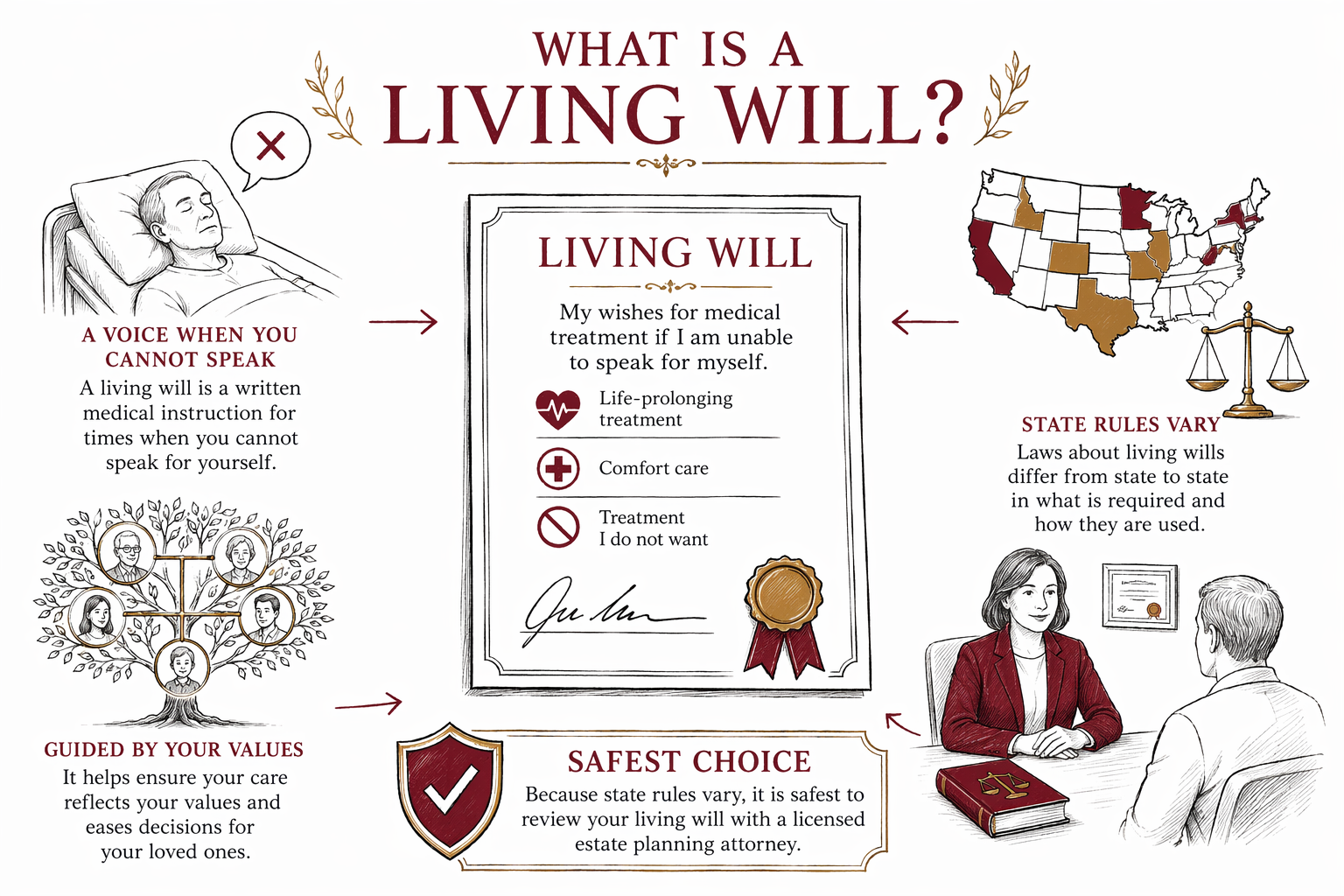
What a living will does
A living will tells doctors and family what kind of end-of-life care you want if you are very sick or permanently unable to communicate. People often use it to say whether they want life-sustaining treatment, such as breathing machines or feeding tubes, in certain serious situations.
It is meant to guide medical decisions when you cannot explain your wishes. It can also reduce stress for family members, because they are not left guessing.
A living will is different from a will that handles property after death. It is also different from a power of attorney for health care, which names someone to make medical decisions for you.
- Living will = your written medical wishes
- Health care power of attorney = the person who speaks for you
- Will = what happens to property after death
Why families make one
Many families make a living will so their loved ones do not have to make painful choices without guidance. It can be especially important if you want your care to match your values, faith, or family beliefs.
It can also help in common situations where people worry about machines keeping someone alive with little chance of recovery. A living will gives direction before a crisis happens.
Still, a living will is only one part of planning ahead. Many people also want a health care power of attorney, a regular will, and sometimes a living trust, depending on their situation.
- It can help your family know your wishes
- It can reduce conflict during a medical crisis
- It works best as part of a larger estate plan
What it does not do
A living will does not usually handle money, property, guardianship for children, or what happens after death. It is not the same as probate, and it does not avoid probate.
It also may not cover every medical situation in detail. Some states use very specific forms, and some allow broader instructions. That is why it is important to use the rules for your state, not a generic form from the internet.
Common pitfalls include using a DIY form that is not valid in your state, forgetting to sign or witness it correctly, and never sharing it with family or doctors.
- DIY forms that fail in your state
- Not signing or witnessing the form correctly
- Not telling family or your doctor where it is kept
How to make one the right way
Start by thinking about the kind of care you would want if you were seriously ill and could not speak. Then talk with a licensed estate planning attorney or an attorney who handles advance directives in your state.
A lawyer can explain what your state allows, help you choose the right documents, and make sure the wording fits your wishes. This matters because estate planning and medical directive rules vary by state and can change over time.
WillArbor is a free matching service, not a law firm, not a lawyer, and it does not draft documents. We can help connect you with a licensed estate planning attorney near you so you can compare options and confirm the flat fee in writing before any work starts.
- Think about your care preferences
- Get state-specific help
- Share the signed document with the people involved
What it may cost
Most estate planning work is quoted as a flat fee, not hourly. For a simple living will or advance directive, the legal fee is often lower than for a full estate plan, but the real number depends on your state, the documents you need, and how much explanation or follow-up is required.
As a general range, some families may see a simple advance directive or living will discussed in the low hundreds of dollars, while a broader plan with multiple documents can cost more. That range is not a quote, and it is not a promise.
The family stays in control: you compare attorneys, choose who to hire, and confirm the flat fee in writing before any work begins.
- Flat fees are common
- Cost depends on the documents and the state
- Ranges are not quotes
If you are starting from scratch
- Decide who you trust to make medical decisions if you cannot.
- Think about whether you want to name that person in a health care power of attorney.
- Ask a licensed attorney whether a living will, power of attorney, or both make sense in your state.
- Share copies with the people who need them and keep one easy to find.
If you are helping a parent or spouse, you can still start with the same questions. The important thing is to get clear, state-specific guidance instead of guessing.
- Name the right decision-maker
- Use state-specific forms
- Keep the signed papers easy to find
A living will is a written medical instruction for times when you cannot speak, and because state rules vary, it is safest to review it with a licensed estate planning attorney.
Common questions
Is a living will the same as a will?
No. A living will is about medical care while you are alive but cannot speak for yourself. A will says what happens to your property after death, and it may name a guardian for minor children.
Do I need both a living will and a power of attorney for health care?
Many people do, because they serve different purposes. A living will gives written instructions, while a health care power of attorney names someone to make medical decisions if needed.
Can I just download a form online?
Sometimes people do, but that is risky because the rules vary by state and the form may not be valid where you live. A licensed attorney can check that the document fits your state and your wishes.
How does WillArbor help?
WillArbor is a free matching service that connects families with licensed estate planning attorneys. We do not draft documents, we are not a law firm, and we do not create an attorney-client relationship.
Related help
The difference between a will and a living trust, when each makes sense, and why many families use both.
Open → How to Avoid ProbatePlain-language ways families reduce or avoid probate — trusts, beneficiary designations, and joint ownership.
Open → What Happens If You Die Without a WillIntestacy explained: how your state decides who inherits when there is no will — and why that may not match your wishes.
Open →