Guides
How to update a will?
You usually update a will by signing a new will or, in some states, a formal amendment called a codicil. Because signing rules vary by state, the safest path is to have a licensed estate planning attorney in your state review it.
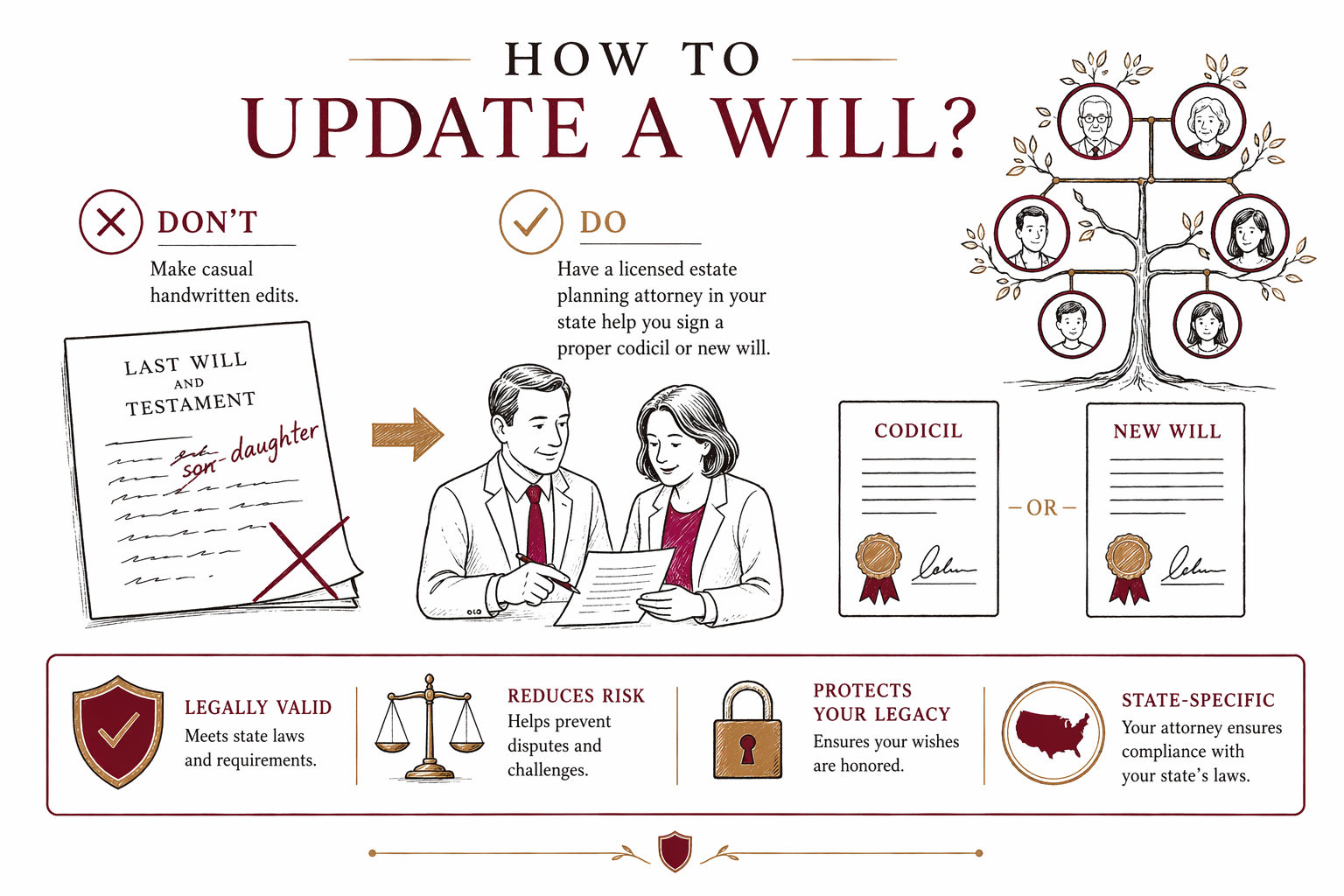
The short answer
If you need to change your will, do not write notes in the margins, cross things out, or staple on extra pages and assume it will hold up later. In many states, those informal changes can cause confusion, delay, or make part of the will invalid.
Usually, people update a will in one of two ways: by signing a brand-new will that replaces the old one, or by signing a separate amendment called a codicil. For small, simple changes, a codicil may be allowed in some states. For bigger changes, a new will is often cleaner and safer.
Because wills must follow state signing rules, this is general information only, not legal advice. A licensed estate planning attorney in your state can tell you which option fits your situation and how to sign it correctly.
When it makes sense to update your will
Many families do not need a new plan every year, but it is smart to review your will after major life changes. A will that was right five years ago may no longer match your family, your wishes, or the people you trust.
Common reasons to update a will include marriage, divorce, the birth or adoption of a child, a death in the family, moving to a new state, buying a home, starting a business, or wanting to name a different executor or guardian. If you now want to leave property differently, protect a child, or coordinate your will with a living trust, that is also a good time to review it.
Even without a big event, many people review their estate plan every 3 to 5 years. Small issues can become bigger problems later, especially if beneficiary designations, powers of attorney, or health care documents no longer match the will.
New will or codicil?
A codicil is a formal change to an existing will. In some states, it can work for a narrow update, such as changing the person you named as executor. But codicils can create confusion if there have been several changes over time, or if the old wording and new wording do not fit together well.
A new will often makes more sense when you want to change several gifts, add or remove beneficiaries, name guardians for children, deal with a divorce or remarriage, or clean up an older plan. A new will can state that it revokes prior wills and codicils, which may help reduce later disputes.
An attorney may suggest a full review of your estate plan, not just the will. For example, if your will says one thing but your retirement account or life insurance beneficiary form says another, the beneficiary form may control. That mismatch is one of the most common estate-planning pitfalls.
How to update a will safely
The safest process is usually simple: review what you have, decide what changed, and sign the updated documents correctly under your state's rules. WillArbor is a free matching service — not a law firm, not a lawyer, and it does not draft documents or create an attorney-client relationship. We help you connect with a licensed estate planning attorney near you.
A practical path looks like this:
- Find your current will and any codicils, trust documents, powers of attorney, and advance directives.
- Make a short list of what changed: people, property, guardians, executor, or your wishes.
- Check whether you moved states or whether your family situation changed in a major way.
- Ask a licensed estate planning attorney in your state whether a codicil or a new will is better.
- Sign the updated document the way your state requires, with the right witnesses and any notarization if needed.
- Store the new signed original in a safe place and tell your executor where to find it.
- Destroy clearly revoked old copies if your attorney tells you to, and update related documents too.
If you want help finding someone local, you can use WillArbor's free matching service. We collect only contact and planning intent — your name, phone, optional email, state, what you want to plan, and preferred language — not account numbers, asset values, or other sensitive estate details.
Common mistakes to avoid
One common mistake is trying to do a serious update with a generic DIY form that does not meet your state's rules. Another is signing a will correctly years ago, then making handwritten edits later that may not be valid. Families also run into trouble when the original signed will cannot be found after death.
Other problems are less obvious. A parent may update a will but forget to name a guardian for minor children. Someone may create a living trust but never transfer property into it, leaving the trust unfunded. Or the will may be updated while old beneficiary designations on retirement accounts and life insurance still point to the wrong person.
If a person dies without a valid will, state intestacy rules decide who inherits. That may not match what the family expected. Reviewing the whole plan together can help avoid those surprises.
What it may cost to update a will
Many estate planning attorneys charge a flat fee, not hourly, for will updates and basic estate-planning work. For a simple will update, families may see flat-fee ranges around $200 to $600. A more substantial rewrite of a will may be more like $400 to $1,200. If the review turns into a broader estate plan update with powers of attorney, advance directives, or trust work, the total can be higher.
The real cost depends on the documents involved, the complexity of your family and property, and the state. Those ranges are not quotes. Always ask what is included, whether the lawyer recommends a codicil or a full new will, and get the flat fee in writing before work starts.
If you are comparing options, learn more about estate-planning topics or explore common services families ask about. Then you can get matched, free, with a licensed estate planning attorney and choose who to hire.
To update a will, do not make casual handwritten edits — have a licensed estate planning attorney in your state help you sign a proper codicil or new will.
Common questions
Can I just cross out part of my will and write in the change?
That is risky. In many states, handwritten changes on an already signed will may not be valid and can create confusion in probate. It is safer to use a properly signed codicil or a new will.
Do I need a lawyer to update my will?
A lawyer is not always legally required, but it is often the safest choice because will formalities vary by state. A licensed estate planning attorney can help you avoid mistakes that may not show up until after death.
Is a codicil enough, or should I make a new will?
For a very small change, a codicil may work in some states. For multiple changes or a major life event, a new will is often cleaner and easier for your family to follow later.
Do I need to update anything besides the will?
Often, yes. Review beneficiary designations, powers of attorney, advance directives, and any living trust so they work together. A mismatch between these documents is a common problem.
What if I moved to another state?
You should have your will reviewed. A will signed in one state may still be recognized in another, but state rules differ, and your plan may need updates to fit your new state's law.
How can WillArbor help?
WillArbor is a free matching service, not a law firm and not your lawyer. We help you connect with a licensed estate planning attorney in your state so you can compare options, confirm the flat fee in writing, and decide who to hire.
Related help
The difference between a will and a living trust, when each makes sense, and why many families use both.
Open → How to Avoid ProbatePlain-language ways families reduce or avoid probate — trusts, beneficiary designations, and joint ownership.
Open → What Happens If You Die Without a WillIntestacy explained: how your state decides who inherits when there is no will — and why that may not match your wishes.
Open →