Guides
Estate Planning For Unmarried Couples
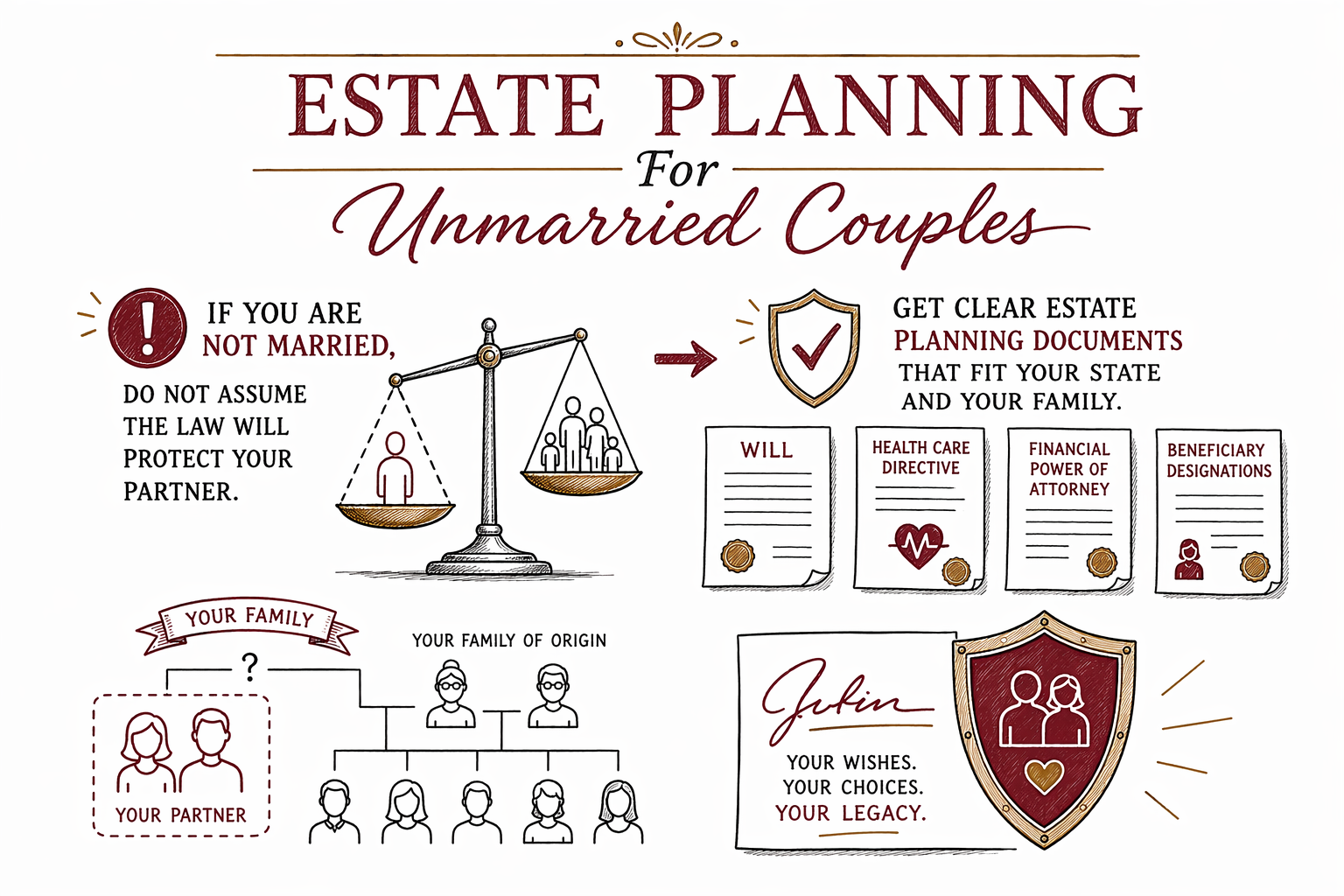
If you are not legally married, your partner may have few or no automatic rights if you die or become unable to make decisions. A careful estate plan can help protect each other, but the rules vary by state.
The short answer
Yes — unmarried couples often need estate planning even more than married couples, because the law usually gives spouses automatic rights that unmarried partners do not have.
A will, powers of attorney, health care documents, and sometimes a living trust can help you choose who inherits, who can make decisions, who can handle money, and who can speak for you in a medical emergency. Without those documents, state law may favor blood relatives instead of your partner.
This is general educational information only, not legal, tax, or financial advice. Estate-planning and probate rules vary by state, and the right setup depends on your family, property, and goals.
Why unmarried couples can be at risk
If one partner dies without a valid will, that person is said to have died "intestate." In many states, intestacy laws send property to children, parents, or other relatives — not to an unmarried partner.
If one partner becomes sick or injured and cannot act, the other partner may also have trouble stepping in unless the right documents were signed ahead of time. A hospital, bank, or financial company may ask for legal authority before sharing information or taking instructions.
This can affect more than money. It can affect who stays in the home, who pays bills, who handles funeral decisions, and who can talk to doctors. For couples raising children together, it can also raise separate questions about parentage and guardianship that should be reviewed under your state's law.
Documents unmarried couples often consider
A basic plan often starts with a will. A will can say who should inherit your property, who should handle your estate, and who you want as guardian for minor children. But a will usually does not avoid probate by itself, and probate rules and costs vary by state.
A durable financial power of attorney can let someone handle banking, bills, and other financial tasks if you cannot act. A health care power of attorney and an advance directive can name who should make medical decisions and explain your wishes about care.
Some couples also use a living trust, especially if they own a home, want more privacy, own property in more than one state, have children from a prior relationship, or want to make things simpler for the person left behind. A trust can help avoid probate for assets properly placed into it, but an unfunded trust — one that was never updated with the right assets — is a common mistake.
Beneficiary designations matter too. Retirement accounts, life insurance, and some bank or investment accounts may pass by beneficiary form, not by your will. If those forms are old or blank, your plan may not work the way you expect.
Important issues to think through together
Unmarried couples often need to be very clear about shared property and separate property. If only one name is on a deed, title, or account, that detail may matter a lot after a death or incapacity. The same is true if one person brought more assets into the relationship, or if one partner has children from another relationship.
You may also want to talk about who can stay in the home, how expenses should be paid, who should inherit personal items, and whether either of you wants to leave something to the other's family. These are emotional topics, but clear documents can prevent confusion and conflict later.
If you have children, do not assume your wishes are obvious or automatic under state law. Naming guardians in a will is important, but unmarried parents may also need state-specific advice about parentage, custody, and who has legal authority to act.
Common pitfalls to avoid
- Dying without a will and assuming your partner will automatically inherit
- Relying on DIY forms that may not meet your state's signing or witness rules
- Forgetting powers of attorney and health care documents
- Leaving old beneficiary designations in place
- Creating a trust but never funding it
- Not naming a guardian for minor children
- Assuming a joint account or shared bill gives full legal authority in every situation
These problems are common, and many families do not discover them until there is already a crisis. A licensed estate planning attorney in your state can help you check whether your documents match your real life.
What it may cost and how to get help
Many estate planning attorneys charge a flat fee, not hourly, for standard planning. Very general ranges — not quotes — might be around $300 to $1,000 for a simple will package for one person, about $600 to $2,000+ for a couple's basic documents, and roughly $1,500 to $5,000+ for a trust-based plan. The real number depends on the documents, the complexity, and the state.
Costs often go up if you want a living trust, own a home, have children from a prior relationship, need tax-sensitive planning, own property in more than one state, or have more complicated wishes. Before any work starts, ask for the flat fee in writing and what it includes.
WillArbor is a free matching service for families — not a law firm, not a lawyer, and it does not draft documents or create an attorney-client relationship. We only collect contact and planning intent: your name, phone, optional email, state, what you want to plan, and preferred language. We do not ask for asset values, account numbers, document contents, Social Security numbers, income, or other sensitive estate details.
You can learn more in our guides, see common planning topics on our services page, or get matched for free with a licensed estate planning attorney near you. Compare your options, confirm the attorney's bar license, and make sure the flat fee is clear before you hire anyone.
If you are not married, do not assume the law will protect your partner — get clear estate planning documents that fit your state and your family.
Common questions
If we are not married, does my partner inherit automatically?
Usually no. In many states, if you die without a valid will or other planning, state intestacy law may give property to relatives instead of your unmarried partner.
Do unmarried couples need a trust?
Not always. Some couples do well with wills and powers of attorney, while others use a living trust to help avoid probate or handle more complex property or family situations. The best choice depends on your state and your goals.
Can a will let my partner make medical decisions for me?
No. A will mainly speaks after death. For medical decisions during your lifetime, people often use a health care power of attorney and related advance directive forms, which vary by state.
What if we already filled out forms online?
Be careful. DIY forms are a common problem if they do not match your state's rules or your family situation. A licensed estate planning attorney can review whether they are likely to work as intended.
Is WillArbor free?
Yes. WillArbor is free for families. It is a matching service, not a law firm or lawyer, and it can help you connect with a licensed estate planning attorney in your state.
Related help
The difference between a will and a living trust, when each makes sense, and why many families use both.
Open → How to Avoid ProbatePlain-language ways families reduce or avoid probate — trusts, beneficiary designations, and joint ownership.
Open → What Happens If You Die Without a WillIntestacy explained: how your state decides who inherits when there is no will — and why that may not match your wishes.
Open →