Guides
What documents do i need for estate planning?
Most families start with a will, a power of attorney, and a health care directive. If you own property, have minor children, or want to avoid probate, a licensed estate planning attorney can tell you whether a trust or other documents also make sense in your state.
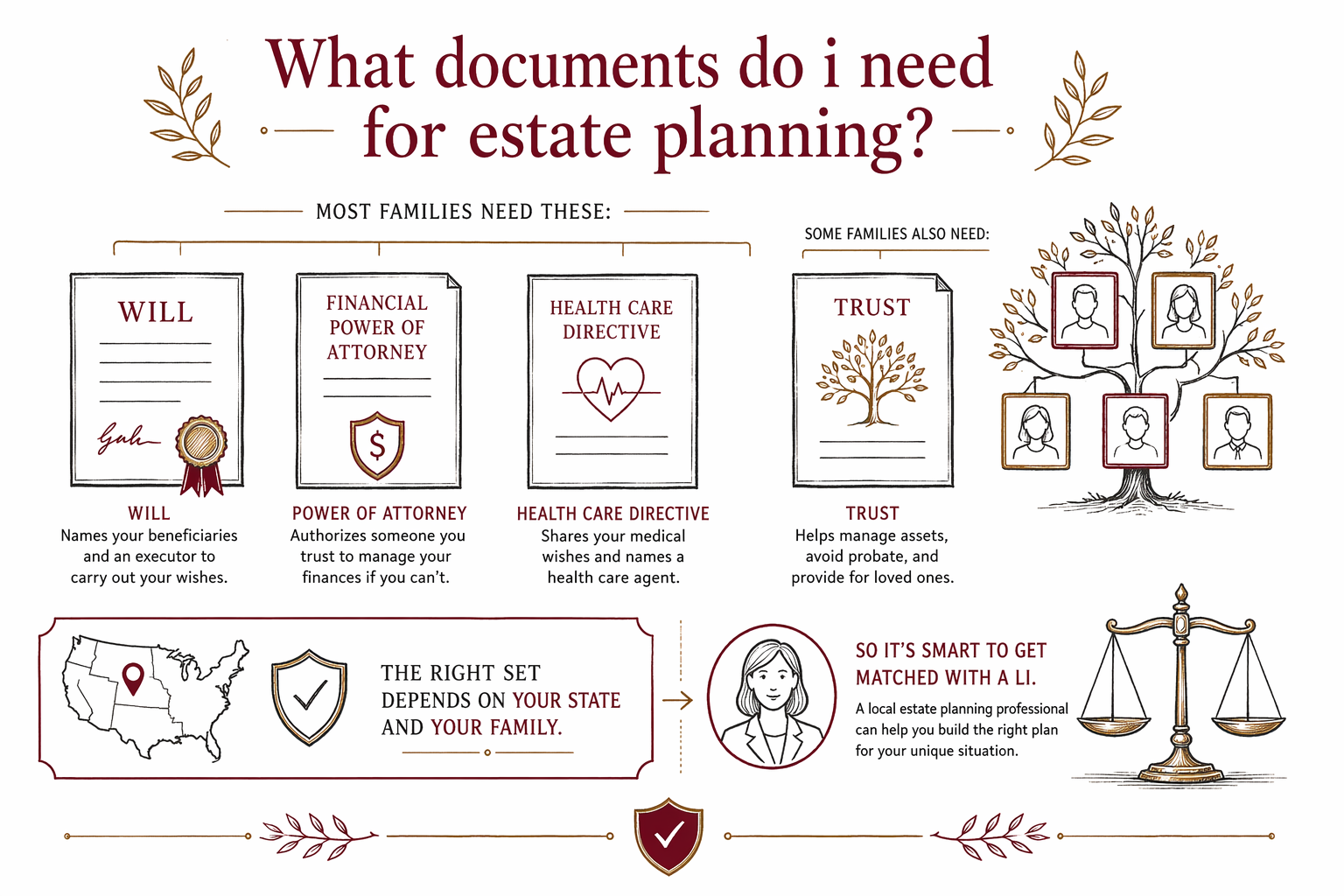
The short answer
The main documents many families need for estate planning are a will, a financial power of attorney, and an advance health care directive or living will. If you want property to pass outside probate, a revocable living trust may also be useful.
The right set depends on your family, what you own, and your state’s rules. Estate planning laws vary by state and change over time, so there is no single checklist that fits everyone.
WillArbor is a free matching service, not a law firm and not your lawyer. We help you get connected with a licensed estate planning attorney near you, so you can ask what documents fit your situation and confirm the flat fee in writing before any work starts.
Core documents most people should ask about
- Last will and testament: says who gets property that does not pass another way, and can name a guardian for minor children.
- Financial power of attorney: lets someone you trust handle money and property matters if you cannot.
- Advance health care directive / living will: explains your medical wishes and can name a health care agent.
- Revocable living trust: can help certain families avoid probate and keep private transfers smoother, but it must be funded to work.
Some people also need beneficiary forms for retirement accounts and life insurance, transfer-on-death or payable-on-death forms, guardianship nominations, and letters of instruction. These are not always part of the estate plan itself, but they matter a great deal.
A local attorney can help you decide which documents are essential now and which are optional based on your state and family situation.
If you have children, a home, or family abroad
If you have minor children, naming a guardian in your will is one of the most important steps. Without that, a court may have to decide who cares for them.
If you own a home, a trust may be worth asking about, especially if you want to reduce probate or make handling the property easier for your family. If you are new to the U.S. or have family in another country, it is especially important to ask how your state treats foreign heirs, jointly owned property, and beneficiary forms.
An attorney can also explain whether your documents should be in English only or paired with translated explanations for your family. The law still follows your state’s rules, but clear documents can prevent confusion later.
Common mistakes to avoid
- Dying without a will, which can leave state intestacy laws to decide who inherits.
- Forgetting to update beneficiary designations after marriage, divorce, a birth, or a death.
- Using DIY forms that are not valid in your state.
- Creating a trust but never funding it by moving assets into it.
- Not naming a guardian for minor children.
- Signing papers years ago and never reviewing them after a major life change.
These problems are common and fixable, but they can be hard on families. A brief review with a licensed estate planning attorney can help you avoid gaps and keep your plan consistent.
What to bring when you ask for help
You do not need account numbers, asset values, or sensitive financial details to start the conversation. WillArbor only collects contact information and planning intent, such as your name, phone, optional email, state, what you want to plan, and your preferred language.
A helpful first conversation is usually about:
- who you want to protect
- whether you have minor children
- whether you own a home or other real estate
- whether you want to avoid probate
- whether you want to name health care and financial decision-makers
From there, the attorney can tell you what documents to prepare and what they may cost. Most estate planning is quoted as a flat fee, but the number depends on the documents, the complexity, and the state.
How to get started
- Think about who you want to protect and who should make decisions if you cannot.
- Gather only basic contact and planning information, not account details.
- Compare licensed estate planning attorneys in your state.
- Confirm the flat fee, scope, and timeline in writing before any work starts.
- Review your plan after a move, marriage, divorce, birth, death, or other major life change.
If you are not sure where to begin, start with a free match and ask your questions directly. A calm first step can save your family confusion later.
You can explore more plain-language help in our guides, learn about services, or get matched with a licensed estate planning attorney near you.
Most families need a will, powers of attorney, and a health care directive, and some also need a trust, but the right set depends on your state and your family, so it is smart to get matched with a licensed estate planning attorney for a flat-fee quote.
Common questions
Do I need both a will and a trust?
Not always. Many families need a will, but a trust can be helpful if you want property to avoid probate or want more control over how assets are handled. A licensed estate planning attorney can tell you what fits your state and your goals.
What happens if I do nothing?
If you die without a will, your state’s intestacy rules decide who inherits, which may not match your wishes. If you become unable to act and have no power of attorney or health directive, your family may have to go through extra court steps.
Can I use online forms?
Sometimes, but DIY forms can fail if they do not follow your state’s rules or if they are not completed correctly. A local attorney can check whether a form is valid where you live and whether it actually fits your family.
How much does estate planning usually cost?
Most estate planning is priced as a flat fee, not hourly. The cost depends on the number of documents, whether you need a trust, and how complex your situation is, so any range is only a general guide—not a quote.
Related help
The difference between a will and a living trust, when each makes sense, and why many families use both.
Open → How to Avoid ProbatePlain-language ways families reduce or avoid probate — trusts, beneficiary designations, and joint ownership.
Open → What Happens If You Die Without a WillIntestacy explained: how your state decides who inherits when there is no will — and why that may not match your wishes.
Open →