Guides
When to Update Your Estate Plan
A good estate plan isn’t “set and forget.” Certain life events and paperwork changes are common triggers to review your will, trust, and decision-makers—so your wishes still match your family’s reality.
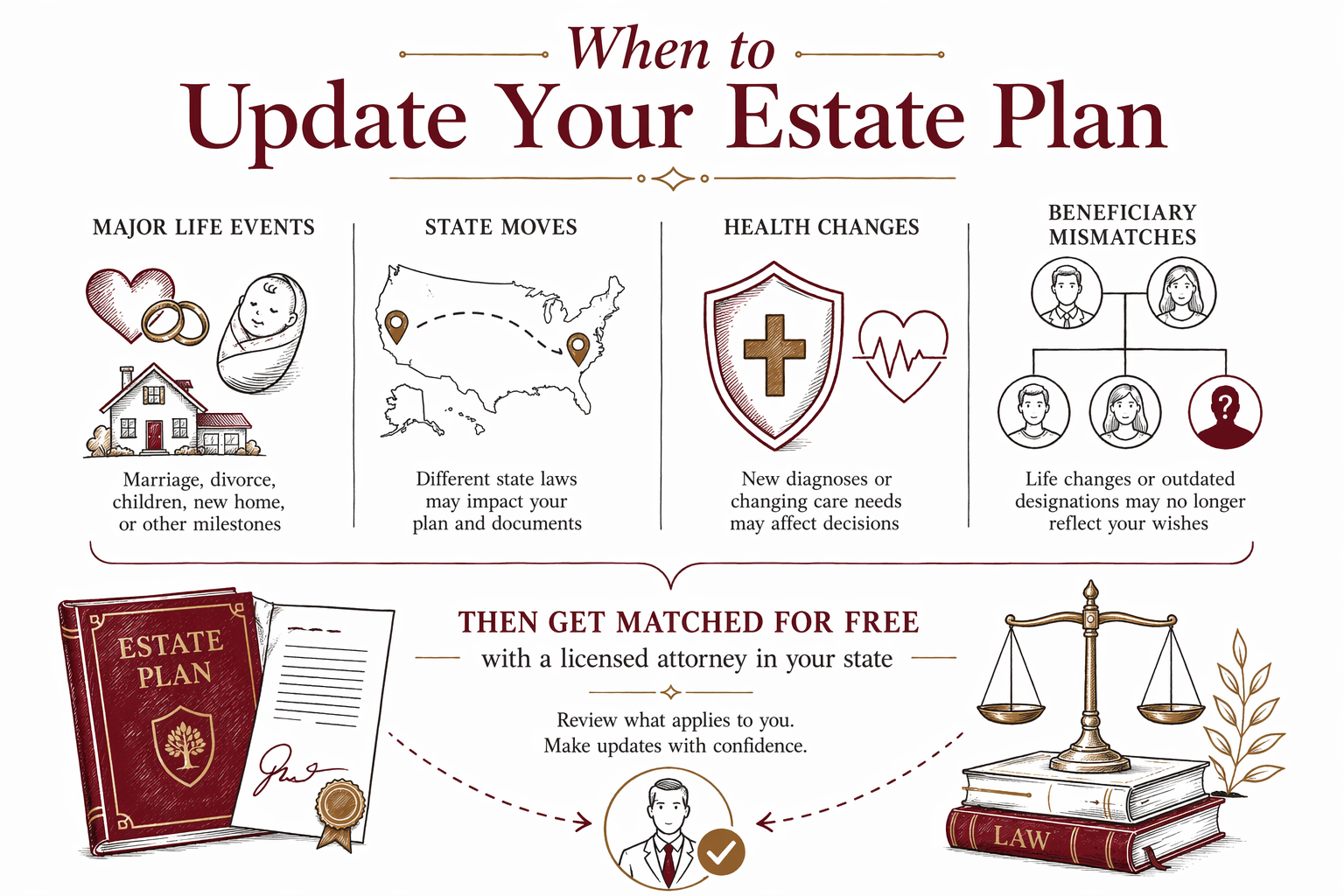
Start here: when should you update your estate plan?
You should review your estate plan after any major life change—or when you notice documents that no longer reflect who you want in charge.
In plain terms, update it when your family, your health situation, your finances, or the law around your state has changed.
If you’re not sure whether something “counts,” it’s okay. A licensed estate planning attorney can help you check what matters in your state.
- Marriage, divorce, or a new domestic partner
- A new child (including adoption) or a change in guardianship needs
- A death in the family (especially a named executor/guardian/beneficiary)
- A move to a new state or long-term relocation
- A big change in assets or how you own property
- A serious health change that affects advance directives or powers of attorney
- Beneficiary designations that don’t match your plan
Life events that commonly trigger a review
Estate planning is connected to real people and real circumstances. When relationships shift, the “who and how” in your plan may shift too.
Here are common triggers families run into:
1) Marriage or remarriage: this often affects who inherits, who manages your affairs, and how guardianship works for any minor children.
2) Divorce or legal separation: divorce can change whether an ex-spouse still has rights under a will or trust. It can also affect powers of attorney and beneficiary relationships.
3) New child, adoption, or blended family: you may need to name or update guardians for minors and adjust how assets pass to children.
- Also review if a child reaches adulthood (guardianship can shift)
- Also review if someone named in your plan dies or becomes unable to serve
Health and decision-making changes (wills, POA, and advance directives)
Even if your finances haven’t changed, your care preferences and who you trust to make decisions might have.
Consider an update if you:
1) Become diagnosed with a serious illness, experience a major decline, or change your wishes about medical treatment
2) Want to change the person(s) you appoint for healthcare decisions or financial decisions
3) Notice documents are missing, outdated, or don’t align with how your family actually supports you today
- Advance directives (“living wills”) and powers of attorney vary by state—your attorney can confirm what forms your state recognizes.
Moves, paperwork mismatches, and out-of-date beneficiary forms
Many estate plans are state-specific. If you move, the rules and the forms that work best in your new state may be different.
Rules vary by state, and estate planning and probate laws can change over time. That’s a key reason to review your plan after relocating.
Also, a very common pitfall is a “mismatch” between your estate plan and your beneficiary designations (for example, life insurance or retirement accounts). These assets often pass by beneficiary forms, not by your will.
- Check beneficiary designations after marriage, divorce, and major relationship changes
- Update your executor/administrator and backup choices if people move, pass away, or can’t serve
After a death, or if your plan is old or incomplete
Two situations deserve special attention: (1) a plan that is outdated or incomplete, and (2) changes you need because of a death.
Common pitfall #1: dying without a valid will (“intestacy”). When that happens, state law decides who inherits and who may manage the estate—often not what the family would have chosen.
Common pitfall #2: DIY forms that don’t fit your state. Forms from the internet may miss required state details and can create avoidable delays.
Common pitfall #3: an unfunded trust. A trust can only do what it’s set up to do. If you created a trust but didn’t transfer the right assets into it (or didn’t update what should be controlled by the trust), it may not work as intended.
- If you’re settling a parent’s estate, a probate timeline and process can differ by state—an attorney can explain what’s typical where you live.
How to do a practical review (without overwhelming yourself)
A review doesn’t have to be complicated. You can start by gathering your key documents and making a short list of what has changed.
1) Make a checklist of your current documents: will, any trusts, powers of attorney, and advance directives
2) Write down life changes since your last update: marriage/divorce, new child, move, major health change, or a key person passing away
3) List any “mismatch” you suspect: beneficiaries on accounts, named guardians, or decision-makers you’d choose today
4) Bring your questions to a licensed estate planning attorney in your state
WillArbor is a free matching service that helps families connect with a licensed estate planning attorney near them. We do not draft documents and we are not your lawyer—rules vary by state, and only a licensed attorney can guide you on what applies to your situation.
- If you’re not sure what to ask, you can simply say what changed and what you want to protect.
Cost and next steps: get matched for free, then confirm a flat fee
Estate planning costs vary by state and by what you need. Most attorneys quote a flat fee (not hourly), but the final number depends on the documents and complexity—such as whether you need a simple will, a trust, updates to POA/advance directives, and whether your situation involves multiple family members or property types.
Typical flat-fee ranges families encounter can look like:
1) Simple will updates or new simple wills: about $500–$2,500
2) More complete planning (for example, adding a trust, coordinating documents, and multiple updates): about $2,000–$6,000+
These are ranges, not quotes. An attorney will confirm the exact scope and the exact flat fee in writing before any work starts. There are no guarantees about outcomes.
You can explore options by getting matched for free with a licensed estate planning attorney near you through get-matched, and you can learn more about the process in services and guides.
- WillArbor is free for families; participating attorneys pay a flat fee to take part—never a percentage or share of your attorney’s fees.
Update your estate plan after major life events, state moves, health changes, or beneficiary mismatches—and then get matched for free with a licensed attorney in your state to review what applies to you.
Common questions
If nothing “big” has changed, how often should I review my estate plan?
Many families review at least every few years and always after major life events like marriage, divorce, a new child, or moving states. Because rules vary by state and laws change over time, a short check-in with a licensed estate planning attorney can help confirm your documents still work.
Does updating my will automatically update trusts and beneficiary accounts?
Not always. A will usually doesn’t automatically change beneficiary designations on accounts like life insurance or retirement plans, and trusts may require separate updates. It’s common to need a coordinated review so everything matches.
We moved to a new state—should we update our whole plan?
Often, yes, at least to review whether your documents still meet that state’s requirements and whether any property-related parts need attention. Rules vary by state, so it’s best to have a licensed estate planning attorney in your new state review what you already have.
What’s the most common mistake people make when they don’t update their estate plan?
A frequent issue is a mismatch—like outdated guardianship choices, decision-makers who are no longer appropriate, or beneficiary designations that don’t reflect current wishes. Another common pitfall is having old or incomplete documents that may fail in your state.
Related help
The difference between a will and a living trust, when each makes sense, and why many families use both.
Open → How to Avoid ProbatePlain-language ways families reduce or avoid probate — trusts, beneficiary designations, and joint ownership.
Open → What Happens If You Die Without a WillIntestacy explained: how your state decides who inherits when there is no will — and why that may not match your wishes.
Open →