Guides
How to avoid probate on a house?
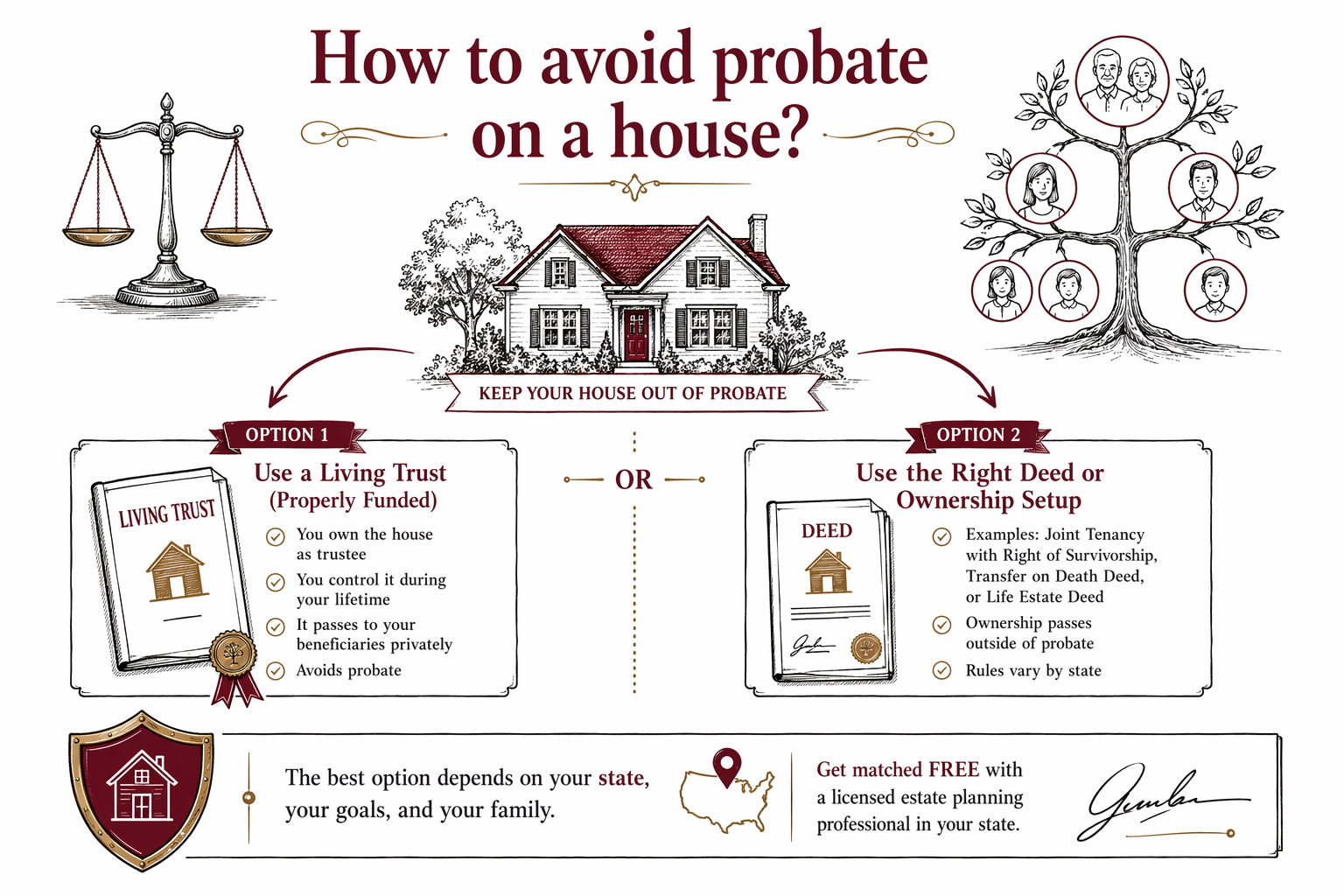
You may be able to avoid probate on a house by using the right ownership setup (often a living trust or the right co-ownership/beneficiary approach). Learn the common options, then talk with a licensed estate planning attorney in your state.
Quick answer: how probate usually happens—and what often helps
Probate is the court process used to move a person’s property to the people they chose after death—if the property is titled in a way that doesn’t automatically pass outside probate.
For a house, the most common ways families reduce or avoid probate are:
- Putting the house into a properly set up living trust (and keeping the trust “funded” by transferring the title)
- Using co-ownership rules (for example, joint ownership that has a “right of survivorship,” where allowed)
- Using beneficiary designations where your state allows them for real estate (some states allow certain mechanisms; others do not)
Because rules vary by state, the “best” option depends on your state’s law, how the deed is currently written, and your family situation. A licensed estate planning attorney can confirm what will work where you live.
Option 1 (often strongest): a living trust + putting the house in it
A living trust is a legal arrangement that can hold property during your life and name where it goes after death, without using the court probate process for trust-owned assets.
In practice, avoiding probate often depends on one key step: the house must be titled in the name of the trust (this is sometimes called “funding” the trust). If you create a trust but keep the house in your own name, probate may still happen.
Important: even with a trust, other issues can still lead to delays or paperwork (for example, liens, taxes, or mistakes in how title is transferred). Rules and requirements vary by state, so it’s best to verify with an attorney.
Option 2: joint ownership (right of survivorship) or other state-approved ways
Some families use joint ownership so that, when one owner dies, the surviving owner keeps the property automatically under the deed’s structure. This is sometimes described as a “right of survivorship.”
This approach can avoid probate for the house in many situations, but it is not always ideal. It can affect Medicaid planning in some cases, can complicate how the property is treated later, and may create issues if the “survivor” isn’t the person you would have chosen to keep everything long-term.
Also, deeds are picky: the exact wording and how the ownership is set up matters. If the deed is not written the way the state expects, you can end up with probate anyway.
Option 3: beneficiary designations for real estate (only if your state allows it)
Some states allow certain beneficiary tools for real estate, which can allow property to pass without probate if set up correctly. Other states do not allow this approach for typical homes.
If your goal is to avoid probate, don’t rely on hearsay or DIY forms from another state. The same name for a form or method can work differently depending on state law.
A licensed estate planning attorney can tell you whether your state allows beneficiary-style transfers for a house and what the requirements are so you don’t accidentally create a plan that fails.
Common pitfalls that can still lead to probate (even with “plans”)
Many families are surprised to learn that probate can still happen because of avoidable issues. Here are the most common pitfalls:
- Dying without a will (“intestacy”). Even if you plan to pass the house, having no clear estate plan can trigger court involvement.
- An out-of-date plan. Beneficiary designations, deed ownership, and trust documents can become inconsistent over time.
- DIY documents that don’t match your state. Estate planning rules and probate rules vary by state, and forms that work elsewhere may not work where you live.
- An unfunded trust. You create a living trust but don’t transfer the house title into it, so probate still happens for the house.
- Assuming beneficiary rules are automatic. Real estate usually follows the deed/ownership rules—not just your last wishes written in a letter.
- No clear backup plan. If something doesn’t work as expected, you want a plan for who handles the situation and how the house transfers.
Because you’re protecting a family member’s future, it’s worth getting this checked by a licensed estate planning attorney in your state.
What to do next (free help to find a licensed attorney)
Start by matching with a licensed estate planning attorney near you for a plan that fits your state and your goals. WillArbor is a FREE matching service—we help families connect with attorneys, but we are not a law firm, we do not draft documents, and we do not provide legal advice.
When you request a match, you’ll share contact information and your planning intent (like “avoid probate on a house,” and your state and preferred language). We do not ask for asset values, account numbers, SSNs, or sensitive details.
About cost: estate planning for a house is often quoted as a flat fee (not hourly), such as for a will and/or a living trust and deed/title work. Typical flat-fee ranges vary widely by state and complexity, but you may see rough ranges like $1,500–$3,500 for a standard basic package and $3,000–$6,000+ when additional documents, multiple properties, or trust funding/title transfers are involved. These are not quotes—your attorney will confirm the exact flat fee in writing after reviewing your situation.
If you’re worried right now, that’s understandable. A short consultation can clarify which option actually avoids probate in your state and what steps are needed so the plan works as intended.
To avoid probate on a house, families often use a living trust (properly funded) or the right deed/ownership setup, but the best option depends on your state—get matched free with a licensed estate planning attorney to confirm what will work.
Common questions
If I put my house into a trust, will probate definitely be avoided?
It often reduces probate, but it is not always a guarantee. Whether probate is avoided depends on your state’s rules and whether the trust is correctly set up and “funded” by transferring the house title to the trust. A licensed estate planning attorney in your state can confirm how it will work for your specific situation.
Can I avoid probate by naming someone to inherit the house directly?
Sometimes, but real estate usually follows deed/ownership rules. Some states allow beneficiary-style transfers for certain types of property, while others do not. Because rules vary by state, it’s important to confirm what’s allowed where you live before relying on a plan.
What if my deed is already in my name only—do I have to change it?
If your goal is to avoid probate, you may need to change how the house is titled (for example, into a living trust) or use another state-approved method. The correct step depends on your state and your current deed wording, so an attorney should review your deed and your documents to confirm the safest path.
Are DIY forms a good idea for avoiding probate on a house?
DIY can be risky because estate planning and probate rules vary by state, and real estate ownership rules are detailed. Common mistakes—like incorrect paperwork, missing signatures, or an unfunded trust—can lead to probate anyway. A licensed estate planning attorney can help you avoid common errors.
Related help
The difference between a will and a living trust, when each makes sense, and why many families use both.
Open → How to Avoid ProbatePlain-language ways families reduce or avoid probate — trusts, beneficiary designations, and joint ownership.
Open → What Happens If You Die Without a WillIntestacy explained: how your state decides who inherits when there is no will — and why that may not match your wishes.
Open →