Guides
Estate Planning For Single Parents
If you’re a single parent, the quickest way to protect your child is to decide who will care for them if you die, and to put that plan in legal documents. WillArbor can help you get matched for free with a licensed estate planning attorney in your state.
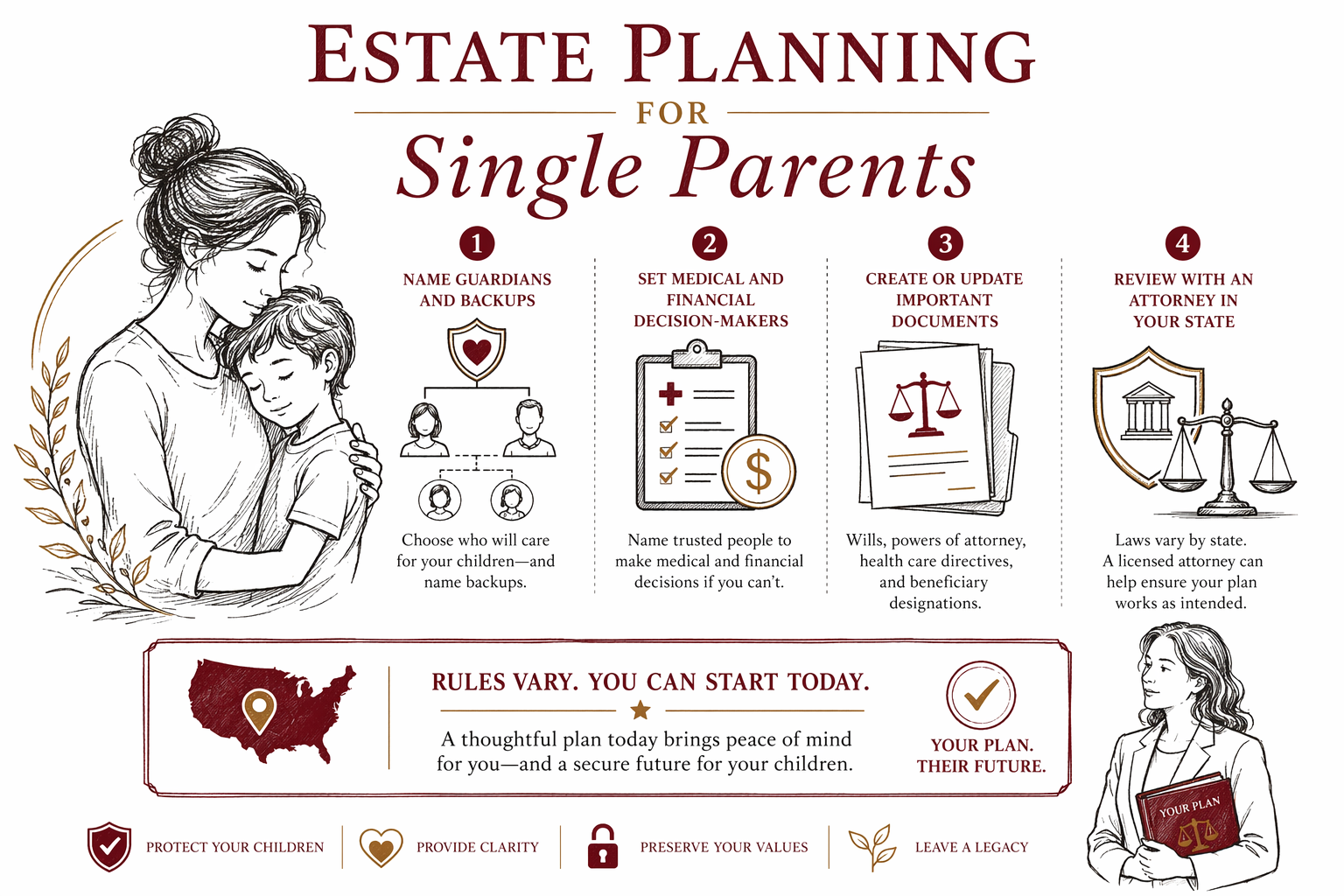
Answer first: What single parents should do in estate planning
For single parents, estate planning usually comes down to three core jobs: (1) name a guardian for your child, (2) decide what happens to your estate (and life insurance/beneficiary accounts, if any), and (3) choose adults who can make decisions for you if you become unable to.
These steps can help you avoid confusion for your child’s future and reduce the chances of your family getting stuck in court. In the US, the best exact documents and rules depend on your state.
WillArbor is not a law firm and can’t draft documents or give legal advice. But we can help you understand what to ask for and get matched for free with a licensed estate planning attorney near you through get matched.
- Name a guardian for your child (and a backup, too).
- Use legal documents that your state recognizes—often a will and related forms.
- Add powers of attorney and advance directives so there’s no gap if you can’t speak for yourself.
Step-by-step: A practical plan you can start this week
You don’t need to know every legal term to begin. Start with decisions your family will need, then bring those decisions to a licensed attorney in your state.
Estate planning rules vary by state, and the right mix of documents can differ. Your attorney will guide you based on your situation and state law (for example, how guardianship is handled and what your state requires).
A simple way to organize your thoughts:
- Decide who should be your child’s guardian and who should be the backup.
- Choose who should manage money or inheritances for your child if they’re still a minor.
- List people you trust to make medical and financial decisions if you cannot.
- Decide where you want your assets to go after your bills and debts are paid.
- Consider whether probate avoidance is important to you (many plans use a living trust, but not every situation requires one).
Then, schedule a consultation and confirm the attorney’s flat fee in writing before any work begins.
- Bring your questions—don’t feel pressured to decide everything at the first meeting.
- Ask whether a will is enough or whether a trust is worth considering in your state.
Why guardianship wording matters (and why backups are crucial)
As a single parent, naming a guardian is often the most emotionally important part of estate planning. But it’s also a legal decision, and the details can affect how your wishes are understood and followed.
Many families choose a guardian who is loving and stable, and then pick a backup person in case the first choice can’t serve. If you don’t name a guardian in a will or other approved way, a court may decide—usually based on what the law allows and what it considers best for the child.
Common pitfalls to avoid:
- Forgetting a backup guardian.
- Choosing someone without discussing it first (guardianship can be a heavy responsibility).
- Relying on a “letter of wishes” alone—these can be helpful to your family, but they may not replace the legal document your state requires.
- Using DIY forms that aren’t valid in your state.
This is why it’s wise to work with a licensed estate planning attorney who practices in your state and can draft language that your local courts will recognize.
- Estate planning rules vary by state—what counts as a valid guardianship nomination can differ.
- Confirm the attorney is licensed and in good standing with your state bar before hiring.
Will vs. living trust (plain language, no jargon)
A will is a legal document that generally tells the court how to handle your estate after you die. A will can also name your child’s guardian.
A living trust is another legal tool that can hold assets so they can be managed and passed along more directly, sometimes reducing court involvement after death. Whether a trust is worth it depends on your situation and state rules.
Here’s the key idea for single parents: a will is commonly the foundation, especially for guardianship. A trust may add benefits, but it also creates more steps—like properly funding the trust (moving the right assets into it) so it works the way you expect.
Common pitfalls:
- An out-of-date will or guardianship plan.
- A “trust” that was never funded, so it doesn’t do what the family thinks it does.
- Assuming beneficiary designations automatically match what your will says—these must often be reviewed separately.
Your attorney can explain what makes sense under your state’s rules and help you avoid paperwork that looks correct but fails in real life.
- Many estate plans are a combination: a will plus powers of attorney and advance directives, sometimes with a trust.
Powers of attorney and advance directives: protect your choices while you’re alive
Estate planning is not only about what happens after death. It’s also about preventing a gap if you become unable to communicate or make decisions.
Two common document types are:
- A power of attorney for financial decisions (so someone you trust can handle tasks like paying bills or managing certain accounts, if allowed under your state).
- An advance directive (often including a “living will” and/or health care instructions) that guides medical decisions.
Rules vary by state, and the names and exact forms can differ. That’s another reason to rely on a licensed attorney rather than generic DIY templates.
Pitfalls to avoid:
- Using old forms that don’t match your current state requirements.
- Naming someone who isn’t willing or available.
- Assuming family members can automatically make decisions—without the right paperwork, they may have to go through a legal process.
If you want your child cared for and your own wishes respected, these documents are usually part of a complete plan.
- Confirm your documents are signed and witnessed/notarized exactly as required in your state.
Cost: what single parents often pay (and what drives the price up or down)
Estate planning is often quoted as a flat fee (not hourly). That said, the real price depends on the documents you need, your state, and how complex your situation is. Cost ranges below are general educational estimates, not quotes.
Typical flat-fee ranges you may see in the US for basic to more complete plans:
- Basic will and essential related documents (like guardianship, health care directives, and powers of attorney): often around $500 to $1,500.
- Will plus a living trust (and related paperwork) or a more tailored plan: often around $1,500 to $3,500+.
- More complex situations (for example, multiple beneficiaries, special needs planning, or plans involving several states): may cost more.
What can increase the cost:
- Trust planning and the need for more drafting and review.
- Multiple children, blended family factors, or complex guardian/asset arrangements.
- Needing extra documents (for example, special decision-making instructions).
What can lower the cost:
- A straightforward plan with clear choices and a single state of residence.
- Using a simple package of documents the attorney recommends.
WillArbor is free for families. Participating attorneys typically pay a flat fee to take part in the service—there is never a share of your attorney’s fees. Before any work starts, ask the attorney to confirm the flat fee in writing and make sure it covers what you need.
Finally, rules vary by state—so the only accurate pricing for your situation is what a licensed attorney in your state offers.
- Flat-fee plans are common, but always confirm scope and total cost in writing before signing anything.
Pitfalls that commonly hurt families (especially single parents)
Even well-meaning plans can fail if they’re missing key parts or are outdated. Here are common problems to watch for:
- Dying without a will (often called “intestacy”): then your state decides guardianship and how assets are handled.
- Not naming a guardian or naming one without a backup.
- Out-of-date beneficiary designations (for example, on retirement accounts or life insurance) that don’t match your plan.
- DIY forms that look right but aren’t valid in your state.
- An unfunded trust, so it can’t do the job it was created to do.
- Forgetting to review your plan after major life changes (moving states, changes in relationships, new children, serious illness).
Estate planning rules vary by state and change over time. A licensed estate planning attorney can help you avoid “paperwork that sounds good” but doesn’t work when families need it most.
If you’re feeling overwhelmed, you’re not alone. Start with the decisions: guardian(s), who you trust for medical and financial choices, and what you want to happen next.
- If you move to a new state, ask an attorney whether your documents still meet that state’s requirements.
How WillArbor helps (free) and how to choose the right attorney
WillArbor is a FREE matching service, not a law firm and not your lawyer. We don’t draft documents, and we don’t collect sensitive details like account numbers, SSNs, or asset values.
We only collect contact information plus your planning intent (name, phone, optional email, state, what you want to plan, and your preferred language). That helps connect you with a licensed estate planning attorney near you.
When you meet an attorney, you can ask practical questions such as:
- What documents do you recommend for a single parent in my state?
- How do you handle guardianship and backup guardians?
- Will beneficiary designations need review as well?
- Is your pricing a flat fee? Can you confirm the total in writing before any work starts?
- Are you licensed in my state, and in good standing?
You stay in control: compare options and choose who to hire. If you feel pressured or unclear about the flat fee and what’s included, it’s okay to pause and ask more questions.
If you’re ready, you can explore services and then get matched for free with a licensed estate planning attorney in your state.
- Be sure any attorney you hire is licensed in your state—confirm with your state bar if possible.
As a single parent, focus on naming guardians and backups, setting medical and financial decision-makers, and reviewing your plan with a licensed attorney in your state—rules vary, and you can start by getting matched for free with WillArbor.
Common questions
Can I name my child’s guardian without a trust?
Yes, often a will is enough to name a guardian for minor children. Whether you also need a trust depends on your goals and your state’s rules, but guardianship is commonly handled through a will.
If I already have beneficiary designations, do I still need a will?
Beneficiary designations and wills can overlap, but they don’t automatically replace each other. A will can handle guardianship and other instructions your beneficiaries can’t cover. It’s common to review both.
What happens if I don’t make an estate plan as a single parent?
If you die without the required legal documents in your state, your state may decide guardianship and how your property is handled. This can create delays and uncertainty for your child and your family.
Are online DIY estate planning forms safe?
They can be risky because rules vary by state, and small mistakes (like required signatures, language, or missing parts) can cause delays or failures. A licensed attorney can help ensure the documents meet your state’s requirements.
How much does estate planning cost for single parents?
Many attorneys quote estate planning as a flat fee, but the total depends on documents and complexity and varies by state. General ranges you may see are roughly $500–$1,500 for basic wills with key related forms and often $1,500–$3,500+ when a trust or additional complexity is involved.
Related help
The difference between a will and a living trust, when each makes sense, and why many families use both.
Open → How to Avoid ProbatePlain-language ways families reduce or avoid probate — trusts, beneficiary designations, and joint ownership.
Open → What Happens If You Die Without a WillIntestacy explained: how your state decides who inherits when there is no will — and why that may not match your wishes.
Open →