Guides
How to Choose an Executor
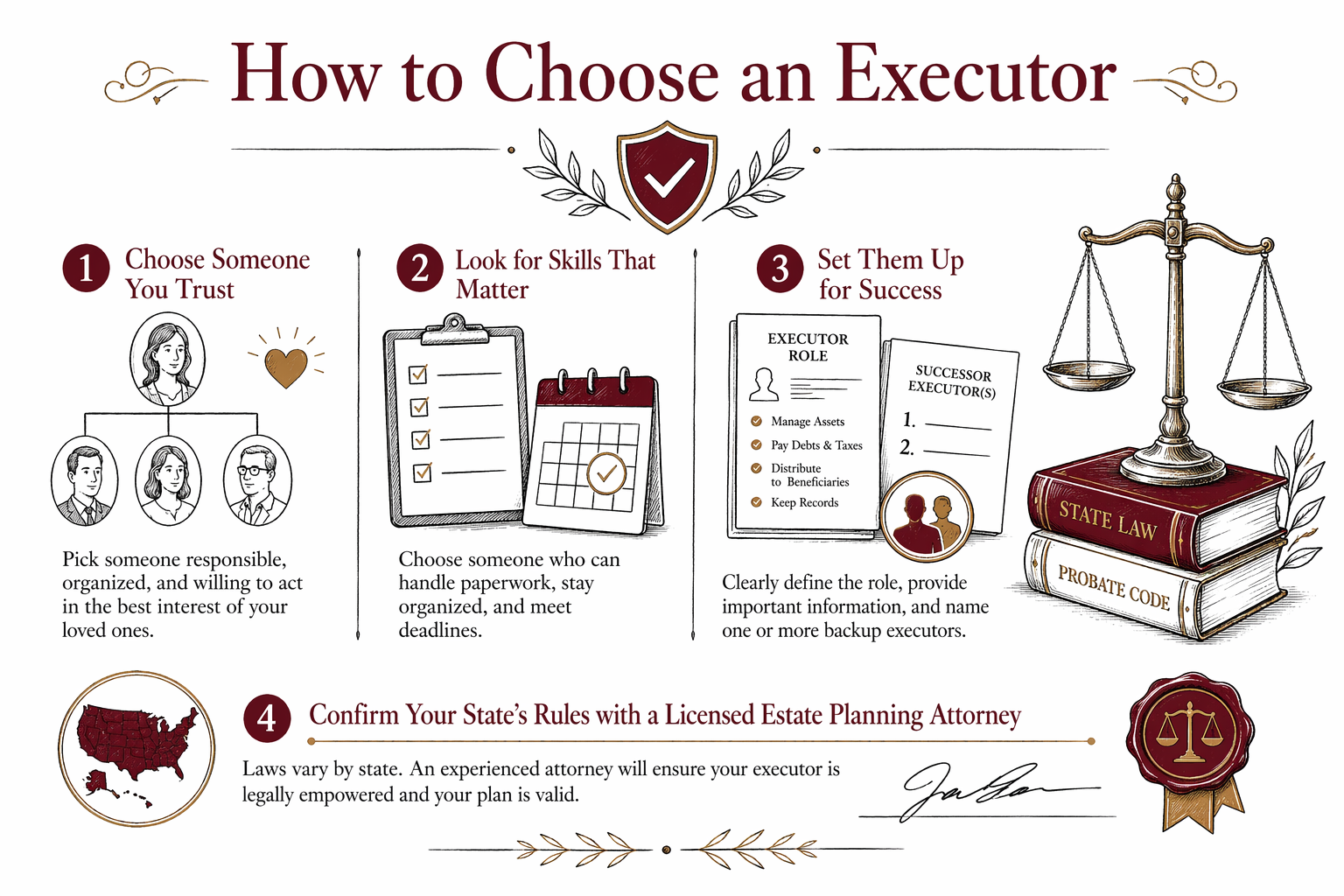
An executor is the person who manages your estate after you die—collecting assets, paying valid bills, and helping file what the court requires. You choose them in a will, and the “right” choice depends on trust, organization, and your state’s rules.
First: what an executor actually does
In plain terms, an executor (sometimes called a “personal representative”) helps carry out your wishes after your death. The exact duties vary by state and by how your estate is set up, but it often includes handling paperwork and coordinating next steps.
Common tasks include:
- Finding and reading your will (if you have one)
- Managing estate accounts and moving assets as needed
- Paying debts and expenses the estate owes
- Filing required court forms, and responding to questions from the court
- Distributing property to the people you name—when legally allowed
If you’re also using a living trust, many duties may belong to a “trustee” instead. A licensed estate planning attorney can explain how your plan works in your state. For a broader overview, see Will vs. Trust basics.
Who makes a good executor (and who usually struggles)
A good executor is someone your family can rely on and that you trust to make careful decisions. Beyond trust, you’re looking for steady judgment, organization, and the willingness to do the work—even when emotions are high.
Good qualities to consider:
- Organized and calm under pressure
- Willing to communicate with family clearly
- Comfortable with paperwork and deadlines
- Honest about problems and asks for help when needed
- Someone who can treat everyone fairly (no favoritism)
People who often struggle:
- Anyone who is frequently unavailable or overwhelmed
- Someone who may argue with family members regularly
- Someone who lives far away with no support
- Anyone who has a conflict of interest (for example, if they’re also the main beneficiary)
That doesn’t mean an executor must be “perfect”—it means you’re choosing the person most likely to keep the process moving. If you want a plan that reduces family conflict, it’s especially worth discussing options with an attorney.
Executor vs. trustee vs. guardian (quick clarity)
Names can be confusing. Here’s the simple way to separate them.
- Executor: manages your estate after death under a will.
- Trustee: manages assets in a trust (often after death, depending on the trust).
- Guardian: a court-appointed caregiver for minor children if you name one.
Many families choose one trusted person to be both executor and trustee, but not always. Also, your executor does not automatically become your children’s guardian—guardianship is a separate decision, and your state’s rules apply.
If you’re still figuring out the roles in your plan, you can browse estate planning essentials and then get matched for a licensed attorney conversation.
How to set up your executor to succeed
Choosing someone is only the first step. You can also help them do the job by reducing confusion and making sure they understand what you want.
Practical steps to prepare:
- Choose a primary executor and a backup executor (so you’re not stuck if the first person can’t serve).
- Talk with the person you’re considering before you name them—ask if they’re willing and able.
- Share where important documents are kept (for example: will, trust documents, insurance information, and contact notes). Keep in mind you should not share sensitive information in a way that could put you at risk.
- Tell your executor what “success” looks like to you (for example, clear communication with family, timely distributions, or paying certain expenses promptly if allowed).
- Ask your attorney what your state requires to start the process (some states have specific forms, timeframes, and court steps).
Note: You generally don’t need to give your executor every detail of your life—but you do want them to have enough to avoid delays. Avoid common pitfalls like vague instructions, naming someone who is unwilling, or forgetting to update your plan after big life changes.
Important pitfalls to avoid
Executor choices often go wrong in preventable ways. These are some of the most common issues families run into.
- Dying without a will (called “intestacy”): your state decides who handles things instead of you.
- Out-of-date plan: changes in marriage, divorce, children, or moving states can make an old executor choice no longer fit.
- Naming someone who can’t serve: for example, if they move away, become unable to act, or don’t understand the job.
- Confusing roles: mixing up executor, trustee, and guardian, or assuming one role covers everything.
- DIY forms that don’t match your state: court acceptance and enforceability can vary.
Also keep in mind: [rules vary by state]. Estate administration, court procedures, and even executor/guardian terminology can differ. A licensed estate planning attorney in your state can help you avoid problems that look small now but create big delays later.
How much does it cost to name and set up an executor?
Estate planning services are often quoted as a flat fee, not hourly billing. For executor-related parts, costs can vary based on your documents and your situation—such as whether you’re making a simple will, adding a trust, planning for minor children, or handling more complexity.
Typical flat-fee ranges you may see (not quotes):
- A basic will in many states: often ranges roughly from a few hundred dollars up to around $1,000+.
- A more complete will or a plan that includes extra components (like guardian nominations and powers of attorney): often ranges higher, sometimes around $1,000–$3,000+.
- A fuller estate plan that uses a living trust: often ranges higher still, commonly around $2,500–$5,000+ depending on complexity and state.
What can move the price up or down:
- Your state (and the documents it requires)
- Whether you add a living trust
- Whether you’re planning for minor children
- Whether assets and beneficiaries are straightforward
- Whether you need related documents (like powers of attorney and advance directives)
These ranges are general and not promises. When you talk with attorneys, confirm the flat fee in writing before any work starts. If you’re worried about cost, that’s a normal conversation to have—ask what’s included in the fixed fee.
Get matched with a licensed attorney (free for your family)
WillArbor is a free matching service—not a law firm, not a lawyer, and we don’t draft documents or provide legal advice. We help families connect with a licensed estate planning attorney near them to discuss questions like “Who should be executor?”
If you’re ready, you can start here: Get matched. Tell us only your contact info, your state, and your planning intent (for example, that you want to choose an executor). We do not collect asset values, account numbers, SSNs, or sensitive estate details.
Then, you can compare options and choose who to hire. A good attorney should explain your state’s rules in plain language and confirm the flat fee in writing before work begins. If you want more guidance first, explore estate planning services and guides.
Choose an executor you trust, who can handle paperwork and deadlines, and set them up with clear roles and backups—then confirm your state’s rules with a licensed estate planning attorney, matched for free through WillArbor.
Common questions
Can I name my spouse as executor if I’m worried they might be overwhelmed?
Yes, many people name a spouse, but it should be based on the person’s ability and willingness—not just relationship. Consider talking with them first and naming a backup executor as well. An attorney can also explain options in your state.
Does my executor get paid?
Sometimes executors may be entitled to compensation, but rules vary by state and by your documents. Many estate plans outline expectations, and courts may oversee compensation. Ask a licensed attorney for how it works where you live.
What if my executor and beneficiary are the same person?
That can create confusion or family conflict. It may also raise questions about impartiality, depending on your situation and your state. A licensed estate planning attorney can help you weigh the risks and write provisions appropriately.
If I have a trust, do I still need an executor?
Often, yes. Trusts and wills can work together, and estate administration may still be needed for things not inside the trust or for court filings. The right setup depends on your state and the documents in your plan.
What’s the biggest mistake families make when choosing an executor?
The most common mistake is choosing someone without checking whether they’re willing and able to do the work. Another frequent issue is using outdated documents or DIY forms that don’t follow state requirements. State rules vary, so it’s worth getting professional guidance.
Related help
The difference between a will and a living trust, when each makes sense, and why many families use both.
Open → How to Avoid ProbatePlain-language ways families reduce or avoid probate — trusts, beneficiary designations, and joint ownership.
Open → What Happens If You Die Without a WillIntestacy explained: how your state decides who inherits when there is no will — and why that may not match your wishes.
Open →