Guides
What is a pour over will?
A pour over will is a will that “catches” assets that end up in your name at death and sends them to your trust. It’s often used to protect a plan that mainly lives inside a living trust.
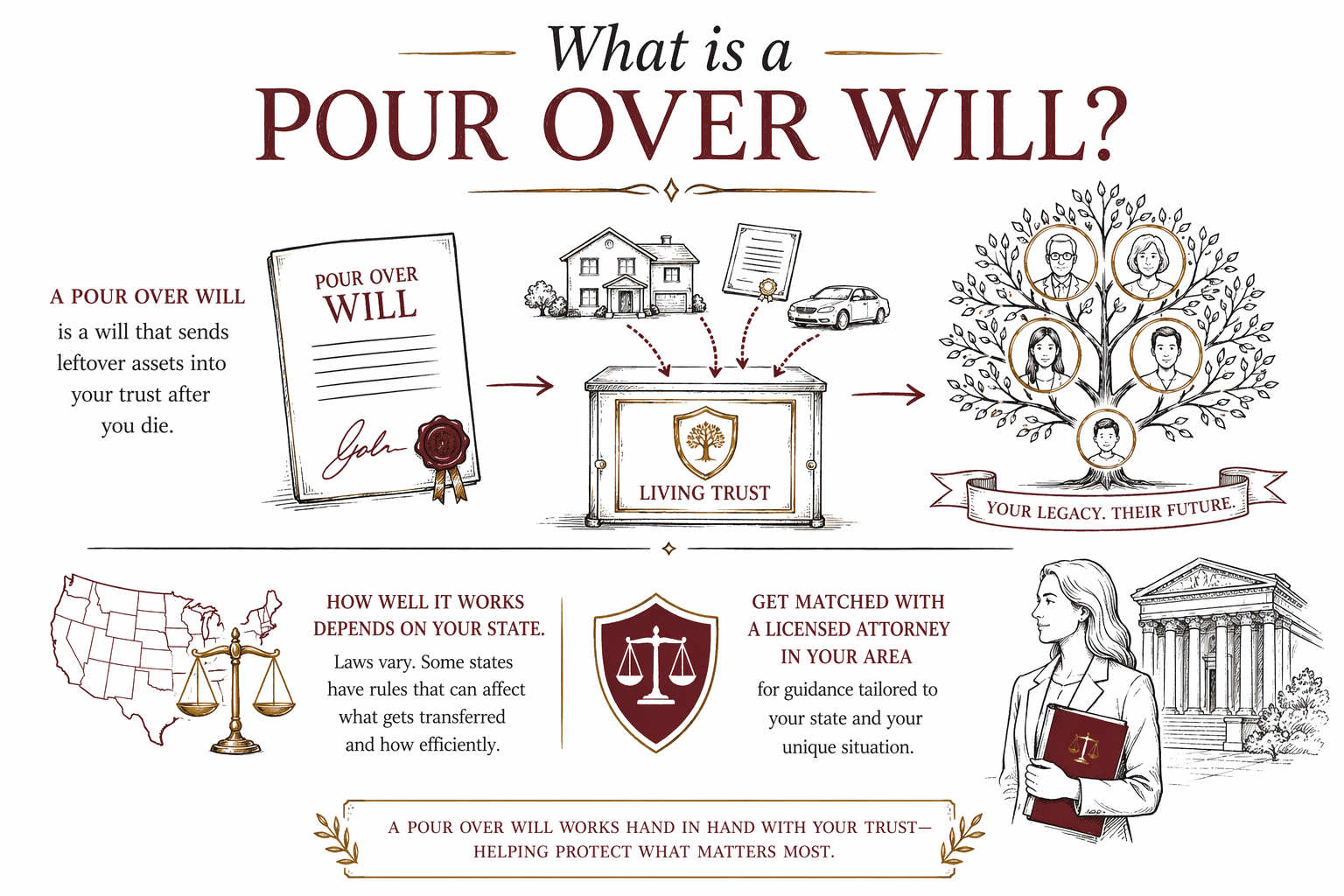
Quick answer: what a pour over will does
A pour over will is a will that directs any leftover assets you own at your death to go into a trust you created (usually a living trust).
Think of it as a backup net. Your main plan may be the trust, but life doesn’t always go perfectly—sometimes an account or piece of property is still titled in your individual name. The pour over will helps move those leftovers into the trust.
Important: the exact legal effect can depend on your state’s probate and trust rules, which can change over time. A licensed estate planning attorney in your state can explain what this means for your situation.
How it fits with a living trust (and why people use it)
Many people build an estate plan around a living trust because it can help avoid or reduce probate for assets that are properly placed into the trust during life.
A pour over will supports that plan. If something was unintentionally left out of the trust, the pour over will can move it into the trust after death—so the remainder of your plan can follow the trust’s instructions.
In plain terms: the trust is where the “real” instructions usually live; the pour over will is the “cleanup” piece that tries to get missed assets into the right place.
What happens to assets not in the trust?
In general, assets that are titled only in your personal name at death may go through probate. The pour over will can direct them toward the trust, but that doesn’t necessarily eliminate probate in every situation.
Whether probate is reduced, delayed, or avoided often depends on state rules, how your accounts are titled, and what documents you used. This is why “rules vary by state” is not just a reminder—it changes the practical outcome.
Common reality check: beneficiary designations (like for life insurance or retirement accounts) usually work differently than a will or trust, and you may need to review them separately.
Common pitfalls (and how to avoid them)
A pour over will can be helpful, but it’s not a magic fix for missing steps. Here are common issues families run into:
- Dying without a will (intestacy): If you don’t have a will and you intended a trust plan, state law may decide where assets go.
- An out-of-date plan: Even with a pour over will, your trust terms, guardianship choices (if applicable), and key instructions should be current.
- DIY forms that don’t match your state: Pour over provisions are only useful if the documents are drafted correctly for your state.
- An “unfunded” trust: A pour over will can only move what’s left. If much of your property was never transferred or titled to the trust, your plan may still be complicated.
- Missing or incorrect beneficiary designations: Many assets pass outside probate based on who’s named. A pour over will usually cannot override those.
- No named guardian (if you have children): Estate planning isn’t only about property—guardianship instructions should be clear.
Because these details vary by state, it’s wise to review your full plan with a licensed estate planning attorney.
Cost and what affects it (flat fee ranges, not quotes)
Attorney fees for a will, a living trust, and a pour over setup are commonly quoted as a flat fee (not hourly). That said, the real cost depends on the documents needed, the complexity of your situation, and your state.
Typical flat-fee ranges you may see (for general planning) include:
- For a basic will-only plan: often a few hundred to around $1,000+.
- For a trust-based plan (living trust + funding guidance + related documents): often around $1,500 to $3,000+.
- For adding specific items (like powers of attorney, advance directives, and additional trust/will details): the total may be higher.
These ranges are not quotes, and they can go up or down. The best next step is to get matched with a licensed estate planning attorney and confirm the flat fee in writing before any work begins.
How WillArbor helps you get matched (free for your family)
WillArbor is a free matching service. We connect families with licensed estate planning attorneys in their state who can answer your questions and help you decide whether a pour over will (and a trust plan) makes sense.
We do not draft documents and we are not a law firm. We also do not provide legal advice. Our role is to help you find the right attorney to speak with in your state.
If you’re ready, you can start here: get matched. Share only contact information and what you want to plan (for example, “living trust backup with pour over will”), along with your preferred language and state—no account numbers or sensitive details are needed.
A pour over will is a will that sends leftover assets into your trust after you die, but how well it works depends on your state—get matched with a licensed attorney in your area for guidance.
Common questions
Do I need a pour over will if I already have a living trust?
Often, yes—many people include a pour over will to catch assets that were not properly placed into the trust before death. But whether you need one, and how it works in your state, depends on your documents and your state’s probate rules.
Will a pour over will completely avoid probate?
Not necessarily. Assets that still require probate may still go through a probate process depending on how your state treats the asset and how your plan is set up. An attorney in your state can explain the likely outcome.
Can a pour over will override beneficiary designations like life insurance or retirement accounts?
Usually, no. Many beneficiary designations pass based on the form you file with the account provider, not through your will or trust. Reviewing those designations is an important separate step.
Is a pour over will the same thing as a living will?
No. A living will usually refers to advance directives about healthcare decisions. A pour over will is a will that directs leftover assets into your trust after death.
Related help
The difference between a will and a living trust, when each makes sense, and why many families use both.
Open → How to Avoid ProbatePlain-language ways families reduce or avoid probate — trusts, beneficiary designations, and joint ownership.
Open → What Happens If You Die Without a WillIntestacy explained: how your state decides who inherits when there is no will — and why that may not match your wishes.
Open →