Guides
Is an online will legal?
Yes, an online will can be legal if it is made and signed in the way your state requires. The important part is not where you found it — it is whether it meets your state’s rules and truly reflects your wishes.
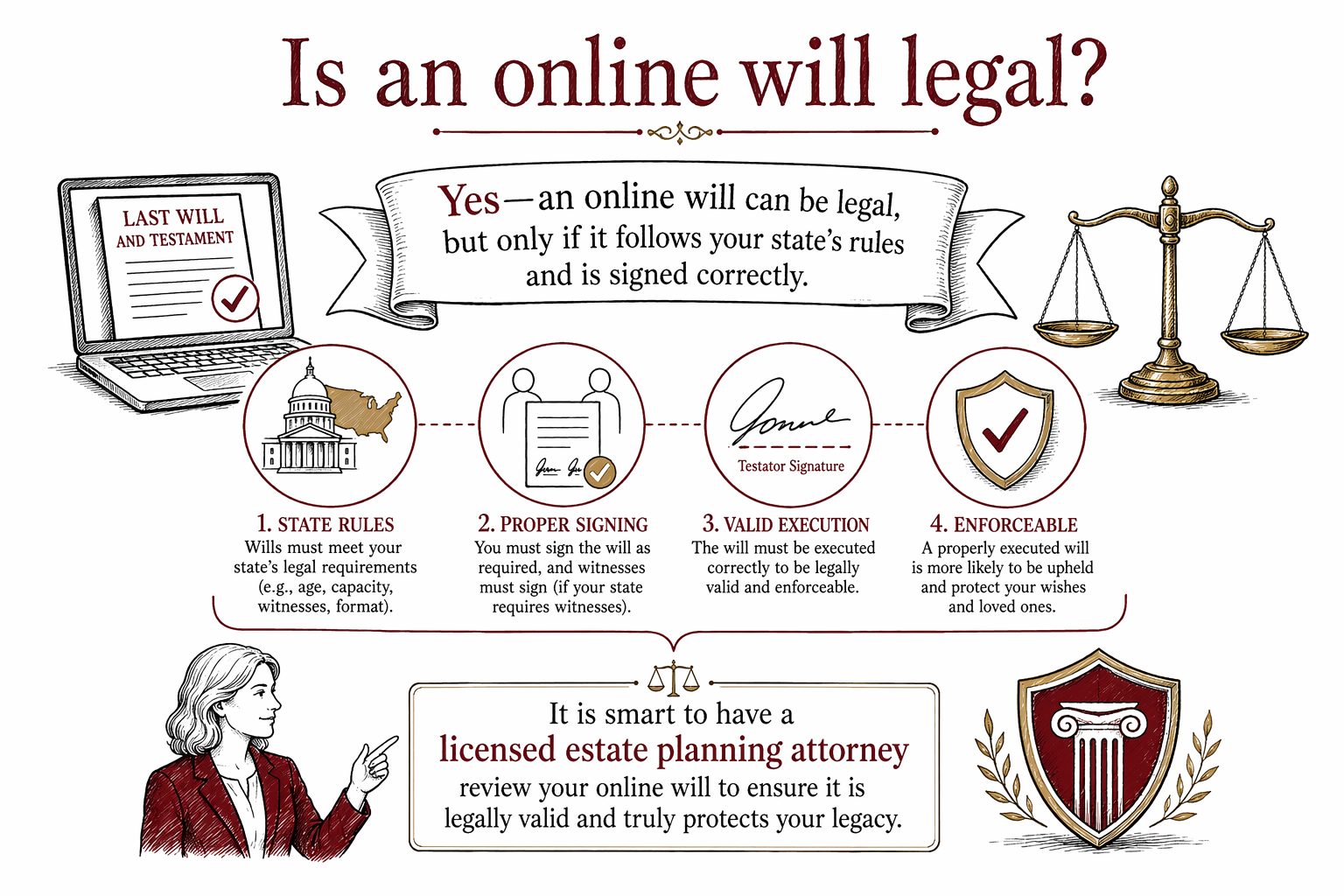
Short answer: sometimes yes, but state rules control
An online will is not automatically invalid just because you used the internet. In many states, a will can be legal if it is written clearly, signed correctly, and witnessed the way state law requires.
But estate planning rules vary by state, and some states have extra requirements that DIY forms do not handle well. A form that looks fine online can still fail if it was not signed, witnessed, or prepared for your state correctly.
That is why many families use an online will as a starting point, then ask a licensed estate planning attorney in their state to review it. WillArbor is a free matching service, not a law firm and not your lawyer.
- State law may require witnesses, a notary, or both.
- A valid will in one state may not be valid in another without changes.
What can make an online will legal
A will usually needs a few basic things: the right age and mental capacity, a clear statement that it is your will, and the proper signatures. In many states, witnesses must watch you sign or acknowledge the document.
If your state allows self-proving affidavits or notarization, those steps can make probate easier later, but they do not replace every signing rule. If the document is not executed correctly, your family may end up dealing with delays or a court challenge.
A licensed estate planning attorney can tell you whether your online form matches your state’s rules and whether it is enough for your family’s situation. Most estate planning is quoted as a flat fee, not hourly, but the real number depends on the documents, complexity, and the state — ranges are not quotes.
- Unsigned or improperly witnessed wills are a common problem.
- Out-of-date forms may not reflect current state law.
When an online will may not be enough
A simple online will may be okay for a very basic situation, but it often is not enough if you own property in more than one state, have a blended family, have a child with special needs, or want to reduce the chance of probate problems.
It also may not solve common pitfalls like an out-of-date beneficiary designation on a retirement account or life insurance policy, or a trust that was created but never funded. Those issues can matter as much as the will itself.
If you are naming guardians for minor children, leaving property to children from a prior relationship, or trying to avoid family conflict, it is wise to have a lawyer check the plan. A small mistake in wording can create a large problem later.
- Dying without a valid will can mean state intestacy rules decide who inherits.
- DIY forms can miss state-specific rules and family-specific details.
WillArbor can help you find the right kind of attorney
If you want to move past the guesswork, WillArbor can help you get matched with a licensed estate planning attorney near you. The service is free for families, and participating attorneys pay a flat fee to take part — never a share of legal fees.
You stay in control. You can compare attorneys, ask about language support, ask whether they handle wills, trusts, powers of attorney, and advance directives, and confirm the flat fee in writing before any work starts.
When you reach out, keep it simple: tell us your name, phone number, optional email, your state, what you want to plan, and your preferred language. We do not ask for asset values, account numbers, SSNs, or document contents.
- You choose whether to hire an attorney.
- Always confirm the attorney’s bar license in your state.
A practical next step for families
If your goal is peace of mind, start with the basics: make sure your will is valid in your state, check beneficiary forms, and think about guardians for children and who should handle your affairs if you cannot.
If you already have an online will, bring it to a licensed attorney and ask whether it is properly signed and whether anything should be updated for your state or family situation. That is often the safest way to turn a draft into a plan your family can rely on.
For more plain-language help, see our guides or get matched with a licensed estate planning attorney.
- A valid will is only one part of a full estate plan.
- It is okay to start simple and improve the plan later.
An online will can be legal, but only if it follows your state’s rules and is signed correctly, so it is smart to have a licensed estate planning attorney check it.
Common questions
Can I just use an online will and be done?
Sometimes, but not always. A simple online will may work for a basic situation if it is valid under your state’s rules, but it can miss important details or fail if it is signed or witnessed incorrectly.
Do I need a lawyer to make a will legal?
Not always, but many families benefit from a licensed estate planning attorney, especially if they want to protect children, avoid probate problems, or deal with a more complex family or property situation.
What is the biggest mistake people make with online wills?
The most common mistakes are using a form that does not fit the state, signing it wrong, forgetting witnesses, or not updating beneficiary forms and other estate documents after life changes.
Is WillArbor a law firm?
No. WillArbor is a free matching service, not a law firm and not your lawyer. We connect families with licensed estate planning attorneys, and the attorney you choose decides how to handle your legal needs.
Related help
The difference between a will and a living trust, when each makes sense, and why many families use both.
Open → How to Avoid ProbatePlain-language ways families reduce or avoid probate — trusts, beneficiary designations, and joint ownership.
Open → What Happens If You Die Without a WillIntestacy explained: how your state decides who inherits when there is no will — and why that may not match your wishes.
Open →