Guides
How to disinherit someone?
You usually can’t “erase” a person just by being upset—but you can make clear, legal decisions about who inherits and who doesn’t. We’ll explain common options and safer next steps, then help you get matched with a licensed attorney near you for free.
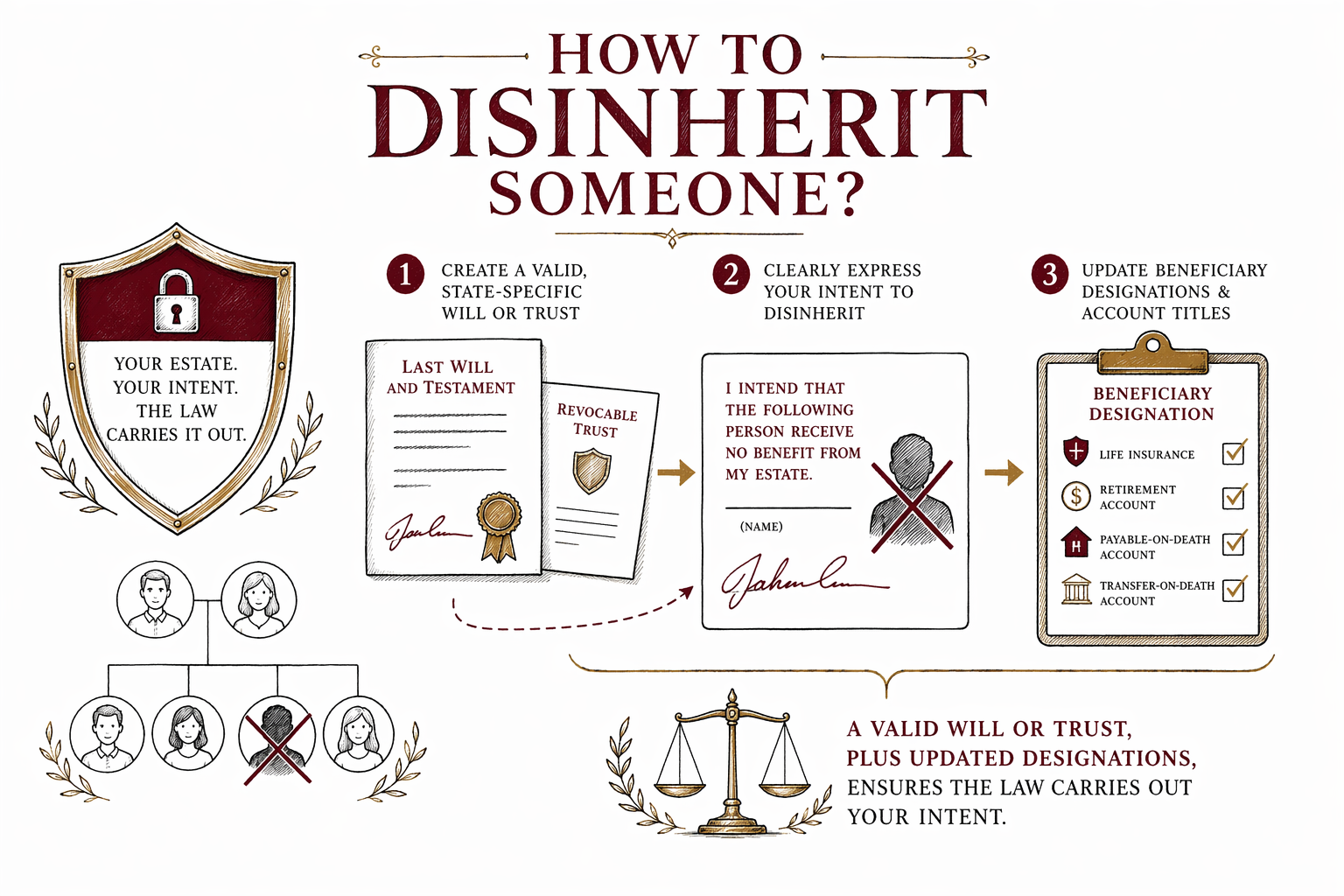
First: the honest answer to “How do I disinherit someone?”
Most of the time, “disinherit” means you intentionally change your estate plan so a specific person receives nothing (or something different). The way you do that depends on your situation—like whether you’re using a will, a trust, and whether state law requires certain people to receive something.
If you’re worried about a child, a spouse, or another close family member, the most important point is this: some states have protections for certain heirs, and rules vary a lot by state. For that reason, get general guidance first and then confirm your plan with a licensed estate planning attorney in your state.
WillArbor is a free matching service that helps you connect with a licensed estate planning attorney near you. We don’t draft documents and we’re not your lawyer—so treat this as education, not legal advice. You stay in control of what you choose to sign and who you hire.
- Disinherit usually means “intentional change” in a will or trust—not a casual note or phone call.
- State rules vary, especially for spouses, children, and sometimes other relatives.
Common, legally safer ways people reduce or remove someone’s inheritance
Estate plans are more than one form. For disinheriting someone, families often use one or more of these tools, depending on their state and their goals.
1) Use a will to name beneficiaries clearly
A will can state who receives your property and who does not. If you leave specific instructions, the attorney can help you make sure the language matches your intent and your state’s requirements.
2) Use a living trust to control what happens after death
Some families use a living trust to manage assets and distribute them without going through probate (in many cases). Trust terms can also direct that a person receives nothing.
3) Update beneficiary designations (when applicable)
Some assets pass outside a will (for example, certain retirement accounts or life insurance). In many situations, the beneficiary form controls who gets the money—so “disinherit” in your will may not matter for those accounts. Reviewing these forms is a common step in estate planning.
4) Consider “leaving something to others” rather than attacking the person
Courts and attorneys prefer clear instructions over emotional wording. A plan that focuses on your intended beneficiaries and your reasons—within reason—can be easier to understand and defend than a vague or angry statement.
Because details matter, ask a licensed attorney in your state how your specific assets and family situation are handled.
- A will sets out your instructions, a trust can control distributions, and beneficiary forms can override both for some assets.
- Clear, specific language usually matters more than dramatic language.
Guardrails that matter: spouses, children, and “mandatory” inheritance rules
In many places, married spouses and sometimes children may have legal rights that limit how completely someone can be left out. That does not mean you have “no options,” but it does mean your plan needs state-specific guidance.
For example, some states may treat a spouse’s rights differently than those of an adult relative. Others may have rules about minors or about certain surviving family members. These laws can also change over time.
This is why “rules vary by state” isn’t a small footnote—it’s central to whether disinheritance works as you expect. A licensed estate planning attorney can explain what your state allows and what you can do to meet your goal as closely as the law permits.
- Your relationship to the person matters (spouse and minor children are often treated differently).
- Only an attorney in your state can tell you what’s possible for your family.
Common pitfalls that cause “disinheritance” to fail
Families often discover too late that someone still received something—usually because the plan didn’t match the law or didn’t cover the right assets.
- Dying without a valid will (intestacy): If you die without instructions, the state’s default rules decide who inherits.
- Out-of-date beneficiary designations: Even with a thoughtful will, some accounts follow the beneficiary form instead.
- DIY forms that don’t fit your state: Estate documents need the right wording and the right rules for where you live.
- Not naming a guardian (if you have children): If you have minors, choosing guardians is part of protecting your family.
- An “unfunded” trust: A trust may exist on paper, but if assets weren’t properly moved or titled, the trust may not control what you thought it would.
- Vague instructions or unclear people: Naming someone the wrong way (or omitting details required by the form) can create confusion.
These pitfalls are fixable, but the fix depends on your state and your documents. If you want a practical starting point, browse our guide hub at Estate planning guides and then get matched to review your situation with a licensed attorney at WillArbor services or get matched.
- If you want someone to receive nothing, your plan has to cover the right “mechanisms” (will/trust/beneficiaries).
- State-specific wording and follow-through are often what make the difference.
What to do next (practical, non-scary checklist)
If your goal is to remove or reduce someone’s inheritance, the safest next step is to talk with a licensed estate planning attorney who can explain what your state allows and help you build a plan that matches your intent.
Before you request help, gather basic facts—without sharing sensitive information:
- Who you are (and whether you’re married)
- The general goal (e.g., “no inheritance to this person” or “leave to others”)
- Which documents you already have (a will, trust, power of attorney, etc.), if any
- Your state of residence
When you contact an attorney, ask clear questions like:
- What would be required in my state to accomplish “no inheritance” to this person?
- Are there people who may have legal rights to inherit even if I don’t want that?
- How should I handle beneficiary forms for accounts that may not follow my will?
- Would a will, a trust, or both be the better approach here?
About cost: estate planning is often quoted as a FLAT FEE (not hourly), but the real number depends on the documents you need and the complexity of your family situation and state requirements. For many families, typical flat-fee ranges are roughly:
- Simple will: about $300–$1,500
- Will plus related documents (like powers of attorney and advance directives): about $800–$2,500
- Living trust-based plan (often more documents and setup): about $1,500–$4,500+
These are broad educational ranges, not quotes. Any range can be higher in complex families or certain states. Always confirm the exact flat fee in writing before work begins.
If you’d like a free, non-binding way to find a licensed attorney near you, use get matched. WillArbor collects only contact and planning intent (like your state and preferred language)—not account numbers, SSNs, or asset details.
- Keep it simple: goal + your state + what documents you already have.
- Confirm a flat fee in writing before signing anything.
If you’re angry or afraid, start with clarity—not emotion
Many people want to disinherit because of betrayal, long estrangement, or fear about how someone will use money. Those feelings are understandable. But in estate planning, the plan needs to be clear enough that it can be followed and interpreted correctly.
A calm approach usually helps you more than a harsh one. Focus on the outcomes you want (who inherits, who doesn’t, who makes decisions if you’re unable). If you need to set limits, structure distributions, or name alternate beneficiaries, an attorney can help you choose a lawful option.
Finally, remember: rules vary by state. What works in one place may not work in another, and even the same documents can have different effects. When you’re ready, you can get matched with a licensed estate planning attorney for free through WillArbor at WillArbor services or get matched—and you can interview attorneys to find the right fit.
- Clarity protects your intentions more than angry wording.
- State rules vary—get state-specific guidance.
To disinherit someone, you generally need a valid, state-specific will or trust (and updated beneficiary forms), so the law carries out your intent.
Common questions
If I write in my will that someone gets nothing, is that enough to disinherit them?
Often it helps, but it may not be enough. Some states protect spouses and sometimes children through “inheritance rights,” and certain assets pass outside your will through beneficiary designations. A licensed attorney in your state can confirm what you need for your specific family situation.
Can I disinherit an adult child?
In many states, an adult child can be left out of a will or trust if your plan is valid and clearly written. Still, it depends on state law and your overall plan, including any beneficiary forms. An attorney can explain the state-specific rules.
Do I need a trust to disinherit someone?
Not always. A will can often direct who inherits, but a trust may be helpful for other goals like managing assets and probate avoidance (depending on your circumstances and state). The right choice depends on how your assets are titled and how you want things to work.
What’s the biggest reason disinheriting doesn’t work the way families expect?
Common reasons include dying without a valid will, leaving beneficiary designations unchanged, using DIY documents that don’t meet state requirements, or creating a trust that isn’t funded properly. Reviewing all parts of your plan is usually key.
How much does it usually cost to change a will or create an estate plan to remove someone?
Many attorneys quote estate planning as a FLAT FEE, not hourly, but the real price depends on which documents you need and how complex your situation is. Educational flat-fee ranges are often roughly $300–$1,500 for a simple will, about $800–$2,500 for a more complete will package, and about $1,500–$4,500+ for trust-based plans. These ranges are not quotes.
Is WillArbor a law firm that will draft my disinheritance language?
No. WillArbor is a free matching service, not a law firm and not your lawyer. We connect you with a licensed estate planning attorney near you, and the attorney drafts and reviews documents based on your state’s rules.
Related help
The difference between a will and a living trust, when each makes sense, and why many families use both.
Open → How to Avoid ProbatePlain-language ways families reduce or avoid probate — trusts, beneficiary designations, and joint ownership.
Open → What Happens If You Die Without a WillIntestacy explained: how your state decides who inherits when there is no will — and why that may not match your wishes.
Open →