Guides
How to avoid family fights over inheritance?
The fastest way to reduce inheritance fights is to write down your wishes clearly (and keep them current) and name the right decision-makers for medical and financial emergencies. A licensed estate planning attorney can help—rules vary by state.
Start with the goal: clarity and a paper trail
Family fights over inheritance usually happen for two reasons: people didn’t know the plan, or the plan wasn’t set up in a way that works.
Begin by deciding your basic choices in writing: who should care for minor children, who should receive assets, and who should handle matters if you become unable or after you pass away. Then make sure your documents match your state’s rules.
If you’re new to the US, it helps to know that “estate planning” often includes several documents—not just one. A will, powers of attorney, and advance directives (living wills) work together, and trusts may be used for specific goals like avoiding probate in some situations.
You can learn more through our guides and services, and if you want direct help finding an attorney near you, you can get matched for free at get-matched.
Get the right documents (and make sure they reflect reality)
A common misconception is that “I’ll just tell my family what I want.” Verbal wishes are easy to misunderstand, and memories differ—especially when grief and stress are high.
For many families, the foundation is a properly prepared will. For some people and situations, a living trust may also be considered. While a will and a trust can both direct where assets go, they behave differently after death and can affect court involvement. An attorney in your state can explain what fits your situation.
Also check the “paper you can’t ignore”: powers of attorney for finances (for incapacity) and advance directives (for medical decisions). If these are missing, families may face difficult emergency decisions or delays while trying to get authority from the court.
Rules vary by state, so what prevents fights in one state may not work the same way in another—plan with someone licensed where you live.
Name guardians clearly (if you have children)
If you have minor children, unclear guardian decisions can quickly become the biggest conflict. Don’t leave this as an afterthought.
In plain terms, you want a document that names who should step in if you’re gone. Many families also add backup choices (in case the first choice can’t serve).
Pitfall to avoid: failing to name a guardian, naming a guardian without backup, or assuming a relative will “just do it.” Without clear written instructions, the court often gets involved—and that can pull family members into a battle you hoped to prevent.
Update the plan after life changes—and review regularly
Even a good estate plan can become a source of conflict if it doesn’t match your current life. Family fights often start when people later discover the plan is outdated.
Think about major “triggers” to review:
- Marriage or divorce
- Birth or adoption of a child
- Death of a named beneficiary
- Big changes in relationships (for example, estrangement)
- Moving to a different state
Pitfall to avoid: out-of-date beneficiary designations on accounts like retirement plans or insurance. Those designations can control where money goes even if your will says something else.
Rules vary by state, so review with a licensed estate planning attorney in your state, and ask how beneficiary designations interact with your will or trust.
Reduce confusion: explain “who decides” and “what happens next”
Disputes grow when family members don’t understand who has authority or what steps will be taken. That’s why it helps to name decision-makers clearly and keep the process as straightforward as possible.
In many estate plans, you’ll choose:
- Someone to manage your estate (if you pass away)
- Someone to make financial decisions if you’re unable
- Someone to make medical decisions (through an advance directive)
Pitfall to avoid: naming someone but not communicating with them. A quick, calm conversation can prevent shock later.
Also consider adding practical instructions outside the legal documents—like where your important papers are kept and who to contact. Just remember: legal documents must still be properly drafted for your state’s requirements.
If you’d like help connecting to a licensed estate planning attorney, you can get matched for free through get-matched.
Avoid common “DIY” traps and confirm costs upfront
DIY forms can fail in two ways: they may not meet your state’s legal requirements, or they may not reflect your real situation (like guardianship, blended families, or state-specific rules).
Common pitfalls to watch for:
- Dying without a will (intestacy), which can send assets to relatives you never intended
- Using forms that don’t fit your state’s rules
- A trust that is created but not properly funded (so it doesn’t work the way people expect)
- Forgetting to update beneficiary designations
- Not naming a guardian or not naming backup options
When it comes to cost, most attorneys quote estate planning as a FLAT FEE (not hourly). Typical flat-fee ranges can vary a lot by state and the documents you need, but many families see total costs that may fall roughly in the low hundreds to a few thousand dollars depending on complexity (for example, simple will vs. a fuller plan that may include a trust, guardianship details, and additional documents). These ranges are not quotes—your actual price depends on the documents, the complexity, and your state. A participating attorney should confirm the flat fee in writing before any work starts.
WillArbor is a free matching service, not a law firm and not your lawyer. We help families connect with licensed estate planning attorneys near them. Always confirm the attorney’s bar license and discuss your plan with them directly—rules vary by state and estate-planning laws can change.
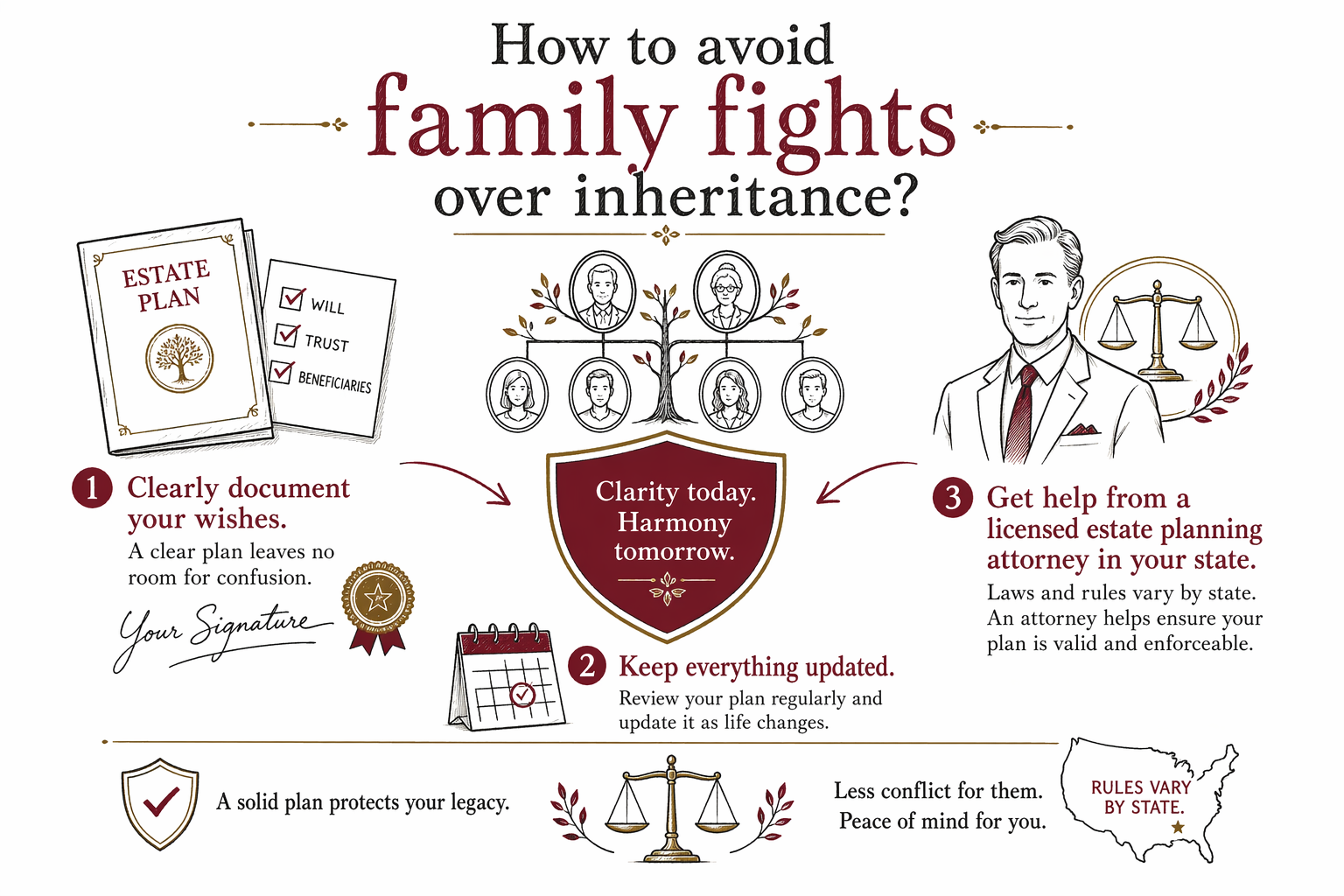
The best way to avoid inheritance fights is to clearly document your wishes, keep everything updated, and get help from a licensed estate planning attorney in your state—rules vary by state.
Common questions
What’s the single biggest thing that causes inheritance fights?
Often it’s unclear or outdated paperwork—especially if a person dies without a will or if beneficiary designations don’t match the rest of the plan. Clarity, correct documents, and regular updates can reduce the confusion that leads to disputes.
Is a trust always better than a will?
Not always. A will and a trust can both be effective, but they work differently and can have different effects after death. Whether a trust helps depends on your state’s rules, your goals (like avoiding probate), and your overall situation—ask a licensed estate planning attorney.
If I write a list of who gets what, does that prevent fights?
A list can help, but it usually isn’t a substitute for legal documents. If you want your wishes to be enforceable and to work with your state’s process, you’ll still need the right will/trust and related documents.
How often should we review our estate plan?
A common approach is to review after major life changes (marriage, divorce, births, deaths, moves) and periodically over time. Your attorney can suggest a schedule based on your state’s rules and your family’s situation.
WillArbor drafts documents or gives legal advice?
No. WillArbor is a free matching service, not a law firm and not your lawyer. We provide general educational information and connect you with licensed estate planning attorneys; any legal advice or document preparation comes from the attorney you choose.
Related help
The difference between a will and a living trust, when each makes sense, and why many families use both.
Open → How to Avoid ProbatePlain-language ways families reduce or avoid probate — trusts, beneficiary designations, and joint ownership.
Open → What Happens If You Die Without a WillIntestacy explained: how your state decides who inherits when there is no will — and why that may not match your wishes.
Open →