Guides
Estate Tax Basics for Families
Estate taxes can sound scary, but for most families in the U.S. the practical question is simple: many estates never owe federal (or state) estate tax. Here are the basics and what to watch for—without guessing your situation.
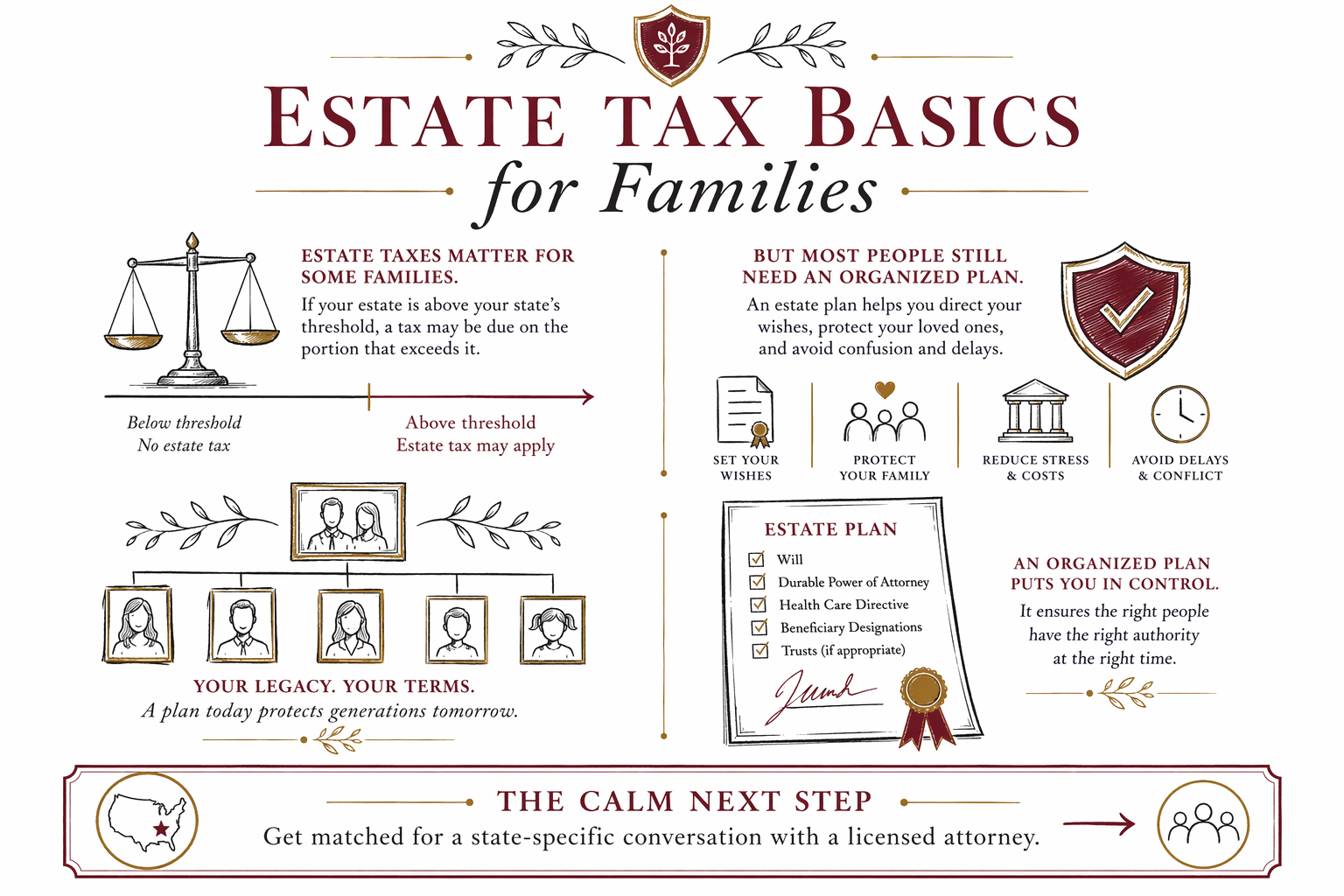
Quick answer: do most families owe estate tax?
Often, no. Federal estate tax applies only if the value of a person’s estate is above a certain exemption amount set by federal law. For many families, especially when life insurance and retirement accounts are handled as part of the overall estate plan, the estate value ends up below that threshold.
State estate taxes (if your state has them) can work differently, with different exemptions and rules. That’s why “estate tax planning” is usually less about panic and more about understanding your state and your total situation.
This is general education only, not tax or legal advice. Estate and tax rules change over time and vary by state. A licensed estate planning attorney in your state can explain what (if anything) you likely need to do.
Federal estate tax: the core idea in plain words
Federal estate tax is a tax on the transfer of a person’s assets at death. The key threshold is the federal exemption amount, which can change with federal law.
If the taxable estate is above the exemption, federal estate tax may apply. If it’s below the exemption, federal estate tax is often not owed. Families should not assume this works the same way from one year to the next.
Because your “taxable estate” is not always the same as what you think of as “everything you own,” it’s important to talk with a licensed professional before making decisions based on a rule-of-thumb.
State estate tax and inheritance tax: why the wording matters
Some states have an estate tax, some have an inheritance tax, and some have neither. Estate tax is typically assessed on the estate itself (at the owner’s death), while inheritance tax is assessed on the people who receive property.
Even when a state has estate tax, it may have a different exemption amount than federal law. Also, some states’ rules and how they define estate value can differ.
Because these rules vary by state—and can change—your best next step is to get matched with a licensed estate planning attorney who practices where you live. You can start here: get matched.
Why families usually focus on estate planning (even if they owe no estate tax)
Estate tax is only one part of the larger picture of protecting your family. Even if you likely won’t owe estate tax, you may still need clear plans for guardianship, who inherits, and how debts and expenses get handled.
Common goals include: having a valid will or living trust, naming a guardian for minor children, choosing who manages your affairs if you become unable to act, and reducing delays for families after a death.
A good estate plan helps your loved ones avoid unnecessary stress and confusion. It also helps prevent common pitfalls like dying without a will (intestacy), having beneficiary designations that don’t match your plan, or using DIY forms that don’t fit your state.
Common pitfalls that can create bigger problems than estate tax
Estate tax planning can be complex, but many families run into simpler issues first. These pitfalls can affect your family even when estate tax isn’t owed.
- Dying without a will (intestacy), which can delay decisions and limit who receives your property
- Out-of-date beneficiary designations on life insurance or retirement accounts
- DIY documents that don’t match your state’s rules
- A living trust that is “unfunded” (assets weren’t moved or properly designated)
- No clear power of attorney or advance directive if someone becomes unable to manage care or finances
- Not naming a guardian for children where required by your state’s rules
If you’re worried, the answer is not to guess—it's to get matched and confirm your options with a licensed estate planning attorney.
What it typically costs to talk to an attorney about estate planning (including tax concerns)
Most estate planning is quoted as a flat fee, not hourly. For families who want to address estate tax questions along with core documents, total cost depends on what’s included (for example: will vs. living trust, powers of attorney, advance directives, and any additional tax-focused strategies). It also depends on the complexity and the state.
As a very broad starting point, many families find flat-fee ranges such as:
- Basic will package: often around $1,000–$3,000+
- Living trust-focused plan (with related documents): often around $2,000–$6,000+
- More complex plans (for example, blended families, business interests, or more involved tax coordination): can be higher
These ranges are not quotes. Your attorney will confirm pricing in writing before work starts. WillArbor is a free matching service and is not a law firm, and we do not draft documents or provide legal/tax advice.
Estate taxes matter for some families, but most people still need an organized estate plan—so the calm next step is to get matched for a state-specific conversation with a licensed attorney.
Common questions
What is the difference between estate tax and inheritance tax?
Estate tax is generally charged to the estate itself, while inheritance tax is typically charged to the people who receive assets. Not all states have both, and the rules vary by state.
If I probably won’t owe federal estate tax, do I still need an estate plan?
Yes. Even when estate tax is unlikely, you still need to protect your family—such as naming guardians, choosing who inherits, and setting up decision-making documents like a power of attorney and advance directive. Those needs don’t disappear just because estate tax might be low.
Do life insurance or retirement accounts count toward estate tax?
They can, depending on how they’re titled and how benefits are designated. Because rules differ and can be nuanced, ask a licensed estate planning attorney in your state to explain how they apply to you.
Does estate planning change year to year?
It can. Federal exemptions and sometimes state rules can change, and your personal situation can change too. A lawyer can help you review and update documents over time.
Can WillArbor tell me if I owe estate tax?
No. WillArbor is a free matching service and not your lawyer, and we provide general educational information only. A licensed estate planning attorney can review your state rules and discuss your specific situation.
Related help
The difference between a will and a living trust, when each makes sense, and why many families use both.
Open → How to Avoid ProbatePlain-language ways families reduce or avoid probate — trusts, beneficiary designations, and joint ownership.
Open → What Happens If You Die Without a WillIntestacy explained: how your state decides who inherits when there is no will — and why that may not match your wishes.
Open →