Guides
Estate Planning In Your 30S
Estate planning in your 30s is not “too early.” It is often the right time to name guardians, decide who gets what, and make sure someone can step in if you get sick or die. Rules vary by state, so a licensed estate planning attorney near you can explain what fits your family.
Do you need estate planning in your 30s?
Often, yes—especially if you have young children, a home, a spouse, a partner, a blended family, or parents who rely on you. Even if you do not have a lot of property, you may still need a will, powers of attorney, and an advance directive.
Many people in their 30s think estate planning is only for older adults or wealthy families. In real life, it is often about making sure the right person can care for your children and make decisions if you cannot.
If you die without a will, state intestacy rules decide who inherits. That may not match your wishes. If you do not name a guardian for minor children, a court may have to decide. That is one of the biggest reasons families start now.
What documents matter most in your 30s?
For many families, the core documents are a will, financial power of attorney, health care power of attorney, and an advance directive or living will. A living trust may also make sense in some situations, but it is not needed for everyone.
A will lets you name who inherits and, if you have minor children, who you want to serve as guardian. A power of attorney can let someone handle money or property if you cannot. A health care document can name the person who speaks with doctors and makes medical choices.
A trust can help avoid probate in some cases, but only if it is properly funded. An unfunded trust is a common pitfall: people sign the trust paperwork, but never move assets into it. A local attorney can explain whether a trust is worth the extra cost for your family.
What can go wrong if you wait?
Waiting can leave your family with avoidable problems. The most common ones are:
- Dying without a will, so state law decides who inherits.
- Not naming a guardian for children.
- Beneficiary forms that are out of date after marriage, divorce, or a new baby.
- DIY forms that do not meet your state’s signing or witness rules.
- A trust that was never funded.
These mistakes are common because life changes quickly in your 30s. Marriage, divorce, a new child, a new home, or moving to another state can all change what your plan should say. That is why rules vary by state and why it helps to review your plan with a licensed estate planning attorney in your state.
How much does estate planning usually cost?
Most estate planning is quoted as a flat fee, not hourly. The real number depends on the documents you need, how complex your family and assets are, and the state where you live. These are general ranges, not quotes:
- Simple will-based plan: often a few hundred dollars to around $1,500
- Will plus powers of attorney and health care documents: often around $500 to $2,500
- Living trust plan: often around $1,500 to $5,000+ depending on complexity
A trust usually costs more than a simple will plan because it takes more work to set up. But the cheaper option is not always the better one, and the more expensive option is not always necessary. Ask for the flat fee in writing before any work starts.
What should you do next?
- Think about who you want to care for your children if needed.
- Make a short list of who should inherit, and who should handle things if you cannot.
- Review any beneficiary forms on life insurance, retirement accounts, and bank accounts.
- Decide whether you want a simple will-based plan or want to ask about a trust.
- Talk with a licensed estate planning attorney in your state and confirm the bar license.
WillArbor can help you get started with a free match. We are not a law firm and not your lawyer, and we do not draft documents. We only collect contact information and planning intent, such as your name, phone, optional email, state, what you want to plan, and your preferred language.
Why families use a free matching service
Estate planning can feel hard to start, especially if English is not your first language or if you are trying to protect a family across generations. A free matching service can make the first step simpler by connecting you with a licensed attorney near you.
You stay in control. You compare attorneys, choose who to hire, and confirm the flat fee in writing before any work begins. Participating attorneys pay a flat fee to take part; it is always free for the family.
If you want a clearer picture of the process, start with our guides, review our services, or get matched with a licensed estate planning attorney near you.
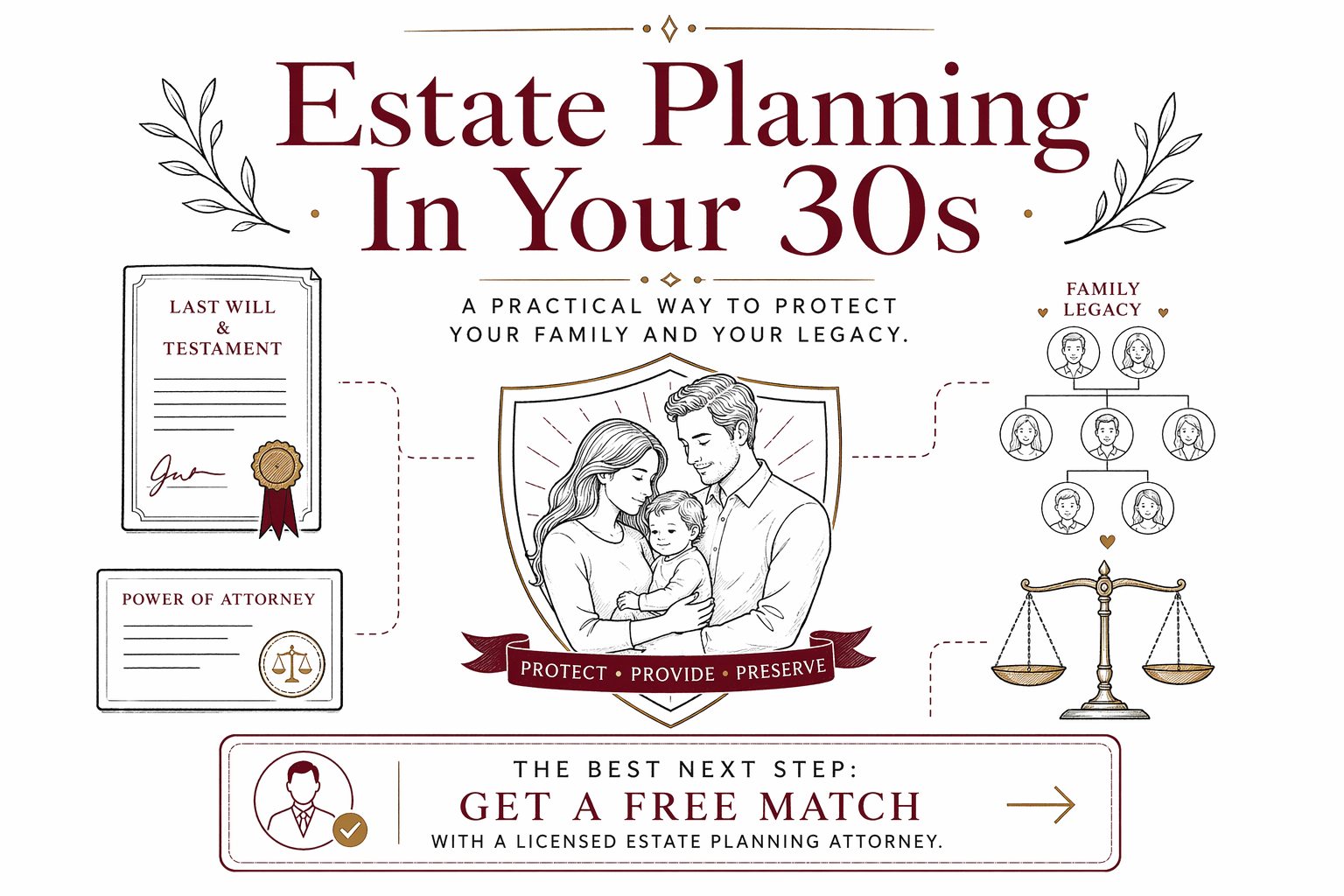
In your 30s, estate planning is a practical way to protect your family, and the best next step is to get a free match with a licensed estate planning attorney.
Common questions
I’m in my 30s and I don’t own much. Do I still need estate planning?
Often yes, because estate planning is not only about wealth. It is also about naming guardians for children, choosing decision-makers, and making sure your wishes are followed if you become sick or die.
Is a will enough, or do I need a trust?
It depends on your family, property, and state law. A will is enough for many people in their 30s, while a trust may help in some situations if you want more control or want to avoid probate; a licensed attorney can explain the tradeoffs.
Can I just use online forms?
Sometimes people try, but DIY forms can fail if they are not signed or witnessed correctly under your state’s rules. That can create problems later, so it is wise to have a licensed estate planning attorney review what you need.
Is WillArbor a law firm?
No. WillArbor is a free matching service, not a law firm, not a lawyer, and it does not create an attorney-client relationship or draft legal documents.
Related help
The difference between a will and a living trust, when each makes sense, and why many families use both.
Open → How to Avoid ProbatePlain-language ways families reduce or avoid probate — trusts, beneficiary designations, and joint ownership.
Open → What Happens If You Die Without a WillIntestacy explained: how your state decides who inherits when there is no will — and why that may not match your wishes.
Open →