Guides
Estate Planning For Small Business Owners
Estate planning for a small business is mostly about protecting your family and your business if you pass away or become unable to make decisions. The right plan usually combines a will (or trust), powers of attorney, and clear instructions for ownership and succession—guided by your state’s rules.
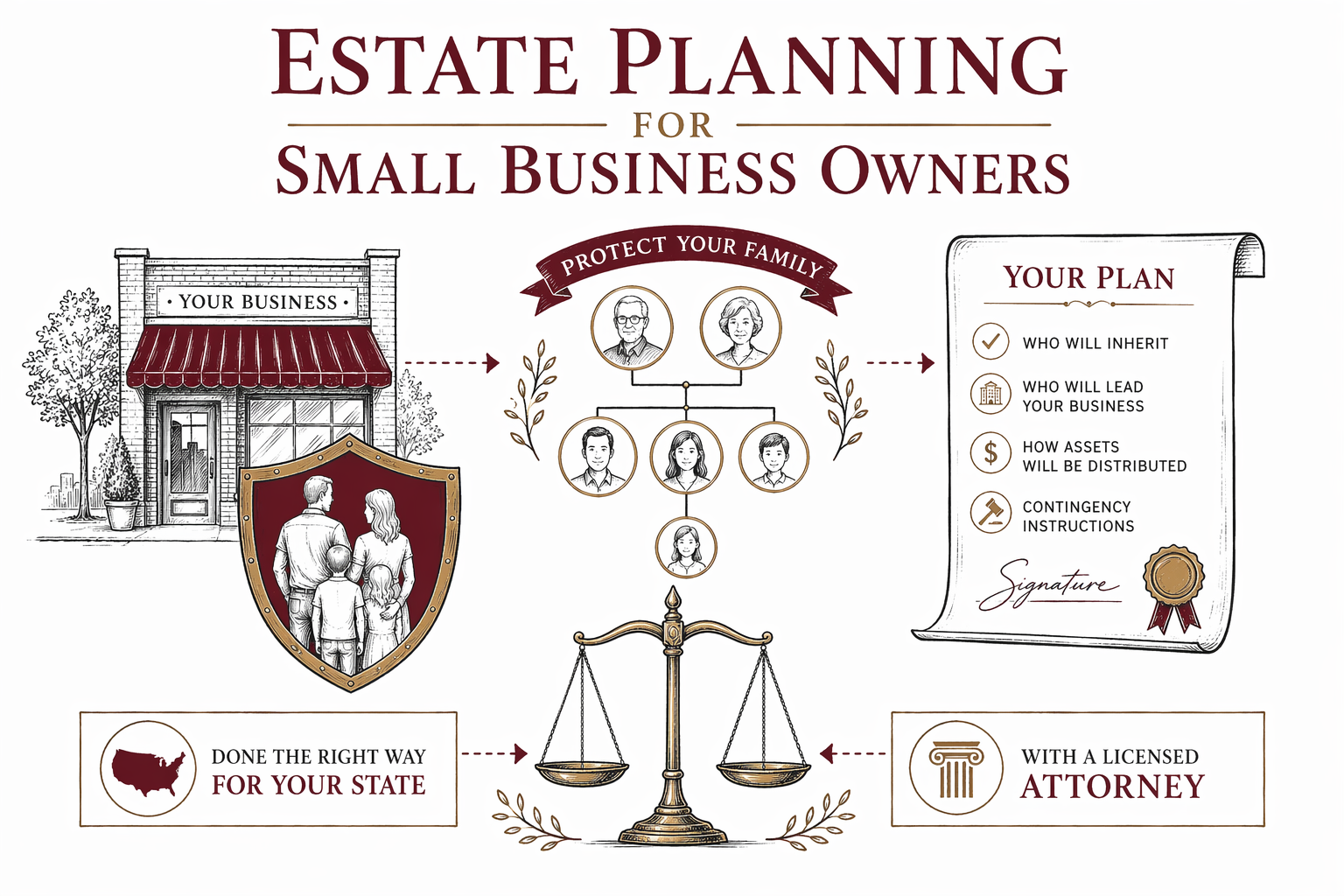
The direct answer: what you need most as a small business owner
Most small business owners benefit from a simple but complete “family + business” estate plan. In plain terms, you want (1) documents that handle your personal decisions and medical wishes, and (2) documents that clearly explain what happens to your business ownership.
A will and/or a living trust can name heirs and guardians, while the business portion can specify who gets your shares or interests and how the transfer should happen. Depending on your business type and state law, you may also need additional steps for smooth ownership changes.
Because rules vary by state (and business law can vary too), it’s smart to talk with a licensed estate planning attorney in your state—especially if you have employees, co-owners, or loans tied to the business.
- Plan for both your family’s needs and your business ownership at the same time
- Get state-specific guidance from a licensed estate planning attorney
Step-by-step: build a “family + business” estate plan checklist
You can think of your estate plan as two linked parts. Start with the part that protects your family, then add the part that protects your business and your ability to keep operating during transitions.
1. Start with personal documents: a will (or a living trust), plus powers of attorney and advance directives (sometimes called living wills).
2. Decide who should inherit what: name beneficiaries for your business ownership and other assets, and name a guardian for minor children if needed.
3. Address the business ownership clearly: if you own an LLC, corporation, partnership interest, or similar, the plan should explain how that interest should pass after death and what happens if you’re unable to act.
4. Coordinate with business agreements: many businesses also use buy-sell agreements or operating agreement rules. An estate plan should align with those documents so heirs aren’t surprised.
5. Review and update: beneficiary designations, ownership records, and any business agreements can get outdated as your life and family situation changes.
- If you have co-owners, make sure the estate plan matches the business’s own ownership rules
- If your spouse or partner is involved, clarify how ownership and caregiving decisions work together
Will vs. trust for business owners (plain differences)
A will is a legal document that explains how your property and ownership interests should be handled after your death. It can also name guardians for children and appoint someone to manage your estate. If probate applies, a will often becomes part of that process.
A trust (often a living trust) is another way to hold and manage assets. Many people use a trust to help avoid some probate steps for certain assets, but trusts don’t remove every issue—especially when state law and business ownership rules apply.
For small business owners, the right choice depends on what you own, how your business is set up, and your state’s process. A licensed attorney can help you connect the personal plan (will/trust) with the business ownership plan so they don’t conflict.
- A will directs what happens after death; a trust can help manage/transfer certain assets more directly (state rules vary)
- Your best fit depends on your ownership structure and your state
Common pitfalls that hurt families and small businesses
Small business estate problems often come from small gaps. Here are frequent pitfalls to avoid—especially if you’re busy and haven’t had time to get documents reviewed.
- Dying without a will (sometimes called intestacy): state default rules may decide who gets your business interests, which can be very different from your family’s needs.
- Out-of-date business records or beneficiary instructions: if ownership details don’t match your current life, heirs may face delays.
- DIY forms that don’t fit your state: estate planning documents need to match your state’s requirements and your business structure. A template that works “somewhere else” can fail at home.
- An unfunded trust (when a trust is created but not properly funded): the trust only works for assets that are actually placed into it, which can leave business ownership untouched.
- No clear answer on “who runs things”: even if your family inherits ownership, someone must manage decisions, payments, and operations—especially if you’re incapacitated.
These issues are fixable, but the fix should be state-specific and coordinated with your business documents.
- If you own through an LLC or corporation, coordination matters—your estate plan and business agreement should work together
- If you’re co-owned, a mismatch can create conflict during a difficult time
Costs: what estate planning may cost for business owners (flat-fee ranges)
Estate planning is commonly quoted as a flat fee, not an hourly rate. That said, the real cost depends on the documents you need, the complexity of your situation (for example, multiple owners, business agreements, minors/guardians, or a trust), and your state.
Typical flat-fee ranges often look roughly like this (for educational planning only—not a quote):
1. Basic will package (may include related documents like powers of attorney and advance directives): often in the lower hundreds to a few thousand dollars.
2. Will + living trust (more likely for those who want broader coverage): often in the mid-thousands to several thousand dollars.
3. More complex business-focused planning (for example, coordinating with co-owners, aligning with buy-sell/operating agreements, or adding additional documents): often higher than basic packages, commonly moving further into several thousand dollars, depending on scope.
What drives prices up or down:
- How many family members and beneficiaries need to be addressed
- Whether you want a trust and how it’s structured
- Whether you have co-owners or complex business ownership
- Whether your business has agreements that must be reviewed or aligned
- Your state’s cost of legal services
Ranges are not promises. Ask the attorney you choose for a written, flat-fee confirmation before any work starts. WillArbor can help you find an attorney; families never pay to use our service.
- Most quotes are flat fees—confirm the exact flat fee in writing before work begins
- Don’t share sensitive details (like account numbers or SSNs) when you request help
How WillArbor helps: get matched (free) to a licensed attorney in your state
WillArbor is a FREE matching service—not a law firm and not a lawyer. We don’t draft documents and we don’t create an attorney-client relationship. We simply help you connect with a licensed estate planning attorney near you.
To get matched, you share contact details and your planning intent (for example, “I need estate planning for my small business and my family”). You choose the attorney to contact and you can compare options. Always confirm the flat fee in writing and confirm the attorney is licensed in your state before signing anything.
If you want a starting point, you can explore our guides and learn about services. When you’re ready, request a match at get matched.
- Rules vary by state—an attorney licensed in your state matters
- WillArbor is free for families; participating attorneys pay a flat fee to take part (never a share of your fees)
Estate planning for a small business is about protecting your family and giving clear instructions for what happens to your business—done the right way for your state with a licensed attorney.
Common questions
If I have a small business, do I automatically need a trust instead of a will?
Not automatically. Many business owners use a will, and others use a living trust depending on their goals and state processes. Because rules vary by state and business ownership can be complex, an attorney can help you choose what fits your situation.
What happens to my business if I become incapacitated, not just after I die?
Estate planning can include powers of attorney that allow someone you trust to make certain decisions if you can’t. For business ownership, the right approach depends on your business structure and the agreements you already have—so coordination with an attorney is important.
Can I just use a DIY estate planning form for my business?
DIY forms can miss state-specific requirements or fail to match your business structure and existing agreements. Common results include confusion for heirs, delays, or documents that don’t work as intended in your state. It’s usually safer to work with a licensed estate planning attorney.
How much does estate planning for a business owner typically cost?
Most attorneys quote flat fees, but the real number depends on the documents and complexity (for example, co-owners and how your business is set up). Many plans fall from the lower hundreds to several thousand dollars, with more complex business-focused planning often costing more. Ask for a written flat-fee confirmation.
Does WillArbor draft documents or provide legal advice?
No. WillArbor is a free matching service, not a law firm, and we don’t draft documents or give legal advice. We help you connect with a licensed estate planning attorney who can advise you based on your state.
Related help
The difference between a will and a living trust, when each makes sense, and why many families use both.
Open → How to Avoid ProbatePlain-language ways families reduce or avoid probate — trusts, beneficiary designations, and joint ownership.
Open → What Happens If You Die Without a WillIntestacy explained: how your state decides who inherits when there is no will — and why that may not match your wishes.
Open →