Guides
Estate Planning For Blended Families
Estate planning for blended families is about making sure the right people are protected, provided for, and not left in conflict. A licensed estate planning attorney in your state can help you put those wishes in writing the right way.
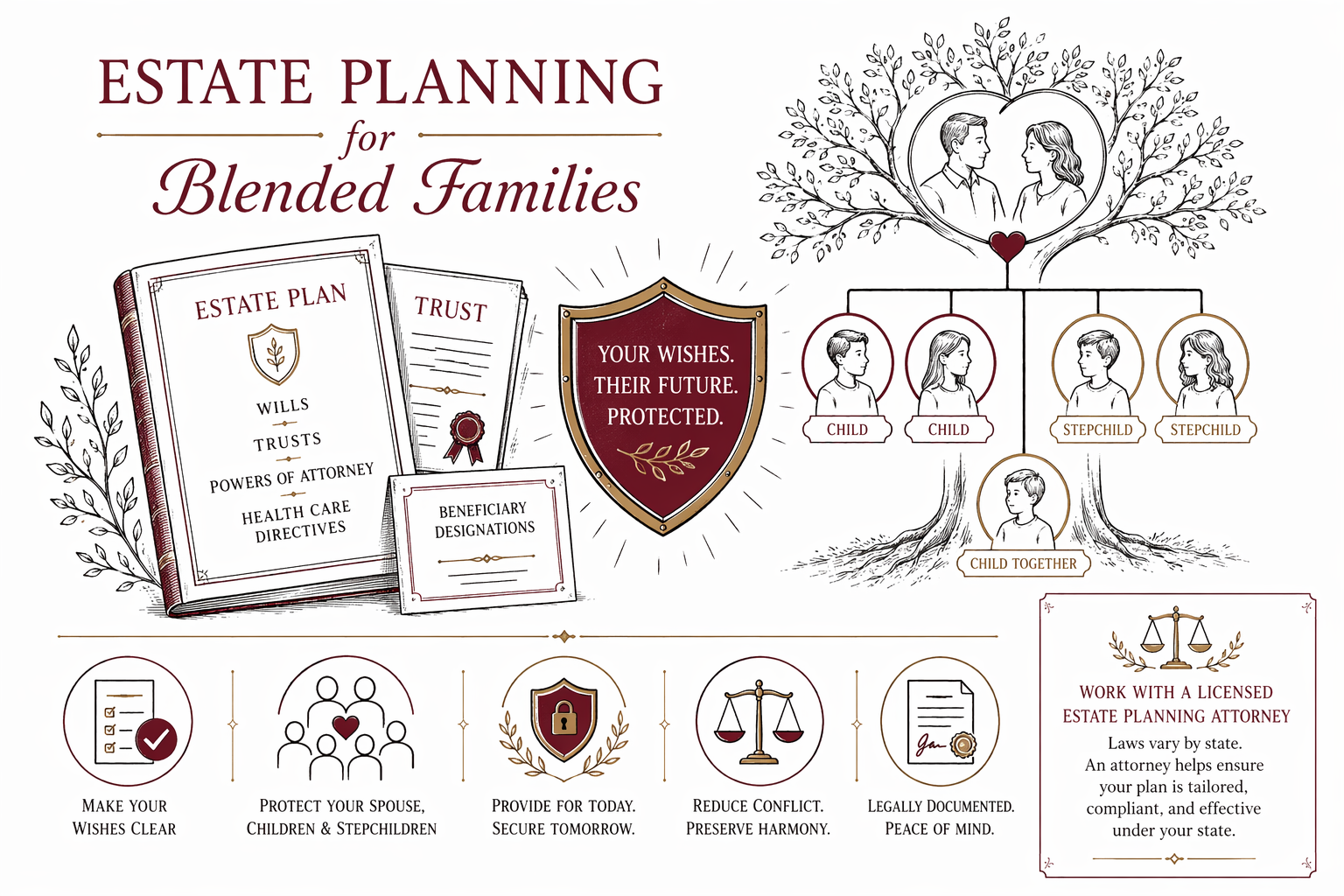
What makes blended-family planning different?
A blended family usually includes children from different relationships, a new spouse, stepchildren, or a mix of all three. That can create questions that a simple “leave everything to my spouse” plan does not fully answer.
The main goal is to avoid surprises. You may want to provide for a spouse for life, protect children from a prior relationship, name guardians, or make sure certain assets go to certain people. Without a clear plan, state law may decide the outcome instead of your wishes.
Estate planning rules vary by state and change over time, so the right answer depends on where you live. A licensed estate planning attorney can explain what your state allows and help you choose between a will, a trust, or a mix of documents.
- State law may give a surviving spouse rights you did not expect.
- Stepchildren do not always inherit automatically unless they are legally adopted or named in a plan.
- A will and beneficiary forms can work together, but they should not conflict.
What documents do blended families often need?
Most blended families start with a will, powers of attorney, and advance directives. Many also consider a living trust when they want more control over who gets what and when.
A will can name guardians for minor children and explain how property should be distributed. A trust can sometimes help manage assets for a spouse now and children later, and may help avoid probate for assets placed into it. But a trust only works well if it is properly funded and kept up to date.
Beneficiary designations matter just as much as the will or trust. Retirement accounts, life insurance, and some bank or investment accounts may pass by beneficiary form, not by will. Out-of-date forms are a common problem in blended families.
- Review retirement accounts, life insurance, and payable-on-death accounts.
- Make sure your will and beneficiary forms do not contradict each other.
- If you use a trust, ask whether it needs to be funded for the plan to work.
Common goals in blended-family plans
Different families want different results, and that is normal. One parent may want the surviving spouse to have use of the home for life, while children from a prior relationship eventually receive the house or its value. Another family may want immediate support for a spouse, but a set inheritance for children.
A good plan can also reduce stress after a death. It can give one person clear authority to act, spell out who handles the estate, and lower the chance of arguments between the surviving spouse and children from another relationship.
Here are some common goals:
1. Provide for a spouse without unintentionally disinheriting children.
2. Protect inheritance for children from a prior relationship.
3. Name a trusted person to manage money or property for minors.
4. Reduce the chance of probate, delay, and family conflict.
- A thoughtful plan can protect both a spouse and children.
- Clear instructions often prevent confusion later.
- The best plan depends on your family, your assets, and your state law.
Pitfalls that often cause trouble
Some of the most common mistakes are easy to miss. People may assume a new spouse will automatically “do the right thing,” but the law may not match that expectation. Others forget to update old beneficiary forms after a marriage, divorce, birth, or remarriage.
DIY forms can also be risky if they do not fit your state’s rules. A trust that is never funded may not help much. And if you have minor children, not naming a guardian can leave that decision to a court.
Common pitfalls to watch for:
- Dying without a will, which can trigger intestacy rules.
- Leaving beneficiary forms unchanged after family changes.
- Creating a trust but not moving assets into it.
- Assuming stepchildren inherit automatically.
- Not naming a guardian for minor children.
- Out-of-date forms can undo a careful plan.
- A “simple” form may not be valid in your state.
- Family changes should usually trigger a plan review.
How WillArbor can help you take the next step
WillArbor is a FREE matching service, not a law firm, and not your lawyer. We do not draft documents or create an attorney-client relationship. We help you get connected with a licensed estate planning attorney near you who can explain your options in plain words.
You stay in control. You compare attorneys, choose who to hire, and confirm the flat fee in writing before any work starts. Most estate planning is quoted as a flat fee, not hourly, but the real number depends on the documents you need, the complexity of your family and assets, and your state. Any ranges you see are only general information, not a quote.
If you are ready, start with basic contact and planning intent only—your name, phone, optional email, state, what you want to plan, and preferred language. Do not send account numbers, asset values, or document contents.
- We help families across the United States, including new immigrants and non-native English speakers.
- A licensed attorney can confirm your state’s rules and help you avoid costly mistakes.
- Start with [Get Matched](/get-matched/) or read more in our [guides](/guides/) and [services](/services/).
Blended-family estate planning is about making your wishes clear so a spouse, children, and stepchildren are protected the way you intend, and a licensed attorney can help you do that under your state’s rules.
Common questions
Do blended families always need a trust?
No. Some families can use a will and updated beneficiary forms, while others benefit from a trust for more control. The right choice depends on your goals, your assets, and your state’s rules.
Will my stepchildren inherit automatically?
Usually not unless they are legally adopted or named in a valid estate plan or beneficiary form. State law varies, so a licensed attorney should review your situation.
Can I leave everything to my spouse and trust them to share with the children later?
You can, but that plan may not protect children from a prior relationship the way you intend. A lawyer can help you decide whether a will, trust, or beneficiary plan better matches your wishes.
What should I bring when I talk to an attorney?
Bring a simple list of family members, what you want to happen if something happens to you, and any current documents you already have. You do not need to send sensitive financial details through WillArbor.
Related help
The difference between a will and a living trust, when each makes sense, and why many families use both.
Open → How to Avoid ProbatePlain-language ways families reduce or avoid probate — trusts, beneficiary designations, and joint ownership.
Open → What Happens If You Die Without a WillIntestacy explained: how your state decides who inherits when there is no will — and why that may not match your wishes.
Open →