Guides
Do you need a lawyer for a will?
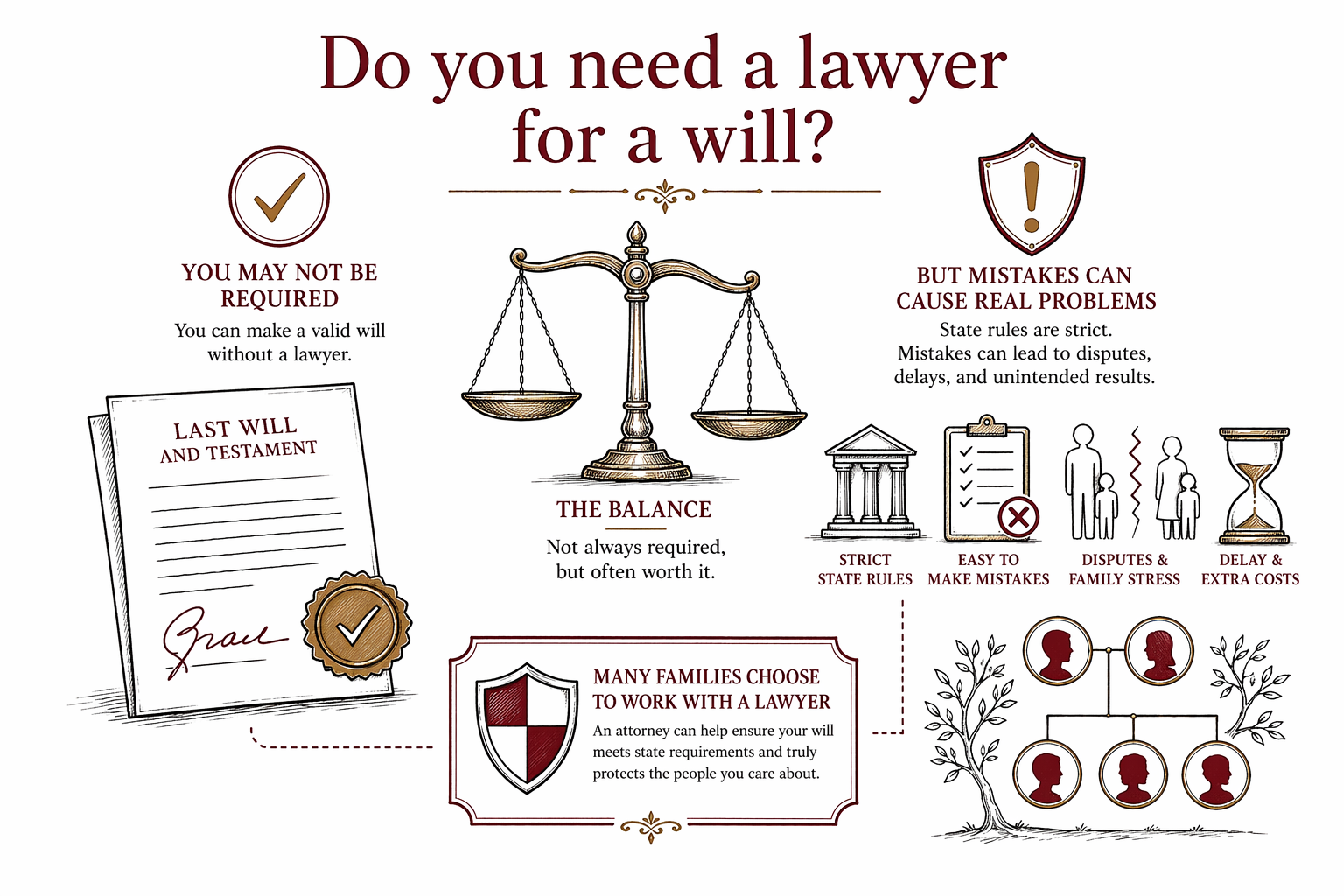
Usually, no law says you must hire a lawyer to make a will. But many families choose a licensed estate planning attorney because small mistakes can make a will unclear, invalid, or hard to use later.
Short answer: not always, but often a good idea
In many states, you do not legally need a lawyer to create a will. A person can sometimes write one themselves and sign it with the required witnesses. But that does not mean a do-it-yourself will is the safest choice.
A will only helps if it follows your state's rules and clearly says what you want. If the signing is done wrong, the witness rules are missed, or the wording is confusing, your family may face delays, court problems, or arguments after a death. Estate planning and probate rules vary by state, and they change over time.
A licensed estate planning attorney is often most helpful if you have children, own a home, want to name a guardian, have a blended family, have property in more than one state, want to avoid mistakes, or simply want peace of mind. If your situation is very simple, some people do use a basic form, but that is where one common pitfall starts: forms that do not meet your state's rules.
When a lawyer is especially worth it
A lawyer can be especially important when your will needs to do more than leave everything to one person. For example, if you want to name guardians for minor children, leave different gifts to different people, protect a child with special needs, plan for stepchildren, or coordinate a will with a living trust, getting legal help can prevent serious problems.
A lawyer is also helpful if you are worried about family conflict. Clear language, proper signing, and a complete estate plan can make it easier for your family to carry out your wishes. Many families think they only need a will, but they may also need powers of attorney and advance directives so someone can help during life, not just after death.
Common pitfalls include dying without a will at all, which is called intestacy; forgetting to name a guardian for children; relying on beneficiary designations that are out of date; using a DIY form that fails in your state; or creating a trust and never funding it. Those are the kinds of problems a careful attorney looks for.
When a simple will may be enough
Some adults have a fairly simple situation: they are single or married, have no complicated family issues, own property in one state, and want to leave everything in a straightforward way. In that kind of case, a simple will may be possible without a lawyer in some states.
Even then, it helps to slow down and ask a few basic questions. Do you know your state's witness and signing rules? Do you know whether notarization is needed or just helpful? Do you know what happens if one beneficiary dies before you? Do you know whether a will alone will avoid probate? In most cases, a will does not avoid probate by itself.
That is why many people start by learning the basics on pages like guides and then speak with a licensed estate planning attorney before signing anything important.
What a lawyer usually does for a will
A licensed estate planning attorney does more than fill in blanks. They usually ask about your family, your goals, the people you trust, and which documents fit your situation under your state's law. They can explain whether you likely need only a will or a fuller plan that may include a living trust, financial power of attorney, and advance directive.
They can also help you name the right people for key roles: executor, guardian, trustee, and agents under powers of attorney. They may catch issues you would not think about on your own, like backup choices, tax questions to discuss further, probate concerns, or conflicts between your will and your beneficiary forms.
Before any work starts, ask for the flat fee in writing, what documents are included, whether revisions are included, and whether there are extra charges for deeds, trust funding help, or more complex planning. Most estate planning is priced as a flat fee, not hourly, but the real price depends on the documents, the complexity, and the state. These are not quotes.
What a will lawyer may cost
A simple will prepared by a licensed estate planning attorney often falls around $300 to $1,000 as a flat fee in many parts of the United States. A will package with related documents, such as powers of attorney and an advance directive, may be more like $600 to $2,000. A more complete estate plan with a living trust often costs more, commonly around $1,500 to $5,000 or higher depending on the state and the complexity.
The price can go up if you have a blended family, minor children, special needs planning, multiple properties, business interests, or complicated wishes. It may be lower if your situation is very simple and you only need a basic will. Costs vary a lot by state and by the attorney's experience, so ranges are general information only, not quotes.
The important thing is that you stay in control. Compare attorneys, ask what is included, confirm the flat fee in writing, and choose who to hire. WillArbor is a free matching service, not a law firm, not a lawyer, and does not draft documents or create an attorney-client relationship. It is always free for the family to get matched.
How to decide what to do next
If you are trying to decide whether you need a lawyer for a will, a practical approach is to start with your risk level. The more people, property, and possible conflict involved, the more helpful a lawyer usually becomes. If your main goal is to protect children, avoid mistakes, or make things easier for family later, professional help is often worth it.
Here is a simple way to move forward:
- List the basics: your state, whether you have children, whether you own a home, and who you want to inherit.
- Think about who you would name as executor, guardian, and backup choices.
- Check whether you may also need powers of attorney or an advance directive, not just a will.
- Review any beneficiary forms on life insurance or retirement accounts so they do not conflict with your plan.
- Speak with a licensed estate planning attorney in your state and confirm the flat fee in writing before work starts.
If you want help finding someone, you can learn more about our services or get matched for free. We only collect contact information and planning intent, such as your name, phone, optional email, state, what you want to plan, and preferred language. We do not ask for asset values, account numbers, Social Security numbers, income, or sensitive estate details.
You may not be required to hire a lawyer for a will, but many families do because state rules are strict and mistakes can cause real problems later.
Common questions
Is a handwritten will legal?
Sometimes, in some states, a handwritten will may be recognized, but the rules are very state-specific. Because mistakes can make it invalid or hard to prove, it is wise to check with a licensed estate planning attorney in your state.
Can a will avoid probate?
Usually, no. A will often goes through probate and tells the court who should receive property. If avoiding probate is a goal, a lawyer can explain whether tools like beneficiary designations, joint ownership, or a living trust may help under your state's rules.
If I am young and healthy, do I still need a lawyer for a will?
Not always, but many younger adults still want help if they have children, own property, or want a complete plan with powers of attorney and health care documents. A will matters at any adult age, especially if someone depends on you.
How do I know if an attorney is really licensed?
You can ask for the attorney's full name and state bar information and verify the license with the state bar or licensing authority. That is a smart step before hiring anyone.
What if I already made a will online?
Do not assume it is fine just because it is signed. A licensed estate planning attorney can review whether it appears to meet your state's rules and whether it matches your current wishes, beneficiaries, and family situation.
What does WillArbor do?
WillArbor is a free matching service that helps families connect with a licensed estate planning attorney. It is not a law firm, not your lawyer, and does not give legal advice or draft documents.
Related help
The difference between a will and a living trust, when each makes sense, and why many families use both.
Open → How to Avoid ProbatePlain-language ways families reduce or avoid probate — trusts, beneficiary designations, and joint ownership.
Open → What Happens If You Die Without a WillIntestacy explained: how your state decides who inherits when there is no will — and why that may not match your wishes.
Open →