Guides
Do i need a will if i have no assets?
If you have “no assets,” you might think a will is unnecessary—but a will can still protect your family, especially for guardianship and how your belongings are handled after your death. A licensed estate planning attorney can explain what applies in your state.
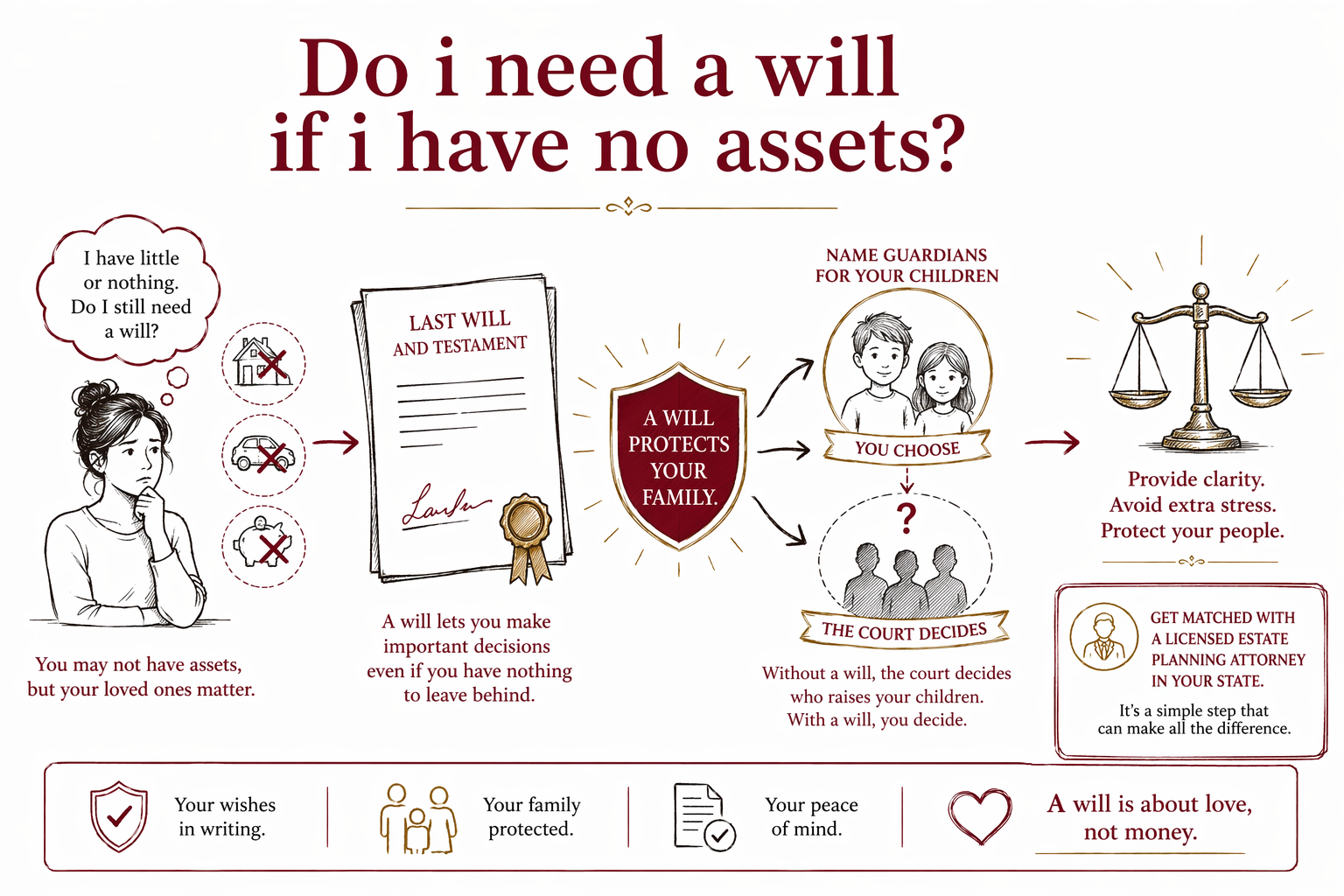
Quick answer: Do you still need a will with no assets?
Often, yes—or at least it’s worth asking a lawyer—because “no assets” can be different from what the law treats as property.
A will can also name a guardian for minor children and can reduce confusion for loved ones. Even if there’s little to leave behind, family members may still face paperwork, court steps, and uncertainty when there’s no clear plan.
Rules vary by state, and this area changes over time, so the most reliable answer depends on where you live and your family situation. A licensed estate planning attorney in your state can review the basics with you.
What “no assets” usually means—and what still matters
People often say “I have no assets,” but in estate planning, “assets” can include things like real estate you own, vehicles, bank accounts, personal property, or even certain benefits that are tied to a person rather than a beneficiary.
Even if you truly have very little, your death still triggers legal questions: Who should care for your children? Who gets any personal property? What should happen if you become unable to make decisions?
Your state’s probate rules may still apply. Some states have simpler processes for very small estates, but those processes still rely on clear legal guidance—especially when children or other dependents are involved.
The biggest reason to consider a will: guardianship for children
If you have minor children, a will is one of the most important documents you can have—even if you have limited possessions.
Without a will, a court generally decides who becomes the children’s guardian. That can be stressful for your family and may not match what you would have chosen.
Your will can also clearly state your preferences so the people you trust can step in with less delay and fewer arguments—again, in a way that follows your state’s rules.
Other documents can matter even when you “have nothing to leave”
A will is not the only piece of planning. Many families also look at:
- A durable power of attorney (to handle financial matters if you can’t)
- Advance directives (sometimes called a living will) for medical decisions if you can’t speak for yourself
These documents don’t depend on having “assets.” They’re about protecting your choices and your family’s ability to act when it’s needed.
Estate planning is state-based. A plan that makes sense in one state may work differently in another.
Common pitfalls to avoid (even if you think you have no assets)
If you skip planning because you assume there’s nothing to pass on, these issues can still happen:
- Dying without a will (often called dying “intestate”), which can force the state’s default rules for who gets things
- Not naming or updating guardians for children
- Relying on DIY forms that don’t follow your state’s requirements
- Out-of-date beneficiary designations (for example, on retirement or insurance), which can override parts of your plan
- No clear plan for medical and decision-making if you become unable to communicate
If you’ve been looking at templates online, it may be tempting to “fill in the blanks.” But state rules can be strict about signing, witnesses, and wording. A licensed estate planning attorney can help you avoid the mistakes that cause delays.
How to get a simple, trustworthy next step (no pressure)
WillArbor is a FREE matching service—not a law firm and not your attorney. We help you connect with a licensed estate planning attorney near you so you can get answers in plain language.
To get matched, share contact details and your state, plus what you want to plan and your preferred language. We do not ask for sensitive details like account numbers or document contents.
Cost varies by state and by what documents you actually need. Many estate planning matters are quoted as a FLAT FEE (not hourly). For a basic plan that may include a will (and sometimes additional documents), flat-fee ranges commonly start around a few hundred dollars and can go higher—especially if guardianship, complex family questions, or additional documents are included. Ranges are not quotes; your attorney will confirm the exact flat fee in writing after they understand your situation.
When you meet with an attorney, ask them to explain (1) whether a will is recommended in your state, (2) what guardianship options apply, and (3) which additional documents would protect you and your family.
Even if you have little or nothing, a will can still protect your family—especially by naming guardians for children—so it’s worth getting matched with a licensed estate planning attorney in your state.
Common questions
If I truly have no money and no property, will a will still be useful?
It can be, because estate planning isn’t only about leaving money. A will can name a guardian for minor children and provide clear instructions for how your belongings and other matters are handled. Rules vary by state, so it’s best to ask a licensed estate planning attorney in your state.
Can I just write something simple at home instead of getting a lawyer?
DIY documents can fail if they don’t meet your state’s signing and witness rules or if they don’t cover the issues your family will face. An attorney can help ensure the document will be accepted and matches your state’s requirements.
If I have children, do I need a will even if I don’t have assets?
In many situations, yes. Naming a guardian for minor children is one of the most important reasons to have a will. Without one, a court may decide, and that may not reflect your wishes.
Would a trust be better than a will if I have nothing to leave?
A trust is not automatically better for everyone, especially when the main goal is guardianship or basic instructions. Whether a trust makes sense depends on your state and your family situation. A licensed attorney can compare options in your state.
How do I know what documents I actually need if I’m worried but unsure?
Start with your state and your goals: children, decision-making if you’re unable to communicate, and who should handle your affairs. You can read more in [guides](/guides/) and then get matched with a licensed estate planning attorney through [get matched](/get-matched/) for a plain-language review.
Related help
The difference between a will and a living trust, when each makes sense, and why many families use both.
Open → How to Avoid ProbatePlain-language ways families reduce or avoid probate — trusts, beneficiary designations, and joint ownership.
Open → What Happens If You Die Without a WillIntestacy explained: how your state decides who inherits when there is no will — and why that may not match your wishes.
Open →