Guides
Can i write my own will?
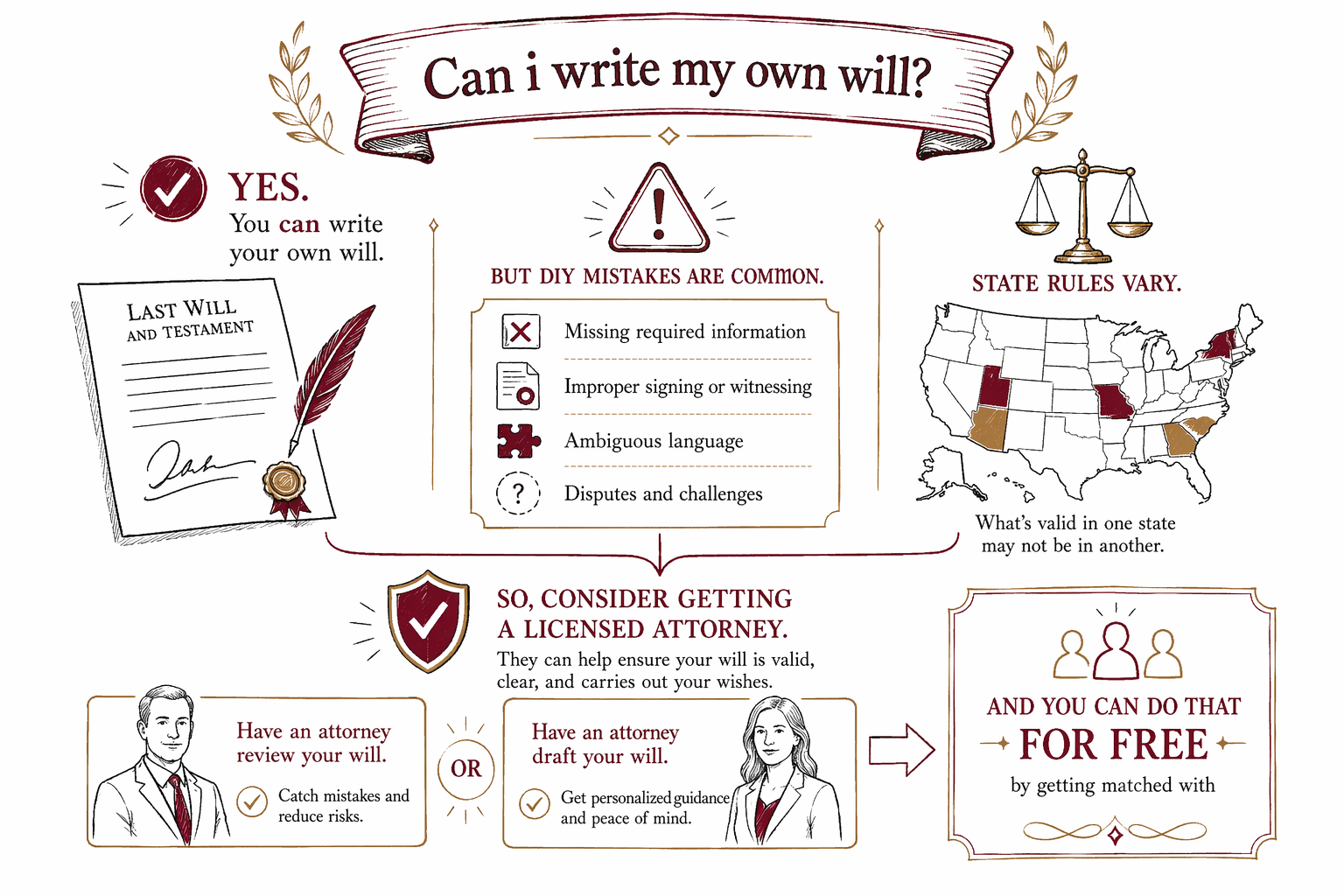
Yes, you can write your own will, but it’s easy for DIY wills to be invalid or not fit your state’s rules. This guide explains when DIY might work, the risks, and how to get matched for free with a licensed attorney.
Quick answer: can you write your own will?
In many states, a person can write a will on their own. But whether it’s legally valid—and whether it truly protects your family—depends on rules that vary by state and can be easy to get wrong.
Most families are surprised to learn how small mistakes can matter: missing required wording, unclear instructions, wrong witnessing rules, or outdated information. If you have children, own property, have complicated family situations, or want to avoid probate, an attorney review is often worth it.
WillArbor is not a law firm and can’t write documents or provide legal advice. We’re a FREE service that helps you get connected with a licensed estate planning attorney near you for your state.
Why DIY wills can be risky (even when your heart is in the right place)
DIY will forms or online templates can look complete, but they may not match your state’s legal requirements for signing and witnesses. A will that fails these requirements might not be followed at all.
Another common problem is clarity. If a will is unclear about who gets what, or who should act for your family, a court may have to interpret it—or your loved ones may end up using more time and money than you intended.
Estate planning also isn’t only about a will. Many families need related documents (like powers of attorney and advance directives) and sometimes a living trust to help manage probate. A will alone may not address all your goals.
If you do write your own will, what matters most?
General educational information only: estate-planning rules (including will validity, witnesses, and probate procedures) vary by state and can change over time.
If you’re considering DIY, you’ll typically want to focus on the items that most often affect validity and family outcomes. Even then, it’s still smart to have a licensed estate planning attorney review your plan.
Common areas where DIY can go wrong:
1. step Ensure it follows your state’s rules for signing and witnesses (requirements vary widely).
2. step Make language clear about who receives assets and in what way.
3. step Name someone reliable to carry out the will (an executor) and include an alternate.
4. step If you have minor children, name guardians clearly and understand how your state handles guardianship.
5. step Avoid outdated information—people, addresses, and situations change.
6. step Remember that some assets don’t go through a will (for example, certain account beneficiary designations).
Common pitfalls families should avoid
Even with good intentions, families often run into predictable problems. Here are a few to watch for:
- Dying without a will (often called “intestacy”), which means state law decides who gets your property
- Using DIY forms that don’t match your state’s signing/witness rules
- Relying on a will while forgetting other key documents, like a power of attorney or advance directive
- Out-of-date beneficiary designations on accounts, which can override what a will says
- Leaving a trust “unfunded” or not updating it when life changes (a trust can be planned correctly but still not do what you hoped if you don’t transfer assets as required)
If any of these sound familiar—or if you’re unsure—speaking with a licensed estate planning attorney can help you avoid avoidable stress for your family.
What it usually costs to have it done by an attorney (flat-fee ranges)
Estate planning costs can vary a lot by state and by what documents you actually need. Most reputable estate planning work is quoted as a FLAT FEE (not hourly), which helps families avoid surprises.
Here are honest, general flat-fee ranges you may see for basic plans (these are not quotes and not guaranteed):
1. step Basic will package (often includes related documents): commonly around $300–$1,500
2. step More comprehensive planning (for example, a will plus a power of attorney and advance directive, and sometimes a trust): commonly around $1,000–$3,500+
These ranges can go up if your situation is more complex (minor children and guardianship, multiple states, business interests, larger estates, blended families, or additional documents). The best next step is to get matched and then confirm the FLAT FEE in writing before any work starts.
WillArbor helps you compare options—free for you—so you can choose who to hire.
How to get help for your state (free matching)
If you’re asking, “Can I write my own will?” it’s usually because you care about your family and want the process to be safe and clear. You don’t have to do it alone.
WillArbor is a FREE matching service. We collect contact details and your planning intent (like what you want to plan, your state, and your preferred language). We do not collect asset values, account numbers, SSNs, or sensitive estate details.
To get started:
1. step Share your state and what you want to plan
2. step Choose your preferred language
3. step Review the matched licensed attorney options and confirm a FLAT FEE in writing before work begins
Learn more about the basics in our guides, see what planning services may include, or start by getting matched.
You can write your own will, but DIY mistakes are common and state rules vary—so consider getting a licensed attorney to review or draft your plan, and you can do that for free by getting matched with WillArbor.
Common questions
If I write my own will, will it automatically be valid?
Not automatically. A will can fail if it doesn’t follow your state’s requirements for signing, witnessing, and wording. Rules vary by state, so DIY validity depends heavily on where you live and how the document is executed.
When is it better to hire a licensed estate planning attorney instead of DIY?
Consider hiring help if you have minor children, a blended family, complicated property or planning goals (like avoiding probate), or you want to ensure related documents are consistent. An attorney can also help you avoid common pitfalls like incorrect witnessing rules and unclear instructions.
What if I already wrote a will—should I change it myself?
You can update documents, but doing it incorrectly (or without following state rules) can create confusion. In many cases, it’s safer to ask a licensed estate planning attorney in your state to review your will and advise the cleanest way to update it.
Will a will replace other estate planning documents?
Often, no. Many families also need a power of attorney and an advance directive to handle medical and legal decisions if you can’t speak for yourself. Whether you also need a trust depends on your goals and your state’s rules.
How does WillArbor help, and is it legal advice?
WillArbor is a FREE matching service, not a law firm and not your lawyer. We provide general guidance and help you connect with a licensed estate planning attorney near you; the attorney provides legal advice for your specific situation.
Related help
The difference between a will and a living trust, when each makes sense, and why many families use both.
Open → How to Avoid ProbatePlain-language ways families reduce or avoid probate — trusts, beneficiary designations, and joint ownership.
Open → What Happens If You Die Without a WillIntestacy explained: how your state decides who inherits when there is no will — and why that may not match your wishes.
Open →