Guides
What is a healthcare proxy?
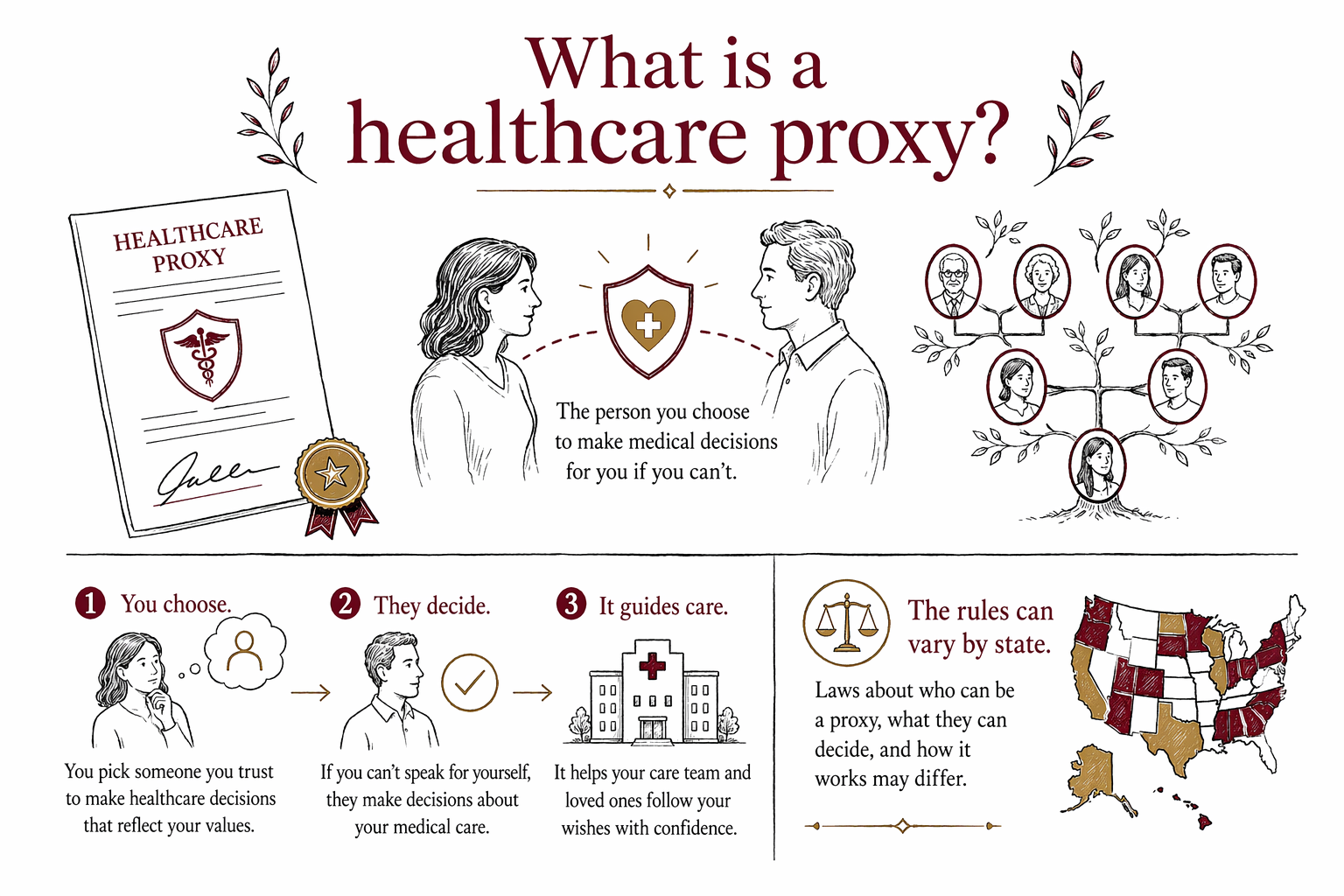
A healthcare proxy (sometimes called a healthcare power of attorney) is the person you choose to make medical decisions for you if you can’t. It’s one part of an advance care plan and can reduce confusion during a crisis.
What a healthcare proxy is (answer first)
A healthcare proxy is a trusted person you name to speak for you in medical situations where you can’t speak for yourself.
Their job is to follow your wishes as stated in your advance directives (when you have them) and work with doctors to make healthcare decisions that match your values. This can include choices about treatments, comfort care, and other medical steps.
Because names and forms can differ, you may also hear terms like “healthcare power of attorney,” “agent,” or “proxy.” If you’re planning ahead in a new state, it’s smart to confirm the exact terms used there with a licensed estate planning attorney.
- It covers decisions when you’re unable to communicate.
- It names a specific decision-maker you trust.
- It works alongside other documents like living wills (in some states).
How it usually works in real life
If you become too sick or injured to make your own decisions, the proxy is typically contacted by your family or healthcare team. The proxy then communicates with clinicians and approves or declines medical treatments based on your instructions and best understanding.
Many families also include an advance directive (often called a living will) to give clearer guidance about specific situations, like long-term life support or end-of-life care. Where those documents fit together depends on state rules.
Your family may still be involved emotionally and practically, but the goal is that one clear person has the authority to talk to doctors. That clarity can help reduce stressful disagreements.
- Doctors look to your documents to find the right decision-maker.
- Your proxy should know your wishes before a crisis.
- Advance directives can provide more specific instructions.
Healthcare proxy vs. a living will (quick, plain difference)
A healthcare proxy is about “who decides.” You choose a person to make decisions for you.
A living will (or similar advance directive) is about “what you want.” It describes your preferences for care in certain medical situations.
You can have one without the other, but many people use both together so there is both a decision-maker and clear guidance. The exact names and legal effect vary by state, so review your state’s requirements with a licensed estate planning attorney.
- Proxy = person to make decisions.
- Living will = your care preferences.
- Some states combine or handle them differently—rules vary.
Common pitfalls to avoid
Families often run into problems when documents are missing, unclear, or not updated. A healthcare proxy is not something to “set and forget.”
Here are a few common issues:
- Dying or becoming incapacitated without the right healthcare documents (the healthcare version of “no will”).
- Naming a proxy who is not available, not willing, or not informed.
- Using DIY forms that don’t match your state’s rules.
- Not sharing documents with the people who need them (family members and your doctor/hospital system when possible).
- Leaving decisions vague so your proxy has to guess your wishes.
- Not reviewing after major life changes (moves to a new state, divorce, death of a chosen proxy, or new medical priorities).
Because state rules vary, what is effective in one state may not work the same way in another—so it’s worth checking with an attorney licensed in your state.
- Keep it clear: name the right person and share the documents.
- Update after life changes and after moving states.
- Avoid DIY forms that don’t meet your state’s requirements.
Cost and what typically affects price (flat-fee ranges)
Most estate planning in the U.S. is quoted as a flat fee (not hourly). A healthcare proxy is often included in a broader set of documents—like a full estate plan or advance care planning package.
Typical cost ranges vary by state and the complexity of your situation, but you may see flat-fee pricing that could include documents such as a healthcare proxy and related advance directives. As a general guide, many families find attorneys pricing in the broad range of a few hundred dollars up to a few thousand dollars depending on what’s included and how complex the plan is.
What can move the price up or down:
- Whether you’re doing a simple healthcare proxy document or a full package (will, trust, powers of attorney, and directives)
- Your state’s requirements and customary forms
- The number of documents and how detailed your instructions are
- Complexity (for example, multiple children, blended families, or coordinating with guardianship needs)
These ranges are not quotes. The only real way to know is to compare written flat-fee options from licensed estate planning attorneys in your state. WillArbor is free for families and helps you find and connect with an attorney—then you choose who to hire and confirm fees in writing.
- Expect flat-fee pricing in many cases (not hourly billing).
- Exact cost depends on documents and state requirements.
- Ranges are not quotes—ask for a written flat fee.
Next steps: how to get matched and do this safely
You don’t have to figure it out alone. A licensed estate planning attorney can explain the healthcare proxy rules in your state and help you make sure your documents fit your situation.
WillArbor is a FREE matching service (we are not a law firm and we don’t draft documents). Share your contact details, your state, and what you want to plan—then you can connect with a licensed estate planning attorney near you.
If you’d like to start, visit get matched. You can also browse our guides for plain-language explanations and our services to understand what the matching process covers.
Reminder: estate planning and probate rules vary by state, and they change over time—so confirm details with a licensed attorney in your state. And before any work begins, compare options and confirm the FLAT FEE in writing.
- WillArbor helps you connect—families stay in control of hiring.
- Rules vary by state: confirm with a licensed attorney.
- Ask for and confirm the flat fee in writing.
A healthcare proxy is the person you choose to make medical decisions for you if you can’t, and the rules for how it works can vary by state.
Common questions
Can I name more than one healthcare proxy?
Some states allow naming one primary proxy and one backup, or allow multiple agents under certain conditions. The exact rules and how authority is handled vary by state, so it’s best to confirm with a licensed estate planning attorney in your state.
When does a healthcare proxy take effect?
It typically takes effect when you can’t make or communicate your own medical decisions, and a clinician determines that condition under state rules. The timing and wording are important, and they vary by state.
Do I need a healthcare proxy if I already have family members who can speak for me?
Family members may be asked to help, but legally speaking, the healthcare proxy is what gives one person clear authority to talk with doctors when you can’t. Without it, your family may face uncertainty or delays.
If I move to another state, do I need new documents?
Often, you may be able to keep using documents, but state law can affect how they are recognized or interpreted. After moving, it’s smart to review your advance care documents with an attorney licensed in your new state.
Related help
The difference between a will and a living trust, when each makes sense, and why many families use both.
Open → How to Avoid ProbatePlain-language ways families reduce or avoid probate — trusts, beneficiary designations, and joint ownership.
Open → What Happens If You Die Without a WillIntestacy explained: how your state decides who inherits when there is no will — and why that may not match your wishes.
Open →