Guides
How to store your will safely?
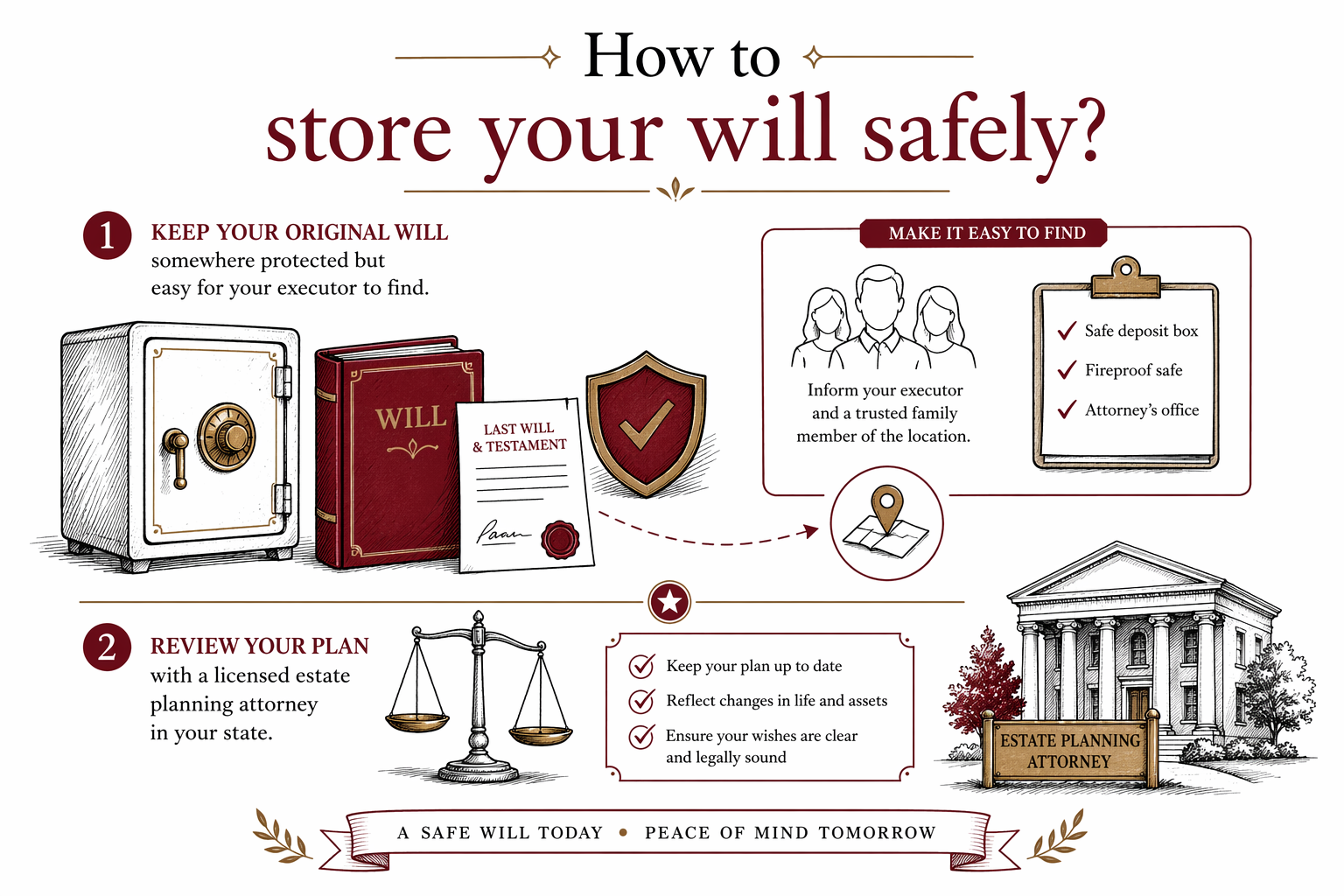
Store your original will in a safe, dry place where the right people can find it after a death. The best choice is usually a fire-resistant home safe or your attorney's storage system, depending on your state and family situation.
The short answer
A will should be kept safe from fire, water, loss, and accidental damage — but it also must be findable when it is needed. For many families, the safest practical option is the original signed will in a fire-resistant home safe or with the estate planning attorney who prepared it, with clear instructions telling trusted people where it is.
Do not hide it so well that no one can locate it. After a death, the original document may matter. In some states and situations, finding only a copy can create delays or extra court questions.
Rules about wills and probate vary by state, and they change over time. This page is general educational information only, not legal advice, and WillArbor is a free matching service — not a law firm, not a lawyer, and it does not draft documents or create an attorney-client relationship.
Best places to store a will
A good storage place protects the will and still allows access when your family needs it. The right answer depends on your state, whether you live alone, who you trust, and whether you have an attorney keeping originals for clients.
Common good options include:
- A fire-resistant, water-resistant home safe
- A clearly labeled file in a secure home office cabinet
- Your estate planning attorney's document storage system, if they offer one
- A safe deposit box only if your state and your family situation make access practical after death
If you use a home safe, make sure at least one trusted person knows it exists and knows how to open it or where to find the key or code. If no one can get in, the will may still be hard to use when your family is grieving.
If your lawyer stores the original, ask how retrieval works after death, during weekends, or if the law office closes. It is wise to keep a copy at home marked as a copy, along with the lawyer's name and contact information.
Places to avoid or use with caution
Some storage choices sound secure but create problems later. The biggest mistake is putting the will somewhere no one can access or even knows about.
Be careful with these options:
- A bank safe deposit box, if access may be blocked after death or require a court order in your state
- An attic, basement, garage, or shed, where heat, moisture, pests, or flooding can damage paper
- A random drawer or pile of papers where it can be thrown away by mistake
- A sealed envelope with no label, hidden so well that your family never finds it
- Only a scanned copy saved online, with no original paper will available
Another common pitfall is clipping, stapling, marking up, or writing notes on the signed original. If you want to change your will, do not hand-edit it yourself. DIY changes and DIY forms can fail under your state's rules. Ask a licensed estate planning attorney in your state how to update it properly.
Who should know where it is?
At minimum, your executor should know where the original will is stored and how to get it. If you have young children, the named guardian should also know who has the will and how to reach that person quickly.
You do not need to share every private detail of the will with many people. But you should leave a simple trail so the right people can act. A short note can say where the original is stored, who prepared it, the date it was signed, and where copies are kept.
A practical checklist:
- Tell your executor where the original is
- Tell a backup trusted person in case the executor cannot act right away
- Keep your attorney's business card or contact information with your records
- Keep a copy with other important papers, clearly marked COPY
- Review your plan after marriage, divorce, a birth, a move to another state, or a death in the family
This matters because estate planning problems are often about missing information, not just missing documents. A family may know a will exists but still lose time if no one knows where the original is.
What about digital copies?
A scanned copy is useful, but it usually should not be your only plan. Keep a digital copy so your executor and family know what the will says and who drafted it, but do not assume a scan can always replace the original signed document.
You can store a PDF in a secure cloud folder or password manager and tell your executor how to access it. That can help if there is a fire or if relatives live in different places. But the original paper will may still be needed for probate, depending on state law and the facts.
The same idea applies to the rest of your estate plan. Powers of attorney, advance directives, and trust documents should also be stored safely and shared appropriately. A trust only helps if it is properly signed and funded, and beneficiary designations on accounts should be kept up to date. Families often focus on the will and miss these other pieces.
When to review your storage plan and get help
You should revisit where your will is stored any time your life changes or your plan changes. Moving homes, getting divorced, naming a new executor, switching attorneys, or moving to a new state are all good times to check that your documents are still valid, current, and easy to find.
Common estate planning pitfalls include dying without a will, not naming a guardian for children, relying on DIY forms that do not meet your state's rules, forgetting to update beneficiary designations, or creating a trust but never funding it. Safe storage helps, but it cannot fix an out-of-date or invalid plan.
If you are making a will or updating a full estate plan, many attorneys charge a flat fee rather than billing by the hour. Very general ranges — not quotes — might be about $300 to $800 for a simple will, $200 to $600 per power of attorney or advance directive package, and around $1,000 to $3,500 or more for a more complete estate plan. Living trust plans are often higher, sometimes roughly $1,500 to $5,000 or more depending on the state, the documents included, and the complexity. The real price depends on your state, your family situation, and what work is included, so confirm the flat fee in writing before any work starts.
If you want help finding someone, WillArbor is a free matching service. You can get matched with a licensed estate planning attorney in your state, compare options, confirm the lawyer's bar license, and decide whether to hire anyone. We only collect contact information and planning intent — such as your name, phone, optional email, state, what you want to plan, and preferred language — not asset values, account numbers, or other sensitive estate details.
Keep your original will somewhere protected but easy for your executor to find, and review the plan with a licensed estate planning attorney in your state.
Common questions
Should I keep my will at home?
Often, yes — if it is in a fire-resistant, water-resistant safe and the right people know how to find it. The main risk is not home storage itself, but storing it where no one can access it after a death.
Is a safe deposit box a good place for a will?
Sometimes, but use caution. In some states or situations, family members may have trouble accessing a safe deposit box after death, which can delay probate or require extra steps.
Can I just scan my will and throw away the original?
That is usually not a good idea. A digital copy is helpful for reference, but the original signed paper will may still be important or required.
Who needs to know where my will is stored?
At least your executor should know, and often one backup trusted person as well. If you have minor children, the named guardian should know who to contact quickly.
What if I moved to a new state?
Review your will and storage plan with a licensed estate planning attorney in your new state. Estate planning and probate rules vary by state, and a move is a good time to make sure your documents still work as intended.
Can WillArbor store my will or give legal advice?
No. WillArbor is a free matching service, not a law firm or lawyer, and it does not draft documents, store wills, or create an attorney-client relationship.
Related help
The difference between a will and a living trust, when each makes sense, and why many families use both.
Open → How to Avoid ProbatePlain-language ways families reduce or avoid probate — trusts, beneficiary designations, and joint ownership.
Open → What Happens If You Die Without a WillIntestacy explained: how your state decides who inherits when there is no will — and why that may not match your wishes.
Open →