Guides
How much does a simple will cost?
A simple will often costs a few hundred to a few thousand dollars, depending on your state and what your will must cover. The easiest way to know the right flat fee is to get matched with a licensed estate planning attorney near you.
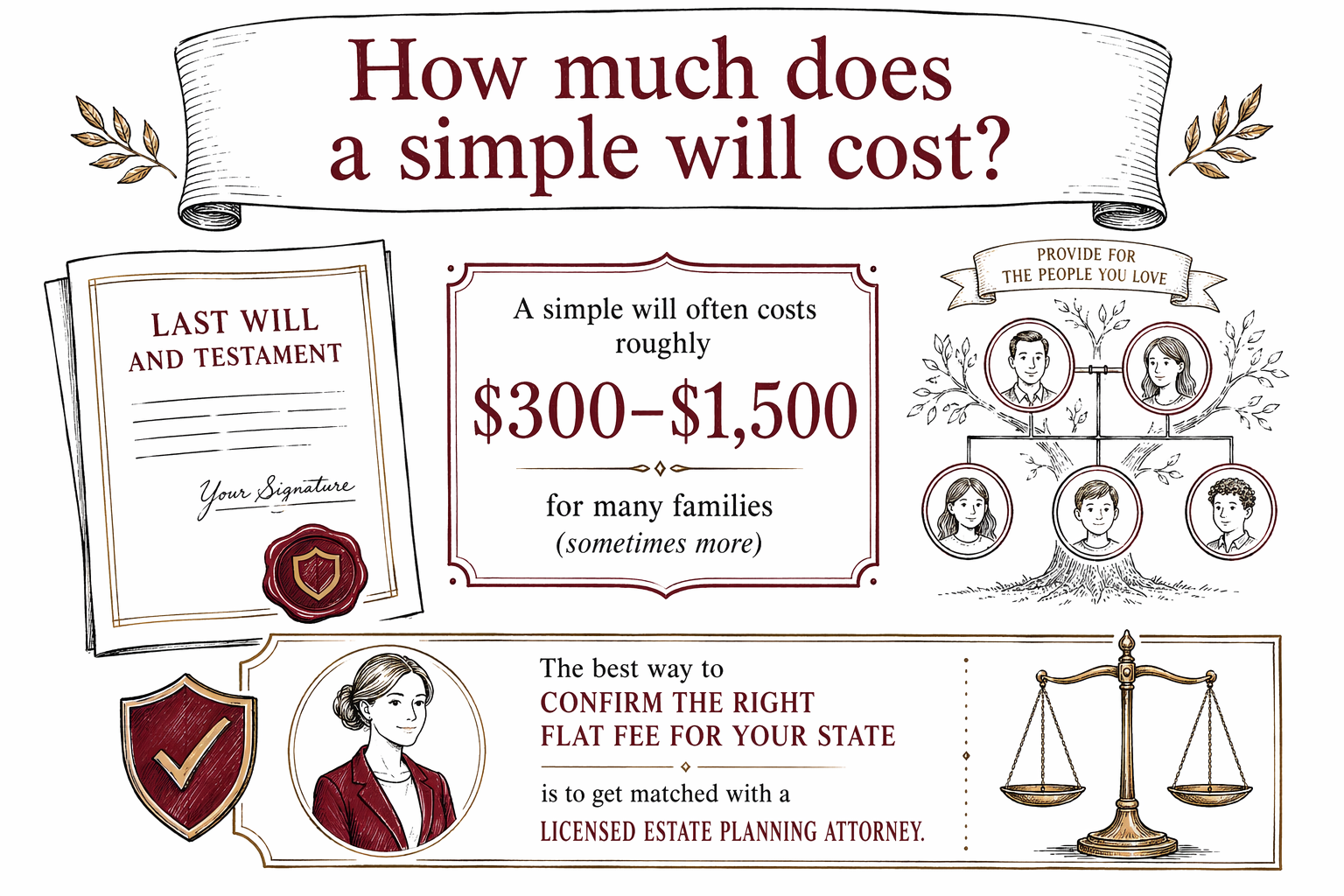
Quick answer: what most people pay for a “simple” will
In many US states, a basic “simple will” is commonly quoted as a flat fee in a range like $300–$1,500.
If your situation is more complex (for example, it includes guardianship, multiple states, or special circumstances), the flat fee can be higher—often around $1,500–$3,000+.
These numbers are general educational ranges, not quotes. Estate planning costs vary by state, the documents involved, and how much legal detail is needed.
Because rules vary by state and can change over time, the most reliable next step is to confirm pricing directly with a licensed estate planning attorney in your state.
Why “simple” can still cost more than you expect
A will is usually “simple” when it covers clear, straightforward goals (for example: who gets your property and who—if anyone—should care for minor children).
But several common factors can increase the time and care your attorney needs:
- Naming a guardian for minor children
- Handling a blended family or complex family relationships
- Appointing executors who may need extra instructions
- Coordinating with prior documents
- Needing certain language for your state’s requirements
Also, many families end up needing more than just a will (for example, a living will/advance directive or a power of attorney). When those are included, the overall flat fee is higher—but it can be worth it for protecting your family day-to-day and in emergencies.
Flat-fee pricing is common—ask for it in writing
Most estate planning attorneys quote pricing as a flat fee (not hourly), especially for standard document sets.
Before any work starts, ask the attorney to confirm the flat fee in writing and list exactly which documents are included (for example: will only, or will + power of attorney + advance directive).
If you’re told the price will depend on “what’s needed later,” ask what situations would change the price and whether the attorney will explain the options before proceeding.
WillArbor is a free matching service, not a law firm and not your lawyer. We help you connect with a licensed estate planning attorney near you based on your state and language preference.
Common pitfalls that can change the cost (or create bigger problems)
People usually don’t start estate planning to cause trouble—they do it to protect loved ones. Still, a few frequent mistakes can make matters harder or more expensive later:
- Dying without a will (“intestacy”), which can delay decisions and send property through state default rules
- Out-of-date beneficiary-related choices (for example, in documents that transfer assets outside the will)
- DIY forms that don’t match your state’s rules or don’t cover important family needs
- Not naming a guardian for minor children when applicable
- Forgetting to update documents after major life events (moving states, marriage/divorce, births, deaths)
If any of those sound familiar, the “simple will” option may still be possible—but an attorney may recommend additional steps to reduce future confusion.
What to ask during a free consultation (so you get a real flat-fee answer)
When you speak with a licensed estate planning attorney, you can keep it simple and focused. Consider asking:
- What flat fee would you charge for a will in my state?
- What documents are included in that fee (will only, or also advance directives and powers of attorney)?
- What would make the price go up or down?
- Will you review and update any existing estate plan documents?
- How do you store and help families locate the documents later?
If you are new to the US or prefer a language other than English, tell the attorney your language preference early. Clear communication helps everyone make better decisions.
Remember: this page is general education, not legal advice or a tax/financial recommendation. Rules vary by state, so confirm details with an attorney in your state.
Next step: get matched for free with a licensed attorney near you
If you want a clear, state-specific flat-fee range, WillArbor can help you get matched with a licensed estate planning attorney near you for free.
To match you, we collect contact and planning intent only (name, phone, optional email, state, what you want to plan, and preferred language). We do not ask for asset values, account numbers, SSNs, or document contents.
You stay in control: compare attorneys, confirm the flat fee in writing, and ask questions until you feel comfortable.
Start here: Get matched. You can also explore our guides in WillArbor guides or learn about what we help with in Estate planning services.
A simple will often costs roughly $300–$1,500 for many families (sometimes more), and the best way to confirm the right flat fee for your state is to get matched with a licensed estate planning attorney—free—through WillArbor.
Common questions
What’s the cheapest I should expect to pay for a will?
In many places, a basic will is often quoted starting around a few hundred dollars, but the exact number depends on your state and what your will must cover (especially child guardianship or other complexities). Ask for a flat fee in writing during your consultation.
Does a “simple will” include everything a family might need?
Not usually. A will only addresses what happens after death. Many families also need powers of attorney and advance directives so decisions can be made during incapacity—rules and document availability vary by state.
Can I use a DIY will form to save money?
DIY forms can be risky because requirements vary by state, and a form may be missing key state-specific language or steps. If you’re worried about doing it right, a licensed estate planning attorney can help you avoid costly mistakes.
How do costs change in different states?
Costs can differ because state law affects what must be included and how documents are handled in probate. Always confirm pricing with an attorney licensed in your state.
Are WillArbor attorneys free, or do they take a cut?
WillArbor is free for families. We do not take any payment, and we don’t charge a percentage or commission. Participating attorneys pay a flat fee to take part, but there’s no fee added to your side.
Related help
The difference between a will and a living trust, when each makes sense, and why many families use both.
Open → How to Avoid ProbatePlain-language ways families reduce or avoid probate — trusts, beneficiary designations, and joint ownership.
Open → What Happens If You Die Without a WillIntestacy explained: how your state decides who inherits when there is no will — and why that may not match your wishes.
Open →