Guides
Estate Planning Checklist
Use this checklist to plan the basics of protecting your family: who cares for children, who receives your belongings, and who can make decisions if you can’t. Rules vary by state—use it as a guide, then get help from a licensed estate planning attorney.
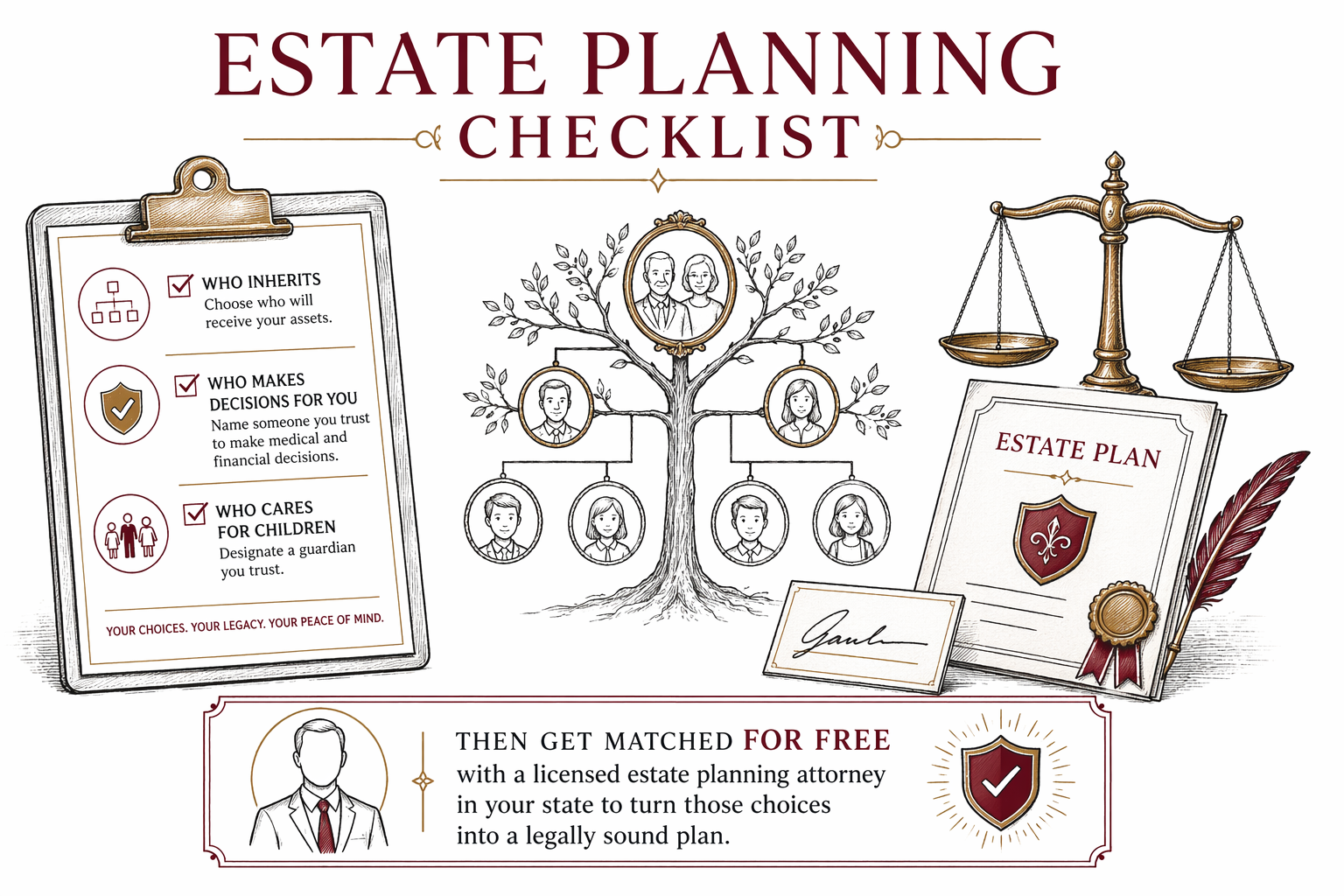
Start here: the essentials you should decide
A solid estate plan usually comes down to a few key decisions: (1) who inherits, (2) who can make decisions for you, (3) who would care for your children if you can’t, and (4) what happens to your estate after a death.
If you feel overwhelmed, you’re not alone. Many families begin by gathering names and making clear choices, then turn those choices into documents with a licensed attorney in their state.
Because estate planning rules and probate processes vary by state (and can change), this is general education—not legal advice. An attorney can confirm what’s needed where you live.
Your personal information checklist (keep it simple)
You don’t need sensitive details to begin planning. Start with basic facts so an attorney can understand your situation and point you to the right documents.
Use this list as a first pass, then update it as needed:
- Your state of residence (estate rules vary by state)
- Full legal names of key people (spouse/partner, children, beneficiaries)
- Names and contact information for potential guardians for children
- Names for people you trust to make decisions for you if you’re unable (health and finances)
- Who should receive copies of key documents (and where they’re stored)
Avoid sharing asset values, account numbers, Social Security numbers, or document contents with a matching service. WillArbor only collects contact and planning intent, not sensitive details.
- Tip: write down names now—even before you choose the final beneficiaries or guardians.
Wills, trusts, and the “what’s the difference?” note
A will is a document that explains what you want done after you die—who should receive your property and (if you have children) who should be the guardian. A living trust is a different tool that can help manage assets during life and may simplify how some assets pass after death.
People often worry that they “need” a trust. Sometimes a will is enough for a straightforward plan; sometimes a trust is helpful. The right answer depends on your state rules, your assets, and your goals (like reducing probate for some assets).
A licensed estate planning attorney can explain which approach fits your goals and your state.
Document checklist: what families usually put in place
Here are common documents families consider. You may not need all of them—your attorney can confirm what fits your state and goals.
- Will (often used to name guardians and spell out inheritance)
- Living trust (optional, used for certain goals like managing trust assets and possible probate avoidance for those assets)
- Durable power of attorney for finances (lets someone handle financial matters if you can’t)
- Health care power of attorney and/or advance directive (living will / health instructions for medical care)
- Beneficiary updates for retirement plans and insurance (these often control outcomes even if you have a will)
- Plan for final arrangements and important contacts (a practical add-on)
If you already have documents, add one step: review dates and ensure everything is current. Estate plans aren’t “set and forget.”
- Common pitfall: dying without a will (intestacy) can send your estate to default rules you didn’t choose.
- Common pitfall: outdated beneficiary designations can override what your will says.
Child guardianship checklist (don’t skip this)
If you have children, naming guardians is one of the most important parts of estate planning. A guardianship choice must be written clearly and aligned with your state’s requirements.
Consider these questions:
- Who would you trust to raise your children if you can’t?
- If your first choice can’t serve, who is your backup?
- Are the guardians willing to take on the role?
- Do you want to include your preferences about where the children live and how they’re raised (within what your state allows)?
Because family and court procedures vary by state, confirm the correct wording and process with a licensed estate planning attorney.
Cost expectations and what changes the price
Estate planning is often quoted as a flat fee, not hourly time. Typical flat-fee ranges can vary widely by state and by what documents you need.
As a general guide, many families see:
- Basic will (sometimes with a simple package): often about $500–$1,500
- Will plus key decision documents (powers of attorney and advance directive): often about $1,000–$3,000
- More complex plans (for example, living trust plans or added complexity): often about $2,500–$6,000+
These are ranges—not quotes—and the final number depends on factors like your state, the documents chosen (will vs. trust), the number of beneficiaries, whether you need guardianship language, and how complex your situation is. Rely on your selected attorney for a written flat-fee confirmation.
WillArbor does not guarantee price, timeline, or outcomes. But participating attorneys set their own flat fees, and the service is free for families.
- What often raises cost: multiple beneficiaries/guardians, trust needs, special circumstances, or more extensive document coordination.
- What often lowers cost: a straightforward plan in a state with standard requirements.
Before you meet an attorney: common pitfalls to avoid
Many families unintentionally create problems that could have been avoided with a little planning. Use this quick “watch for these” list:
- DIY forms that don’t match your state’s rules
- A will that names heirs/guardians but ignores how other assets pass (like retirement accounts)
- An outdated plan that wasn’t reviewed after major life events (marriage, divorce, births, deaths)
- An unfunded trust (if you use a trust, some assets still need to be titled/assigned properly)
- No clear plan for who makes decisions if you can’t (missing power of attorney or advance directive)
If you want a calm, organized start, gather the names and decisions first, then let a licensed estate planning attorney tailor the documents to your state and goals.
You can get matched for free with a licensed estate planning attorney near you. WillArbor is not a law firm and does not draft documents, but we can help you connect with the right professional and your preferred language.
Use this checklist to decide who inherits, who makes decisions for you, and who cares for children—then get matched for free with a licensed estate planning attorney in your state to turn those choices into the right documents.
Common questions
I’m new to the US—where should I start if I’m worried about protecting my family?
Start with the essentials: who should inherit, who you trust to make medical and financial decisions if you can’t, and who should be the guardian for any children. Then contact a licensed estate planning attorney in your state—rules and probate processes vary by state and can be complex for families with cross-border situations.
Do I need a trust, or is a will enough?
A will and a trust do different things. Sometimes a will is enough, and sometimes a trust helps with specific goals—like managing certain assets or simplifying what happens after death. An attorney can explain the best fit for your state and your priorities.
If my family already has documents, should we still review them?
Yes. Estate plans can become outdated after major life changes, and rules vary by state. A quick review can confirm beneficiary designations, guardianship choices, and whether your documents still match your current goals.
Will a will alone prevent probate?
Not always. Probate depends on state law and how your assets are titled or designated. Some assets pass outside probate (for example, certain beneficiary designations), while others may still require court steps.
How much does estate planning usually cost?
Most estate planning is quoted as a flat fee, not hourly. Typical flat-fee ranges can be roughly $500–$1,500 for a basic will and about $1,000–$3,000 for a will plus key decision documents; more complex plans (like some living trust plans) can be about $2,500–$6,000+. Exact pricing depends on your state and the documents you need, and ranges are not guaranteed quotes.
Related help
The difference between a will and a living trust, when each makes sense, and why many families use both.
Open → How to Avoid ProbatePlain-language ways families reduce or avoid probate — trusts, beneficiary designations, and joint ownership.
Open → What Happens If You Die Without a WillIntestacy explained: how your state decides who inherits when there is no will — and why that may not match your wishes.
Open →