Guides
Durable Vs Springing Power Of Attorney
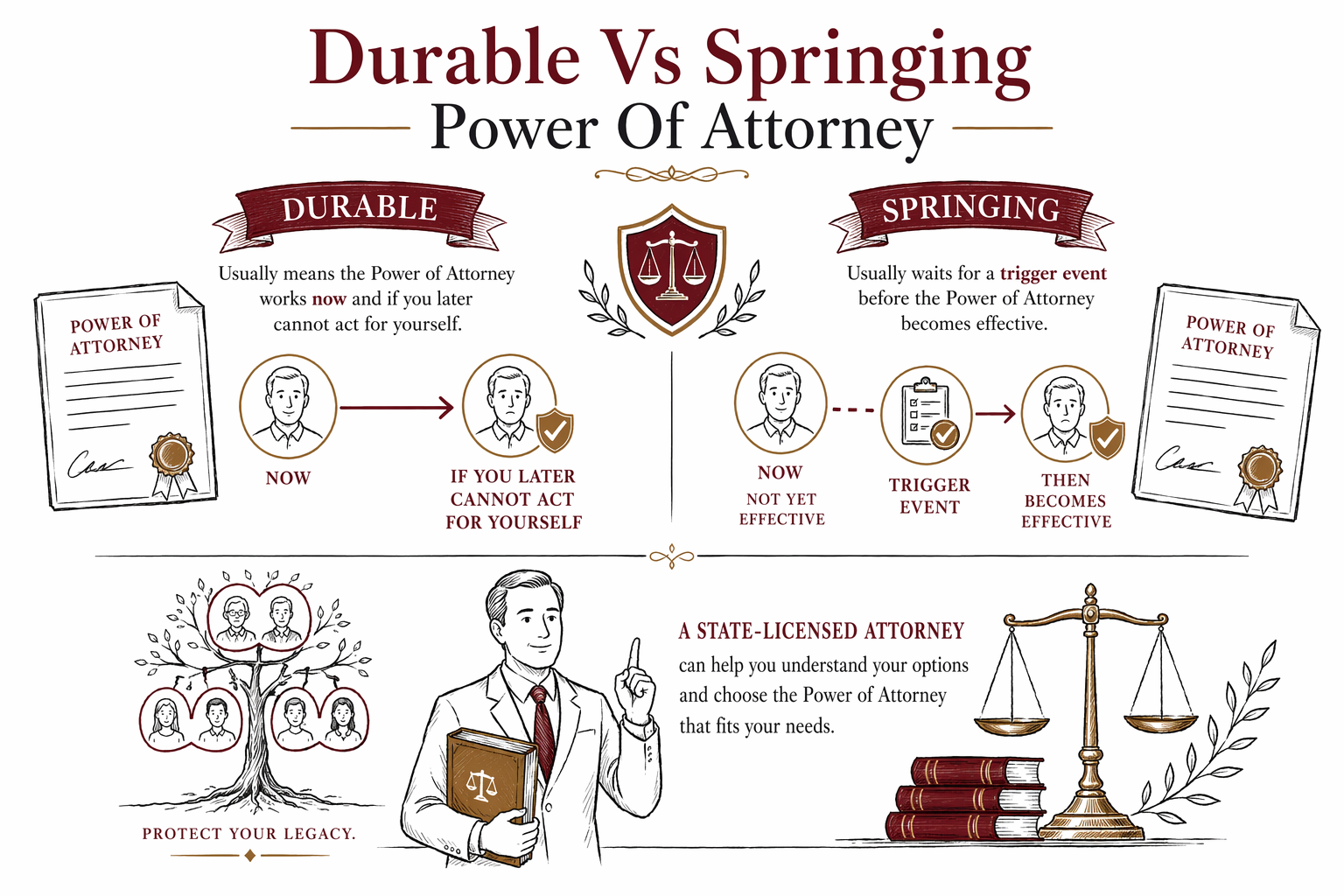
A durable power of attorney usually starts working right away and stays valid if you become unable to make decisions. A springing power of attorney usually only starts after a stated event, often a doctor saying you are incapacitated.
The short answer
If you want someone to be able to help sooner and avoid delays, a durable power of attorney is often simpler. If you want the document to turn on only after a future event, a springing power of attorney may feel more comfortable to some families.
The important part is that the right choice depends on your state’s rules, your family situation, and how your bank, county, or other institution handles the document. Estate planning rules vary by state and can change over time, so it is wise to review this with a licensed estate planning attorney in your state.
WillArbor is a free matching service, not a law firm and not your lawyer. We help you connect with a licensed estate planning attorney near you, and you stay in control of who you hire.
What “durable” means
“Durable” does not mean hard to break. In estate planning, it usually means the power of attorney keeps working even if you later become unable to manage your own affairs.
That matters because many families want help ready before a crisis. A durable power of attorney can make it easier for a trusted person to handle bills, bank matters, insurance, or other financial tasks if you cannot do them yourself.
In many states, a power of attorney is durable only if the document says so clearly. A licensed attorney can make sure the wording matches your state’s law.
What “springing” means
A springing power of attorney usually does not take effect immediately. It “springs” into effect only when a specific condition is met, such as proof that you are incapacitated.
Some families like this because they want to keep full control unless a real need arises. But springing documents can create delays if doctors, banks, or others disagree about whether the trigger has been met.
That delay can be stressful during a medical crisis. It is one of the main reasons some attorneys prefer a durable power of attorney for many families.
Which one is better for a family?
There is no one right answer for every family. A durable power of attorney is often more practical because it can be used right away if needed. A springing power of attorney may feel more limited, but it can be harder to use quickly when time matters.
A good attorney will help you think through who you trust, how much control you want to give, and whether your state makes springing language difficult to use. The best choice depends on your state law and your comfort level.
If you are also planning for children, home ownership, or a blended family, a full estate plan may be more helpful than one form alone. You can start with our guides or get matched with an attorney.
Common mistakes families run into
A few problems come up again and again:
- using a DIY form that is not valid in your state
- naming someone who is not ready or not available when needed
- waiting too long and not having any power of attorney in place
- assuming a springing document will be easy to prove
- forgetting to review the document after marriage, divorce, a move, or a major health change
Another common pitfall is confusing a power of attorney with a will. A power of attorney helps while you are alive. It does not decide who inherits after death.
If you are helping a parent or spouse, it can also help to check whether they already have a current document and whether their bank or other institutions have their own requirements.
What to ask before you hire an attorney
A licensed estate planning attorney can explain how your state treats durable and springing powers of attorney and whether one option is better for your situation. When you speak with an attorney, you can keep it simple:
- Ask which type they recommend for your state.
- Ask what the flat fee is in writing before work starts.
- Ask whether the document will work with local banks and institutions.
- Ask what other estate planning documents you may need.
- Ask them to confirm their bar license in your state.
Most estate planning work is quoted as a flat fee, not hourly. The real number depends on the documents, complexity, and the state. For a simple power of attorney, some attorneys may charge a few hundred dollars; a fuller estate plan is often higher. Those are only general ranges, not quotes.
Durable usually means the power of attorney works now and if you later cannot act for yourself, while springing usually waits for a trigger event, and a state-licensed attorney can help you choose the safer fit.
Common questions
Is a durable power of attorney safer than a springing one?
Not always, but it is often easier to use in real life because it can work right away and does not depend on proving a trigger event. A licensed attorney can help you decide what fits your state and your family.
Can I have both durable and springing language in one document?
Sometimes, but whether that is a good idea depends on state law and the exact wording. A lawyer in your state should review it so the document is clear and usable.
Does a power of attorney still work after death?
No. A power of attorney generally ends at death. After that, a will, trust, or probate process may control what happens next, depending on your state and your planning.
How can WillArbor help me?
WillArbor is a free matching service that helps you connect with a licensed estate planning attorney near you. We do not draft documents, and you decide who to hire after comparing your options.
Related help
The difference between a will and a living trust, when each makes sense, and why many families use both.
Open → How to Avoid ProbatePlain-language ways families reduce or avoid probate — trusts, beneficiary designations, and joint ownership.
Open → What Happens If You Die Without a WillIntestacy explained: how your state decides who inherits when there is no will — and why that may not match your wishes.
Open →